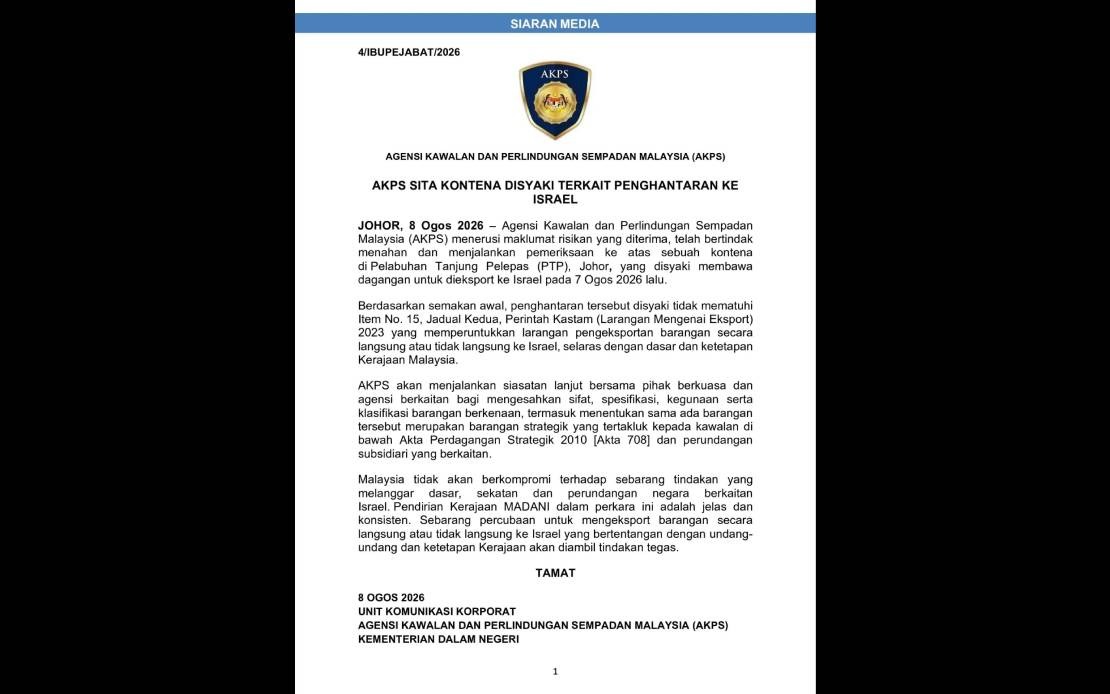
Prime Minister Datuk Seri Anwar Ibrahim has commended the Malaysian Border Control and Protection Agency (AKPS) for intercepting a shipment suspected of containing strategic goods destined for Israel at the Port of Tanjung Pelepas in Johor. The seizure, completed yesterday, represents a tangible enforcement of Malaysia's long-standing position on Middle Eastern geopolitics and underscores the government's determination to align trade policy with its stated values.
In remarks posted to social media, Anwar framed the interception as evidence of Malaysia's resolve to prevent its infrastructure from facilitating commerce that could indirectly bolster what the government characterises as Israeli actions against Palestinians. The Prime Minister emphasised that the country's ports and logistics network will not serve as conduits for trade flows that contradict official policy on the Israeli-Palestinian conflict, a position that has become increasingly central to Malaysia's diplomatic messaging.
The seizure aligns with Malaysia's participation in The Hague Group, an international coalition focused on monitoring and enforcing restrictions on trade with Israel. Anwar noted the consistency of this action with broader commitments undertaken through multilateral forums, suggesting that the government views export controls as part of a coordinated international effort rather than a unilateral stance. This framing is significant as it positions Malaysia within a wider framework of nations pursuing similar policies.
Malaysia implemented a formal prohibition on Israeli vessels and cargo-carrying ships from using its ports beginning in December 2023. The measure represents one of the most concrete trade restrictions any Southeast Asian nation has imposed against Israel, distinguishing Malaysia's approach from neighbouring countries that maintain more conventional diplomatic and commercial relationships with Tel Aviv. The ban extends beyond direct Israeli operators to encompass any shipping carrying goods destined for Israel, effectively creating a comprehensive blockade of maritime commerce.
According to AKPS, the detained container violated Item No. 15 of the Second Schedule of the Customs (Prohibition of Exports) Order 2023, which explicitly forbids the export of goods to Israel whether through direct shipment or indirect routing. The agency's statement indicates that enforcement mechanisms are operationalising these restrictions, with port inspectors now conducting targeted scrutiny of containerised cargo to identify Israel-bound shipments before they depart Malaysian territory.
The broader significance of this seizure extends beyond the immediate commercial value of the intercepted goods. For Malaysia, which operates as a significant regional trading hub, the decision to actively screen exports on political grounds rather than purely commercial or security bases represents a deliberate policy choice. This approach carries implications for how Malaysia manages relationships with trading partners, particularly those nations that maintain substantial commerce with Israel or object to export restrictions on political grounds.
The timing and publicity surrounding this seizure suggests the government views such actions as politically valuable for demonstrating commitment to its constituency, particularly among populations that view support for Palestinian causes as a moral imperative. By publicly celebrating the AKPS's work, Anwar signals that border enforcement reflects the government's values and responds to domestic expectations regarding Malaysia's international posture on this issue.
From a regional perspective, Malaysia's enforcement approach may influence how other Southeast Asian governments approach similar questions. While most ASEAN nations maintain formal diplomatic neutrality on the Israeli-Palestinian conflict, Malaysia's assertive position creates different expectations and potentially different commercial patterns across Southeast Asia. Multinational companies and logistics operators must now account for Malaysia's export restrictions when planning regional supply chains, particularly for goods with potential Israeli end-users.
The reference to defending Palestinian rights and dignity through upholding international law indicates the government's view that these export restrictions constitute a form of enforcement of international norms rather than political protectionism. Whether this interpretation aligns with broader international legal frameworks remains contested, but the government's rhetorical positioning frames the action as consistent with principles of justice and humanitarian concern rather than economic coercion.
Moving forward, this seizure establishes a precedent that Malaysian enforcement agencies will actively interdict Israel-bound commerce, which may deter companies from routing such goods through Malaysian ports. The practical effect is a gradual reshaping of regional logistics networks to circumvent Malaysian territory, potentially affecting the port's competitiveness while reinforcing the government's stated commitment to its Palestine policy. For Malaysian businesses and the broader maritime industry, understanding these restrictions is now essential for compliance and operational planning.

