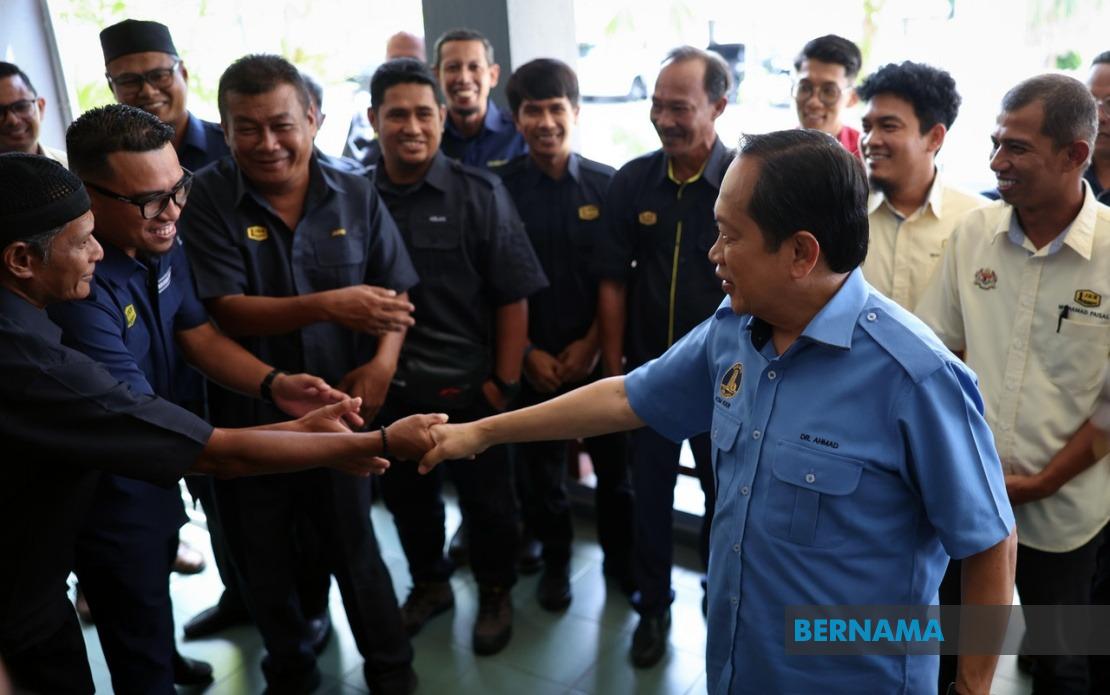
The construction of additional classrooms employing modular precast technology across Malaysia will be finalised by the end of this year, Deputy Works Minister Datuk Seri Ahmad Maslan announced during a site inspection in Alor Gajah on Wednesday. The programme, executed under Program Cakna MADANI, aims to ensure educational facilities are operational in time for the 2027 school intake, addressing capacity constraints in the nation's education system.
Ahmad emphasised that the adoption of the Modular Precast System (MPS) represents a significant shift in how Malaysia approaches infrastructure delivery. Rather than relying on conventional construction methods, the technology streamlines the building process while maintaining structural integrity and durability. This approach has enabled projects nationwide to maintain their schedules without delay, he noted during his remarks to journalists at the JKR Alor Gajah District Engineer's Office. The minister's confidence in meeting the December deadline underscores the effectiveness of this accelerated construction methodology, which has become increasingly critical as Malaysia grapples with rising student enrolment pressures in many districts.
The inspiration for Malaysia's adoption of modular construction stems from international best practices, particularly China's advanced prefabrication techniques. Ahmad highlighted that the Chinese system has demonstrated remarkable efficiency, capable of erecting a 10-storey structure in merely 28 hours and 45 minutes. Beyond speed, the approach delivers significant economic advantages. Construction costs are substantially reduced without sacrificing quality or longevity. Ahmad stressed that buildings constructed via MPS maintain their structural soundness for decades, positioning this technology as a long-term investment rather than a short-term expedient. The minister proposed this innovation to Prime Minister Datuk Seri Anwar Ibrahim in the previous year, recognising its potential to transform how the government delivers public infrastructure.
In Alor Gajah specifically, the JKR is orchestrating a substantial educational infrastructure programme. The district's Program Cakna MADANI initiative encompasses 14 schools receiving additional classroom facilities at a combined investment of RM12.05 million. Beyond classrooms, two additional schools are benefiting from covered multipurpose halls and courts, representing a RM1.83 million undertaking. These supplementary spaces are essential for supporting holistic student development, enabling schools to conduct physical education, cultural activities, and community functions without weather-related disruptions. The investments reflect the government's recognition that educational infrastructure must extend beyond basic teaching spaces to support comprehensive learning environments.
Parallel to the modular classroom programme, JKR Alor Gajah is executing five separate Federal building projects valued at RM22.6 million. These initiatives address critical infrastructure gaps identified across the district. Sekolah Kebangsaan Kampung Tengah and Sekolah Kebangsaan Kuala Linggi are undergoing reconstruction, replacing aging structures that have deteriorated over decades of service. Sekolah Ramuan Cina Besar is receiving a new canteen facility, essential for student nutrition and welfare. The Lesung Batu Mosque is being constructed to serve the spiritual and community needs of the surrounding population. Additionally, the Alor Gajah National Youth Skills Institute's Hospitality Department is receiving facility upgrades to enhance its capacity to train the next generation of Malaysian workers in this economically important sector.
Financial commitments extend beyond new construction. The government has allocated an additional RM5.1 million specifically for maintaining existing Federal buildings across multiple agencies and ministries. This maintenance funding encompasses facilities operated by the Ministry of Education, the Ministry of Natural Resources and Environmental Sustainability, and the Ministry of Health. This investment demonstrates a commitment to asset preservation, recognising that regular maintenance prevents costly deterioration and extends infrastructure lifespan. Such preventive spending is often more economical than emergency repairs or complete reconstruction, reflecting pragmatic resource management within the public sector.
The broader implications of Malaysia's embrace of modular construction technology are substantial for the nation's infrastructure agenda. As the country faces demographic pressures, urbanisation, and expanding service demands, traditional construction methods increasingly appear inadequate to meet timelines and budgetary constraints. The modular approach addresses these challenges while improving project predictability. For Malaysian policymakers, the success of Program Cakna MADANI's classroom initiative provides proof of concept that could justify expanding MPS adoption to other infrastructure categories, from healthcare facilities to transport infrastructure.
Ahmad's vision for modular construction extends beyond current educational applications. He indicated that while the immediate focus remains on augmenting existing school facilities, the technology possesses capacity for broader deployment across permanent institutional buildings. This suggests that future Government buildings—ministry offices, hospitals, administrative centres—could potentially benefit from the same construction methodology. Such expansion would represent a paradigm shift in how Malaysia designs and executes public infrastructure, potentially accelerating multiple development programmes simultaneously while maintaining quality and durability standards.
For Southeast Asian context, Malaysia's adoption of Chinese-inspired modular construction reflects the region's growing openness to innovative infrastructure solutions that enhance delivery speed and cost-efficiency. The Programme Cakna MADANI becomes a regional model, potentially influencing how other ASEAN nations approach their own infrastructure challenges. As education systems across Southeast Asia struggle with capacity constraints and aging facilities, Malaysian success with this approach could catalyse similar initiatives throughout the region, creating demand for modular construction expertise and technology transfer.
The educational sector stands to benefit substantially from these infrastructure investments. By 2027, the affected schools will have modern, well-equipped facilities that support contemporary pedagogical approaches. Additional classrooms reduce overcrowding, enabling more effective teaching and learning experiences. Multipurpose halls facilitate extracurricular activities essential for student well-being and skill development. Improved facilities contribute to better retention rates and student satisfaction, indirectly supporting Malaysia's human capital development objectives. These investments signal government commitment to educational quality improvement beyond curriculum reform, addressing the physical infrastructure that forms the foundation of effective schooling.
Looking forward, the December completion deadline establishes accountability benchmarks for both the JKR and private contractors involved in the modular construction programme. Meeting this timeline will validate Ahmad's confidence in the technology and scheduling, potentially opening doors for expanded use of MPS in subsequent infrastructure phases. Conversely, any delays would provoke scrutiny regarding the technology's reliability and project management effectiveness. The success of Program Cakna MADANI thus carries significance beyond the immediate 14 schools in Alor Gajah, serving as a proving ground for Malaysia's evolving approach to public infrastructure delivery in an era demanding greater efficiency and fiscal responsibility.

