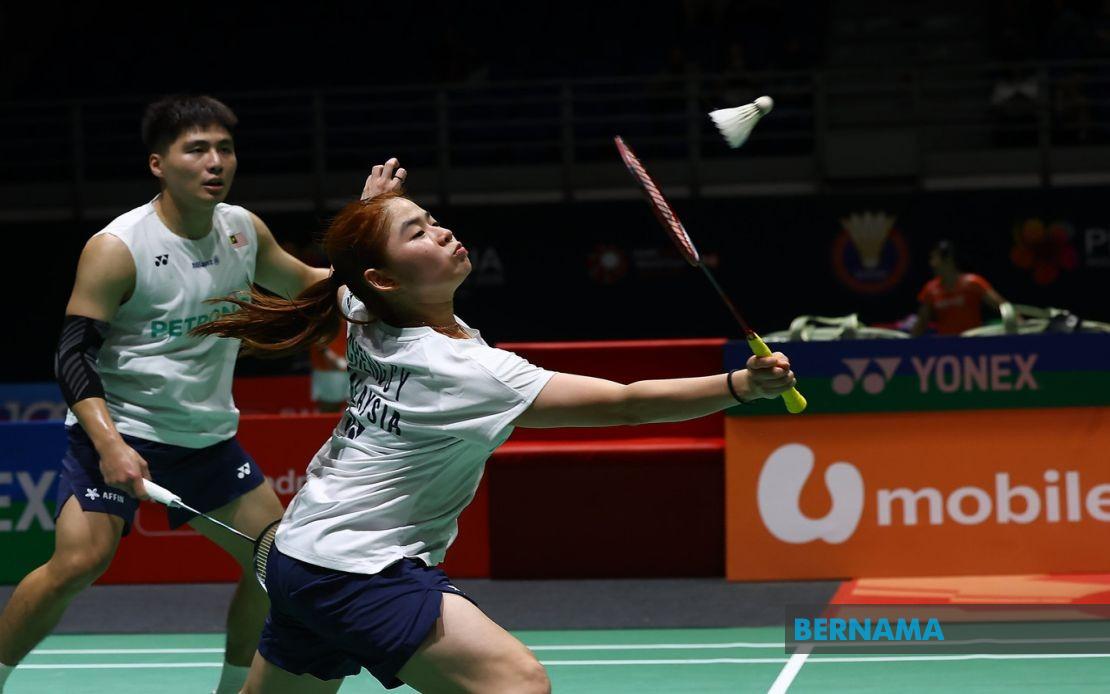
Malaysia's challenge at the 2026 Japan Open concluded in Tokyo as the nation's final two remaining pairs fell at the semi-final stage, marking the end of what had been a promising run by both teams in the prestigious tournament. The exits came on the same day, with neither pairing able to advance to the championship matches despite competitive performances against formidable international opposition.
In the mixed doubles competition, the unseeded combination of Jimmy Wong and Cheng Su Yin succumbed to Hong Kong's Tang Chun Man and Tse Ying Suet in a tightly contested 69-minute battle that went the full three games. The Malaysian pair lost 17-21 in the opening set before levelling the match with a 21-18 victory in the second, but they could not sustain the momentum through to the deciding frame, eventually falling 21-15. Despite the loss, the result represented a creditable achievement for Wong and Cheng Su Yin, whose deep run through the tournament had already featured several impressive victories over higher-ranked opponents.
The mixed doubles pair's impressive progression was underpinned by their willingness to compete fearlessly against more established pairings throughout the event. Their giant-killing campaign demonstrated that Malaysian badminton continues to produce talent capable of challenging the established order in world doubles competitions. The experience gained at such a significant international stage provides valuable lessons for a partnership still developing its consistency at the highest level of the sport.
Parallel to the mixed doubles exit, Malaysia's men's doubles hopes also came to an end when Goh Sze Fei and Nur Izzuddin Rumsani came up short against South Korea's Kim Won Ho and Seo Seung Jae, who currently hold the world number one ranking. The Malaysian duo's match lasted 58 minutes but was characterised by an uneven performance, with the opening set proving particularly challenging as they managed just 12 points in losing 12-21.
However, Goh and Nur Izzuddin demonstrated resilience by rebounding impressively in the second game, orchestrating a dominant 21-11 victory that forced a deciding third set. This turnaround suggested the pair had made necessary tactical adjustments and temporarily seized the momentum, setting up what could have been a competitive final frame. Unfortunately, they were unable to carry this form into the decider, where the South Koreans' superior ranking and experience proved decisive as they secured the match 21-13.
The loss to Kim and Seo marked another chapter in an increasingly one-sided head-to-head record between these teams. Goh and Nur Izzuddin have now suffered three defeats in their last five meetings with the South Korean duo, indicating a pattern of struggle against this particular pairing despite occasional flashes of competitive cricket. This record suggests that while the Malaysian men's doubles team can produce competitive patches, they have yet to find a consistent formula for neutralising the top-ranked team's strengths across an entire match.
For Malaysian badminton, these semi-final exits provide both disappointment and perspective. The Japan Open remains one of the sport's most prestigious tournaments, and reaching the final rounds represents a significant achievement for any nation. The fact that Malaysia had two pairs competing in semi-finals underscores the depth of the national badminton programme and the talent pipeline being developed by the national coaching system.
The performances at this level of competition offer crucial intelligence for Malaysian coaches and players as they prepare for upcoming tournaments throughout the remainder of 2026. The experience of competing against world-class opposition, particularly the world number one pairing, provides invaluable data about what adjustments in tactics, fitness, and mental preparation might be required to break through at the very highest level of international badminton.
Looking forward, the challenge for Malaysian badminton will be to build on these solid semi-final finishes and convert competitive performances into tournament victories. The gap between reaching semi-finals and claiming titles remains significant, particularly when facing South Korean and Hong Kong opponents who have dominated doubles badminton for several years. Understanding the specific tactical and physical advantages these teams possess will be essential as Malaysia seeks to reclaim greater prominence in international doubles competitions.

