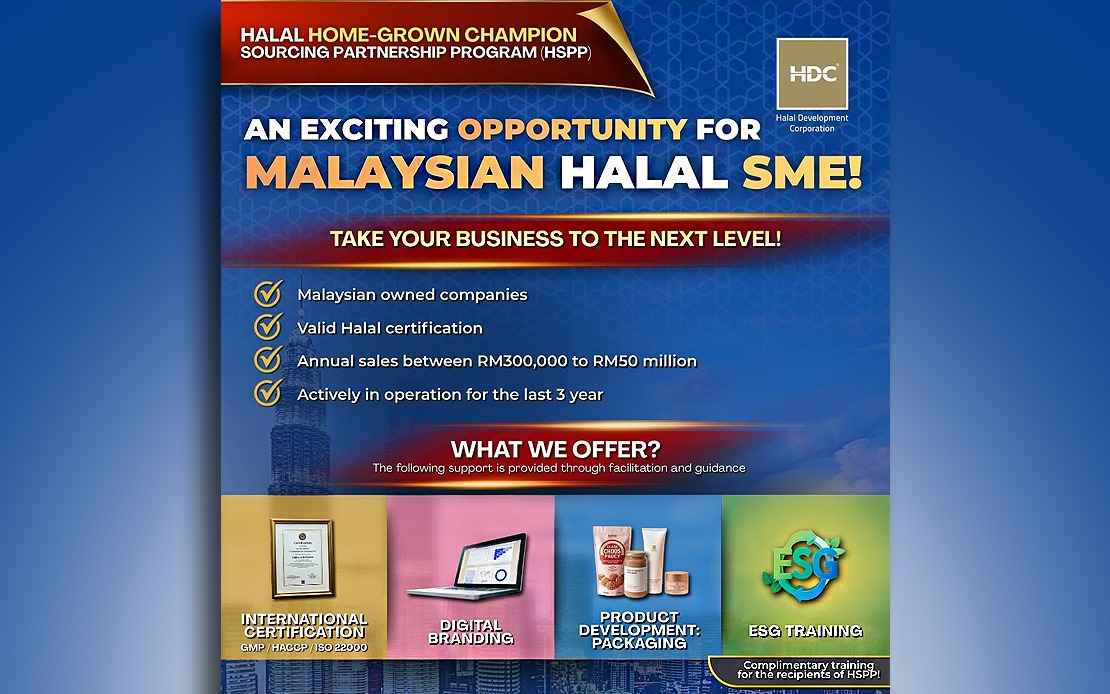
Malaysia's halal sector is experiencing accelerated growth through a government-backed intervention initiative that has successfully mobilised over 500 small and medium-sized enterprises across the country. The Halal Home Grown Champion – Sourcing Partnership 2.0 programme, operational since 2024 and continuing through 2026, represents a strategic pivot toward nurturing domestic talent within an industry where Malaysia already commands significant international credibility. The scheme has channelled support to 313 halal companies, while simultaneously prioritising inclusivity by backing 158 Bumiputera-owned operations and 52 businesses led by women entrepreneurs, collectively generating RM187.91 million in potential sales revenue across the three-year implementation window.
The Ministry of Investment, Trade and Industry (MITI) designed this targeted intervention to address a fundamental challenge facing Malaysia's micro, small, and medium enterprises: scaling operations whilst accessing reliable supply chains and market networks. By focusing narrowly on halal-certified enterprises, the programme aligns broader industrial policy with Malaysia's established position as a custodian of globally recognised halal standards—a competitive advantage that transcends mere regulatory compliance. Rather, it reflects decades of institutional credibility that permits Malaysian halal products to command premium positioning in international markets, from Southeast Asia to the Middle East, Europe, and increasingly, Muslim-majority communities across North America and East Asia.
The demographic composition of beneficiary enterprises reveals deliberate policy architecture. The inclusion of Bumiputera-owned firms reflects constitutional commitments and state-level economic participation goals, whilst the concentration on women-led businesses signals recognition of gender-based entrepreneurial barriers and untapped productive capacity within the Malaysian economy. This three-pronged approach—general halal MSMEs, indigenous businesses, and female entrepreneurs—distributes opportunities across constituencies whilst maintaining programme coherence around a single sectoral focus. Such precision targeting contrasts with broader stimulus initiatives that dilute impact across heterogeneous beneficiary groups.
Looking forward, Malaysia's trade development machinery is preparing for Malaysia International Halal Showcase (MIHAS) 2026, scheduled for September 23–26 at the Malaysia International Trade and Exhibition Centre (MITEC) in Kuala Lumpur. This iteration of the world's largest halal trade exhibition represents more than a commercial event; it functions as a concentrated platform for Malaysian MSMEs to establish direct relationships with international buyers, distributors, and logistics partners. With 2,400 exhibition booths allocated and projections suggesting that over 1,000 local MSMEs will participate, MIHAS 2026 consolidates the gains from the Halal Home Grown Champion programme into a high-visibility international showcase that amplifies Malaysian sector visibility and generates authentic commercial connections.
The strategic calculus underlying these initiatives reflects economic reality. Malaysia's halal industry remains concentrated in traditional markets and conventional product categories—processed foods, beverages, and basic foodstuffs dominate exports. The challenge identified by policymakers, including in parliamentary questioning by Tan Sri Mahiaddin Mohd Yassin (PN–Pagoh), concerns market diversification, value-addition, and reducing dependency on familiar geographies and product segments. New market entry requires not merely product certification but also regulatory navigation, local partnership development, and brand positioning—burdens that individual MSMEs struggle to shoulder alone. Government-coordinated programmes that bundle these functions reduce friction and lower barriers to international expansion.
Value-addition emerges as a central concern for Malaysia's halal sector trajectory. Whilst Malaysia maintains the world's largest halal certification infrastructure and regulatory frameworks, competitors including Indonesia, Turkey, and the UAE have begun capturing downstream manufacturing and branded product segments. Malaysian companies risk remaining trapped in commodity supply, exporting raw materials or semi-processed goods rather than capturing value through branding, retail packaging, and direct-to-consumer channels. The Sourcing Partnership 2.0 framework implicitly addresses this by facilitating enterprise-to-enterprise networks that encourage product upgrading and supply-chain sophistication.
From a regional perspective, Malaysia's halal sector development has implications extending beyond domestic borders. As the lead certifier and standard-setter for the Association of Southeast Asian Nations (ASEAN) and increasingly for broader Muslim-majority markets, Malaysia's institutional role positions it as a regional node connecting local producers across the bloc to global buyers. Vietnamese seafood processors, Thai food manufacturers, and Indonesian spice exporters all require halal certification to access certain markets—a role that Malaysian authorities and certification bodies have monetised and institutionalised. By strengthening domestic Malaysian halal producers simultaneously, the country reinforces its dual position as both regional certifier and competitive exporter.
The RM187.91 million potential sales figure, whilst substantial, warrants contextualisation. This represents projected revenue over a three-year window across over 500 enterprises, averaging approximately RM368,000 per firm—modest by multinational standards but significant for typical Malaysian MSMEs operating with constrained capital and limited export experience. The Programme's value lies partly in opening market access doors; direct revenue figures alone underestimate secondary effects including employment generation, supplier network development, and technological spillovers across participating firms and their networks.
Government rhetoric surrounding Malaysia's halal sector emphasises global leadership, and MITI's written response to parliament underscores the foundations supporting this claim: globally trusted certification architecture, comprehensive ecosystem infrastructure, and strategic market-access initiatives. Yet global leadership in halal requires continuous renewal. Competitors are advancing rapidly, and consumer preferences evolve toward ethical sourcing, sustainability, and transparency—dimensions insufficiently addressed in Malaysia's existing halal frameworks, which remain primarily certification-focused rather than holistic assurance systems. Integrating environmental sustainability, fair-trade principles, and supply-chain transparency into halal branding would differentiate Malaysian products in increasingly sophisticated international markets.
The temporal window through 2026 indicates medium-term policy commitment. However, sustained sector growth requires institutional persistence beyond three-year cycles. Malaysia's halal sector, having achieved regulatory maturity and international recognition, now faces the more demanding challenge of upgrading competitive positioning through innovation, branding, and value-chain sophistication. Government programmes can catalyse initial momentum, yet ultimate trajectory depends on enterprise-level innovation, private-sector investment, and international partnership quality. The Halal Home Grown Champion programme and MIHAS 2026 provide necessary infrastructure, but Malaysian companies must ultimately compete on product quality, reliability, and distinctive market positioning rather than certification alone.

