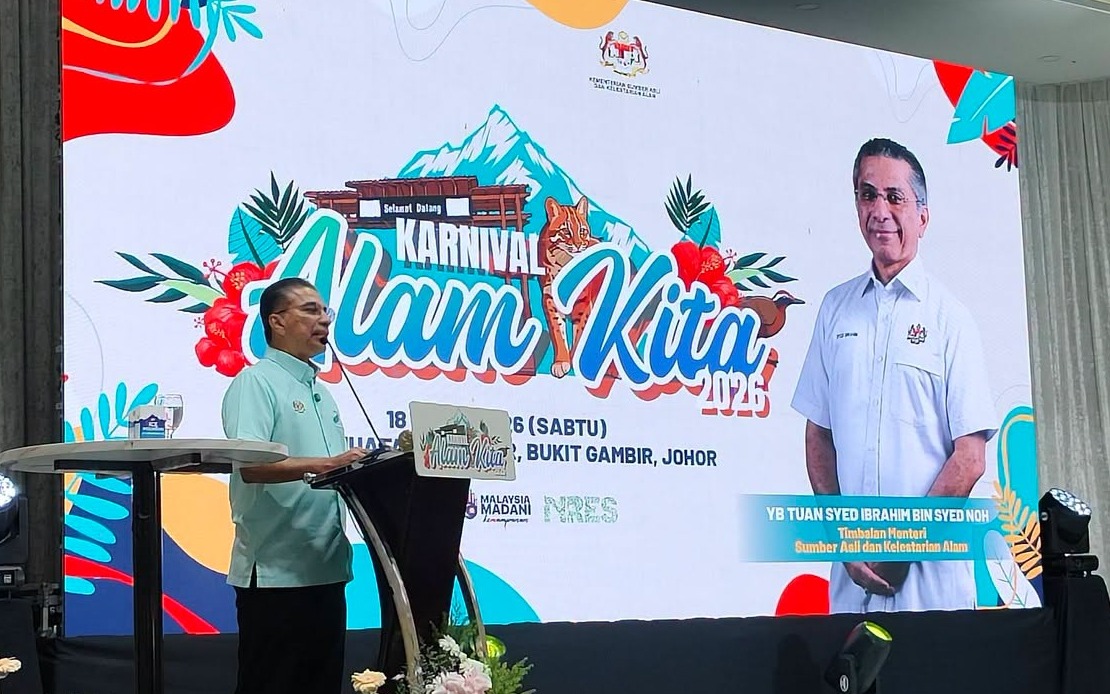
Malaysia's push towards environmental sustainability gained momentum this week with the launch of Karnival Alam Kita 2026 in Johor, an initiative designed to translate climate action and resource conservation from policy documents into everyday household practices. The carnival, organised by the Ministry of Natural Resources and Environment (NRES), represents a deliberate shift in how the government communicates complex environmental challenges to ordinary Malaysians, moving beyond technical jargon to frame sustainability as an accessible aspect of daily life rather than an abstract governmental concern.
Deputy NRES Minister Syed Ibrahim Syed Noh articulated this strategic reframing during the launching ceremony at Dewan Muafakat Bukit Gambir, emphasising that the carnival's purpose extends beyond displaying green initiatives. Rather, the event aims to place information, technology, and practical resources directly into community hands, allowing Malaysians to witness how sustainability integration functions within real households and workplaces. This ground-level approach acknowledges a persistent gap between environmental awareness campaigns and actual behavioural change—a challenge that resonates across Southeast Asia's developing economies where competing priorities often eclipse climate concerns in household decision-making.
Central to the NRES strategy is a reframing of environmental responsibility that explicitly rejects siloing sustainability as merely a government function. Syed Ibrahim stressed that environmental stewardship represents a shared obligation extending from individual homes through schools and workplaces into broader community structures. This distributed model of responsibility reflects growing recognition that top-down policy implementation has limited effectiveness without corresponding shifts in social norms and household consumption patterns. For Malaysia, where household waste generation and electronic waste management remain persistent challenges, delegating accountability to community level offers potential to address infrastructure gaps through behavioural change.
The ministry's diagnostic observation addresses a significant communication breakdown in previous environmental campaigns. Officials acknowledge that when sustainability messaging invokes rare earth elements, mineral extraction, electronic waste, climate change, or forestry management, many Malaysians struggle to perceive personal relevance. This disconnect between macro-level environmental threats and micro-level daily choices represents a critical vulnerability in Malaysia's transition toward its net zero carbon 2050 aspiration. The carnival strategy attempts to bridge this gap by demonstrating how recycling decisions, cooking oil disposal, battery management, and product consumption directly translate into measurable emissions reductions and resource preservation.
Complementing the carnival itself, the NRES launched the Young Environmental Ambassador Programme, a targeted initiative directing environmental education toward secondary school students. This programme recognises that generational shifts in sustainability practices require cultivating young leaders capable of influencing peer groups and family consumption patterns. By positioning teenagers as environmental ambassadors within their communities and households, the initiative leverages peer influence and familial trust as mechanisms for norm change—potentially more effective than top-down regulatory approaches in societies where informal networks drive decision-making.
Simultaneously, the carnival hosted KUDAH, a waste collection initiative implemented through the NRES Lestari Squad in partnership with strategic partner Bateriku (M) Sdn Bhd. The pilot operation proved instructive: collecting 37 kilograms of waste, predominantly plastic bottles totalling 17.3 kilograms, the activity generated measurable environmental outcomes of 43.2 kilograms of carbon dioxide equivalent reductions—equivalent to taking a petrol-powered vehicle off the road for approximately 100 kilometres. This quantification strategy transforms abstract sustainability into concrete metrics, demonstrating to participants that individual actions produce tangible environmental benefits.
The carnival's comprehensive programming encompassed interactive partnerships with government agencies, non-governmental organisations, and commercial stakeholders, collectively offering recycling campaigns for electronic waste, used cooking oil collection, biodiversity exhibitions, and green product sales. This multi-stakeholder approach reflects Malaysia's transition toward public-private partnership models for environmental management, though it also raises questions about how commercial incentives intersect with conservation goals. For Malaysian consumers, the carnival's integration of green product marketing alongside educational programming signals that sustainability increasingly intersects with consumption opportunities rather than requiring purely restrictive behavioural changes.
Johor's selection as the carnival location carries particular significance within Malaysia's environmental geography. As one of the country's most industrialised states, combining manufacturing, agricultural, and resource extraction activities, Johor faces concentrated pressures on water resources, air quality, and waste management systems. Launching sustainability initiatives in Johor specifically addresses these regional vulnerabilities while signalling that green transitions are not merely coastal urban concerns but encompass industrial and agricultural heartlands where emissions reductions carry disproportionate weight.
The timing of Karnival Alam Kita 2026 warrants consideration within Malaysia's broader climate commitments. The nation has pledged net zero carbon achievement by 2050, a target requiring sustained sectoral decarbonisation across energy, transport, manufacturing, and agriculture. Community-level sustainability practices, while essential for cumulative impact, cannot independently meet this target without corresponding infrastructure transformation, renewable energy deployment, and industrial process modification. Consequently, the carnival functions partly as complementary awareness-building supporting larger systemic transitions rather than substituting for structural policy shifts.
For Southeast Asian observers, Malaysia's carnival approach offers a pedagogical model for sustainability communication. The region faces widespread environmental challenges—from plastic marine pollution to deforestation—alongside limited public resources for environmental enforcement. Community mobilisation through accessible, locally-grounded initiatives like Karnival Alam Kita potentially offers more cost-effective and culturally resonant pathways for driving behaviour change than centralised regulatory approaches. However, sustained impact depends on whether the carnival's enthusiasms generate persistent habit formation or represent temporary engagement spikes absent from ongoing community structure.
The initiative also reflects recognition that Malaysia's net zero aspiration requires public buy-in beyond elite policy circles. Educational campaigns targeting school-age populations, waste collection events generating measurable environmental outcomes, and commercial partnerships offering green alternatives collectively construct a sustainability narrative emphasising individual agency. Whether these efforts translate into voting preferences favouring climate-focused candidates, consumer choices supporting sustainable products, or household practices reducing resource consumption remains uncertain—but the deliberate attempt to localise environmental action represents progress in integrating climate considerations into Malaysian political culture.
The carnival's success metrics extend beyond waste collection tonnages or programme participation statistics. The initiative succeeds if it reframes how ordinary Malaysians conceptualise their relationship to environmental sustainability, moving from perception of external constraint imposed by government regulation to recognition of personal interest in resource conservation. As Malaysia confronts intensifying climate pressures and resource scarcity, cultivating this psychological shift from obligation to enlightened self-interest may ultimately prove as significant as technical environmental management.

