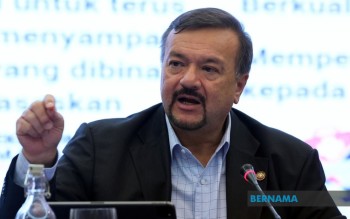
Malaysia's economic performance is outpacing expectations in an increasingly turbulent global environment, according to Finance Minister II Datuk Seri Amir Hamzah Azizan, who presented an optimistic assessment of the country's growth trajectory during a press conference in Putrajaya on August 7. Despite contending with trade tensions, geopolitical conflicts in West Asia, and broader economic uncertainty affecting nations worldwide, Malaysia has maintained a steady expansion that suggests the government's strategic initiatives are taking hold across multiple economic sectors.
The statistical evidence underpinning this confidence is substantial. Malaysia recorded 5.2 per cent gross domestic product growth in 2024 and repeated this performance in 2025, demonstrating consistency rather than a temporary spike. More encouragingly, quarterly data reveals an acceleration pattern: the first quarter of this year registered 5.4 per cent growth, while advance estimates for the second quarter indicate expansion of 5.8 per cent. When averaged across the year to date, these figures translate to approximately 5.6 per cent growth, suggesting the economy is gathering momentum rather than losing steam as external pressures intensify.
This performance becomes particularly significant when contextualised against the volatile international landscape confronting Malaysia's policymakers. The preceding year saw disruptive trade wars that threatened supply chains and investor confidence across the region. The current year has brought fresh complications from escalating geopolitical tensions in West Asia, a region with which Malaysia maintains substantial trade relationships. That the economy continues accelerating despite these headwinds indicates underlying structural strength that extends beyond cyclical factors or temporary favourable conditions.
Amir Hamzah attributed much of this resilience to the implementation of the MADANI Economy Framework, a comprehensive policy architecture designed to reshape how Malaysia approaches development and prosperity creation. According to his account, the various initiatives emerging from this framework are beginning to translate from policy documents into tangible economic results. The transition from planning to implementation typically involves delays and friction, yet the minister's presentation suggested that recent quarterly data reflects genuine momentum from initiatives deployed throughout 2024 and into 2025.
Central to this framework is the GEAR-uP programme, which the Ministry of Finance has shepherded since 2024. This initiative channels domestic direct investment totalling RM120 billion across the period from 2024 through 2028, representing a substantial commitment to internally generated capital formation. The scale of this investment programme is noteworthy for Southeast Asian context, signalling that Malaysia is prioritising domestic capacity building rather than relying entirely on foreign direct investment, which remains vulnerable to international sentiment shifts.
Government-linked investment companies and government-linked companies operating under the GEAR-uP framework serve multiple functions beyond simple capital allocation. According to Amir Hamzah, these institutional investors function as catalysts for domestic industries, helping Malaysian enterprises access talent pools, upgrade human capital, and attract international partners bringing both financial resources and technical knowledge. This multiplier effect distinguishes comprehensive frameworks from simple subsidy programmes; by positioning GLICs and GLCs as connective tissue between domestic industries and global opportunities, the government creates conditions for sustained competitive advantage.
The minister's emphasis on this institutional architecture reveals a sophisticated understanding of development economics that goes beyond merely importing capital. He explicitly distinguished between simply moving money across borders and creating conditions where capital deployment generates widespread benefits that elevate Malaysia toward developed economy status. This distinction matters because many developing nations accumulate foreign investment that enriches narrow elites while leaving broader populations relatively unchanged. Malaysia's articulated approach suggests policymakers are attempting to structure investments such that talent development, technology transfer, and capability building accompany capital flows.
For Malaysian observers and regional analysts, the growth trajectory carries several implications worth considering. Domestically, sustained GDP expansion in the 5.6 per cent range creates policy space for government initiatives while reducing pressure to implement destabilising austerity measures. Labour markets should continue absorbing workers and supporting wage growth, though inflation management remains essential. Regionally, Malaysia's demonstrated resilience contrasts with mixed performances among neighbouring economies, potentially attracting investors seeking stability within Southeast Asia during uncertain periods.
The MADANI Economy Framework represents an attempt to institutionalise development planning in ways that survive political transitions and economic cycles. By embedding strategic priorities within government-linked institutional frameworks, Malaysian policymakers have sought to create continuity that transcends individual administrations. Whether this approach successfully delivers long-term transformation rather than merely improving near-term statistics remains a question for subsequent years of data.
Amir Hamzah concluded his remarks by expressing confidence that Malaysia remains positioned to achieve its long-term development aspirations, contingent upon sustained cooperation among stakeholders implementing the MADANI Economy agenda. The language of institutional coordination and multi-stakeholder involvement suggests that policymakers recognise economic transformation exceeds any single entity's capacity. This acknowledgment, combined with concrete quarterly growth figures and investment commitments, presents a case for cautious optimism about Malaysia's medium-term economic trajectory, even as global uncertainties persist.

