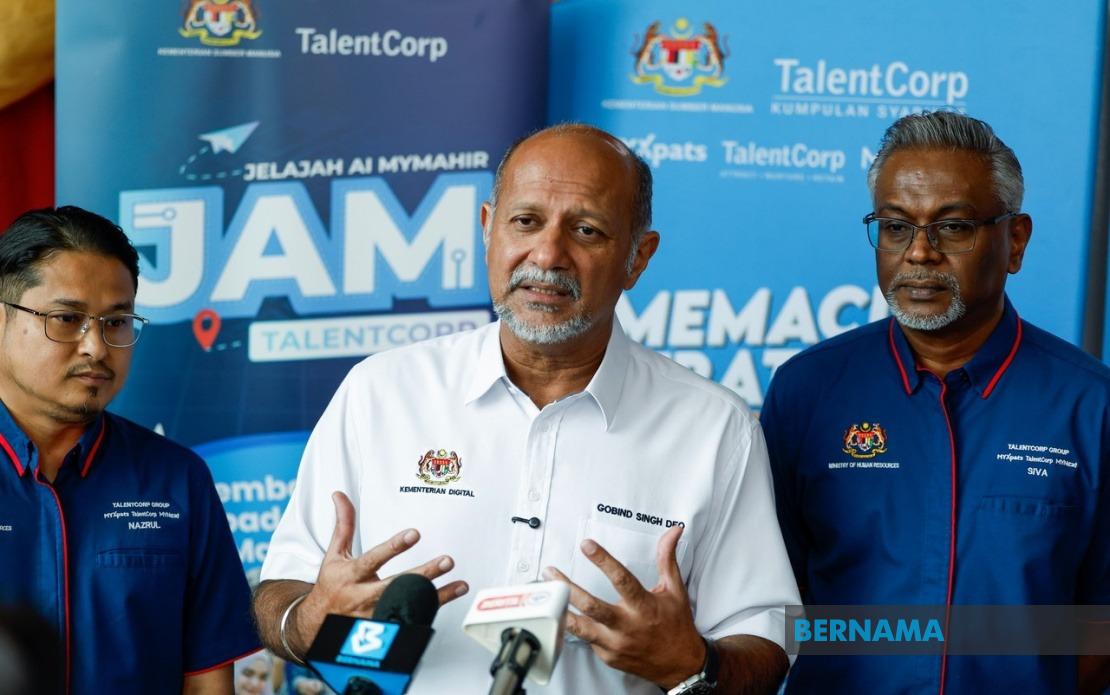
Malaysia's digital creative economy has emerged as a significant economic powerhouse, generating RM92.5 billion in revenue whilst attracting RM85.7 billion in direct investments, Digital Minister Gobind Singh Deo announced during the Borneo Animation and Games Festival 2026 in Kuching. The sector has simultaneously created over 11,000 high-value employment positions, demonstrating the substantial job-creation potential beyond traditional industries. With RM12.1 billion in export earnings already achieved, the digital creative space has transitioned from a niche cultural sector into a legitimate driver of economic growth that warrants serious policy attention and resource allocation at the federal and state levels.
The minister's pronouncements at BAGFest 2026, a watershed moment for the animation and games industry in Borneo, underscore a fundamental shift in how Malaysia's government perceives creative content production. Rather than viewing animation, game development and digital storytelling purely through a cultural or artistic lens, policymakers now recognise their capacity to generate substantial commercial returns and establish Malaysia as a regional creative hub. This reframing carries particular significance for smaller Southeast Asian economies attempting to diversify beyond conventional manufacturing and resource extraction, positioning creative industries as a viable pathway to sustained economic development.
The success of homegrown intellectual properties represents perhaps the most tangible evidence of Malaysia's creative capacity. Franchises such as Upin & Ipin, Ejen Ali and Mechamato have transcended domestic audiences to achieve meaningful traction across regional and international markets, demonstrating that Malaysian storytelling possesses sufficient appeal to compete globally. These properties exemplify how cultural distinctiveness can translate into commercial advantage, generating licensing revenue, merchandising opportunities and downstream services that extend far beyond the initial creative production. The existence of such properties creates blueprints for emerging Malaysian creators and validates continued investment in the sector.
Government projections envision even more dramatic expansion ahead. Officials target a 30 per cent contribution to national GDP from the digital economy by 2030, a figure that would represent substantial growth from current baselines. Complementing this macroeconomic ambition is a commitment to generate 500,000 high-value digital jobs within the next four years, though achieving such expansion will require coordinated efforts across skills development, infrastructure investment and regulatory streamlining. The magnitude of these targets indicates that policymakers view digital creative industries as central to Malaysia's economic transformation strategy rather than peripheral to it.
Sarawak's emerging role in this narrative warrants particular attention. The state possesses several inherent advantages that position it attractively for animation and games development: a distinctive cultural heritage that can inform original narratives, a growing digital infrastructure ecosystem and an increasingly sophisticated creative community. By hosting BAGFest 2026, described as the first international animation and games festival of its scale in Borneo, Sarawak signals serious commitment to establishing itself as a regional creative production centre. This positioning could attract talent migration from other Malaysian states and Southeast Asia whilst creating opportunities for local creators to network with international industry participants.
The federal government's commitment to partnership with Sarawak reflects recognition that creative industry development requires more than market forces alone. Through coordinated initiatives aimed at strengthening digital capabilities and connecting Sarawak's creative practitioners to opportunities across Malaysia, Southeast Asia and beyond, federal authorities are effectively investing in regional capacity building rather than concentrating economic benefits in established urban centres. This decentralisation approach may prove crucial for achieving the 500,000-job target, as it distributes creative opportunities beyond Kuala Lumpur and Selangor where talent and infrastructure remain concentrated.
The export component of Malaysia's digital creative achievement deserves emphasis in the regional context. At RM12.1 billion, export earnings from this sector represent hard currency flowing into the nation's accounts, not merely domestic circulation of spending. For a country seeking to improve its balance of payments position and reduce dependence on volatile commodity exports, the growth of creative services exports offers genuine strategic value. Singapore's experience demonstrates that animation, game design and digital content production can generate substantial foreign exchange earnings for a resource-constrained city-state, suggesting Malaysia possesses comparable potential given its larger domestic market and lower production costs.
Investment attraction to the tune of RM85.7 billion signals that both domestic entrepreneurs and foreign entities perceive genuine commercial opportunity in Malaysia's creative ecosystem. This capital inflow funds studio expansion, technology acquisition and talent recruitment necessary for industry scaling. However, sustaining investment momentum requires consistent policy frameworks that protect intellectual property, facilitate technology transfer and ensure regulatory certainty. Malaysian policymakers must recognise that investor confidence remains fragile in creative industries, which operate in rapidly evolving technological and cultural landscapes where regulatory missteps can rapidly undermine competitive positioning.
The high-value job creation narrative carries particular resonance for Malaysian policymakers confronting stagnant wage growth and skills mismatches in conventional sectors. Creative industry positions typically command higher compensation than manufacturing or basic services roles, particularly at the professional and specialist levels where animation directors, game designers and digital artists command premium salaries reflecting their skills scarcity. This wage premium creates multiplier effects throughout regional economies as these workers spend earnings on accommodation, dining, retail and services. For Sarawak particularly, the prospect of high-value employment opportunities may help stem outmigration of educated youth seeking economic opportunities in Peninsular Malaysia or abroad.
Connecting Sarawak's creative industry to opportunities across Southeast Asia reflects understanding that regional scale provides necessary market size for creative ventures. Individual Southeast Asian markets remain too small to sustain large-scale animation studios or game development enterprises independently, necessitating collaboration and distribution networks spanning multiple countries. Malaysia's geographical position and existing cultural connections across ASEAN position it well to serve as a creative services hub distributing content and talent throughout the region, potentially capturing market share from established competitors in Korea, Japan and Thailand.
The Borneo Animation and Games Festival itself merits consideration as a strategic infrastructure investment. By establishing a premier international gathering for creative professionals in Kuching rather than Kuala Lumpur, organisers deliberately project growth ambitions beyond established creative clusters. Festivals serve multiple economic functions beyond immediate entertainment value: they attract visiting professionals and entrepreneurs, generate media coverage enhancing regional visibility, facilitate networking that spawns collaborative projects and create spectator spending that benefits hospitality sectors. BAGFest 2026's scale and international profile suggest it may establish Sarawak as a permanent fixture on global creative industry circuits.
Moving forward, several implementation challenges warrant attention. Skills development infrastructure must expand to produce animators, game developers and digital artists meeting international standards, suggesting closer coordination between educational institutions and industry practitioners. Tax incentives and regulatory frameworks favouring content production must remain competitive relative to competing Southeast Asian jurisdictions increasingly pursuing similar strategies. Infrastructure investment in broadband connectivity, studio facilities and equipment must be prioritised, particularly in Sarawak where digital infrastructure lags Peninsular Malaysia. Finally, intellectual property protections must be strengthened and consistently enforced to reassure creators and investors that their commercial interests will be defended against infringement.

