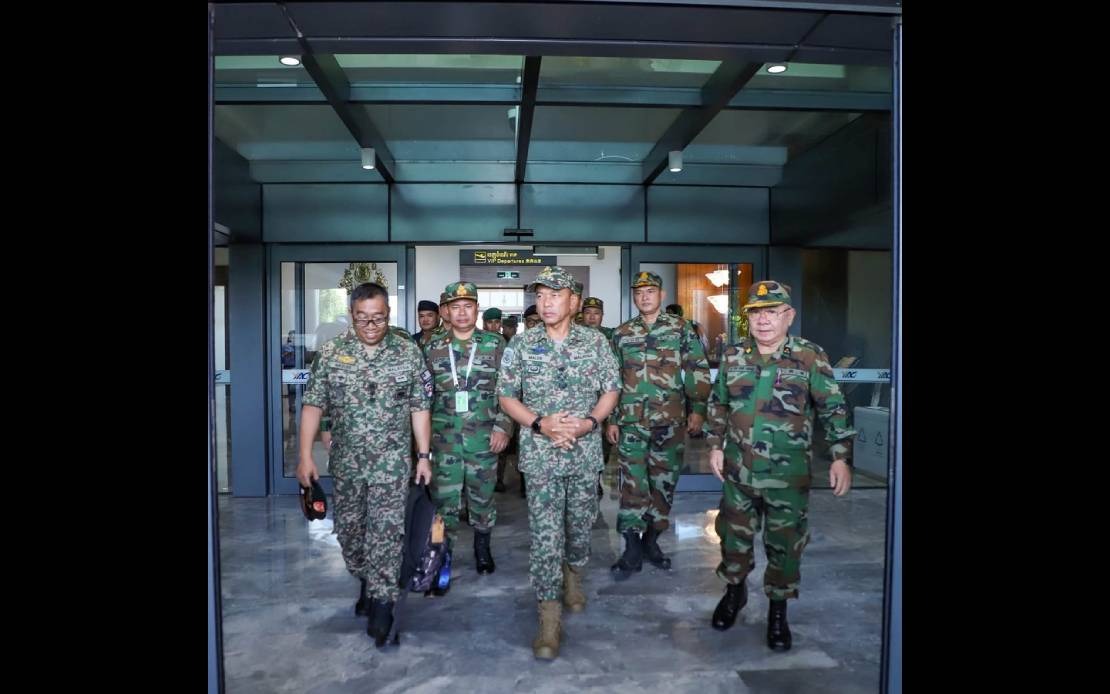
Malaysia's Chief of Defence Force Gen Tan Sri Malek Razak Sulaiman has undertaken a visit to the Cambodian border area in Banteay Meanchey province, seeking direct insights into the prevailing security dynamics in the strategically significant northwestern region. The visit, which commenced on July 8 and runs through July 11, reflects the high-level attention Kuala Lumpur is placing on cross-border stability in mainland Southeast Asia, a region where Malaysia has historically maintained keen strategic interests despite its geographic distance.
During his time in the province, the Malaysian defence chief received comprehensive briefings from the ASEAN Observer Team stationed along the Cambodia-Thailand frontier. The AOT provided Malek Razak with detailed assessments of the current security environment and operational challenges facing peacekeeping efforts in the region. This direct engagement underscores Malaysia's commitment to understanding ground-level realities rather than relying solely on diplomatic reports, signalling to both Cambodia and the broader ASEAN community that Kuala Lumpur views border stability as a collective concern warranting senior-level oversight.
The visit comes at the formal invitation of General Vong Pisen, the Commander-in-Chief of the Royal Cambodian Armed Forces, indicating warm bilateral military relations between Malaysia and Cambodia. Such high-level exchanges serve multiple purposes: they demonstrate solidarity between ASEAN partners, facilitate knowledge-sharing on security matters, and reinforce the principle that member states are invested in each other's stability. For Malaysia, a country that has navigated its own complex border arrangements and maritime disputes, understanding Cambodia's ground situation carries particular relevance.
The ASEAN Observer Team itself represents a significant institutional development in regional conflict management. Established in the preceding year to monitor the ceasefire agreement between Cambodia and Thailand, the AOT was activated following a substantial military confrontation that erupted on July 24, 2025, sparked fundamentally by competing territorial claims. The creation of this monitoring mechanism reflects ASEAN's maturation in developing homegrown solutions to intra-regional disputes, moving away from external mediation towards collective peer oversight. Malaysia's decision to engage directly with this institution, through its defence chief's presence on the ground, signals confidence in the ASEAN mechanism while also enabling Kuala Lumpur to contribute informed perspectives to regional security discussions.
Philippines leadership of the AOT, coinciding with its tenure as ASEAN chair, positions Manila as the principal stakeholder in this monitoring operation. Malaysia's engagement with the team, however, reflects the principle that border security challenges concern all ASEAN members, not merely those geographically proximate to the dispute. This broader engagement approach has become increasingly important as regional interdependencies deepen, and as experiences from one conflict zone yield lessons applicable elsewhere. Malaysia's active interest in understanding the Cambodia-Thailand situation, therefore, should be viewed through the lens of collective ASEAN learning and capacity-building.
The broader significance of this diplomatic visit extends to Malaysia's positioning within ASEAN's security architecture. By participating directly in border assessment activities, Malaysian military leadership demonstrates that Southeast Asia's major powers view cross-border stability as foundational to regional prosperity and ASEAN cohesion. Given Malaysia's own history with border management—including long-standing maritime disputes and overland boundary considerations—the country brings substantive experience to discussions about conflict resolution and monitoring mechanisms.
For Malaysian readers and policymakers, the visit carries implications for how Malaysia itself engages with ASEAN mechanisms and collective security frameworks. It suggests a strategic preference for hands-on involvement in regional issues, even those not directly affecting Malaysian territory, underscoring the interconnected nature of Southeast Asian security. This approach contrasts with more passive observation, instead positioning Malaysia as an active stakeholder in shaping regional norms around border dispute resolution and ceasefire monitoring.
The Cambodia-Thailand border dispute, which precipitated the AOT's establishment, involved military confrontation serious enough to warrant multilateral monitoring. Understanding the dynamics of this conflict—including the underlying grievances, the mechanisms preventing escalation, and the effectiveness of ceasefire arrangements—provides Malaysian defence planners with valuable case studies. These insights may inform how Malaysia approaches its own regional engagements and contributes to ASEAN-wide frameworks for dispute prevention and management.
Moreover, the visit reflects Malaysia's confidence in the AOT's effectiveness and legitimacy. By engaging with the team at the defence chief level, Malaysia is effectively endorsing this ASEAN institution as a credible mechanism for regional peacekeeping. This endorsement carries weight: it suggests to other ASEAN members that participating in such monitoring operations is worthwhile, and to external actors that ASEAN is serious about managing internal disputes through peer mechanisms rather than seeking external arbitration or intervention.

