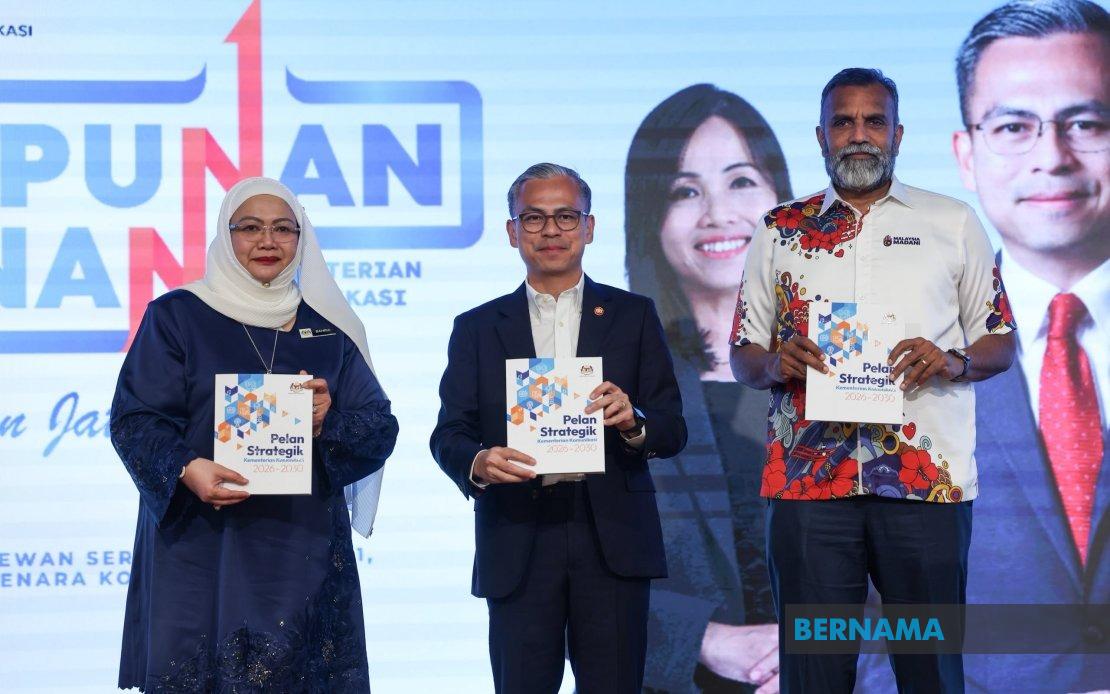
Communications Minister Datuk Seri Fahmi Fadzil has introduced a comprehensive five-year strategic blueprint that will steer Malaysia's digital and media landscape from 2026 through 2030. Launched at the ministry's headquarters in Putrajaya, the Communications Ministry Strategic Plan (PSKK) 2026-2030 establishes a detailed framework for executing policies and programmes that directly support both the 13th Malaysia Plan and the broader Malaysia MADANI governance agenda. This roadmap signals the government's commitment to positioning communications and digital infrastructure at the heart of national development priorities.
The strategic plan reflects three fundamental priorities that resonate with persistent public concerns and emerging digital challenges facing Malaysian society. Minister Fahmi identified these as superior internet connectivity reaching underserved communities, the production and promotion of high-quality creative content from local creators, and the dissemination of accurate, trustworthy information in an era of misinformation. Rather than abstract objectives, these priorities address concrete issues that Malaysians regularly raise with the ministry and its subordinate agencies. The structured approach suggests the government recognises that communications and digital transformation have moved beyond technical infrastructure debates to encompassing questions of media literacy, content creation economics, and information sovereignty.
The architectural framework underpinning this five-year initiative comprises an ambitious vision statement—'A Connected, Informed and Creative Malaysia'—supported by three overarching missions. The first mission concentrates on reinforcing Malaysia's communications infrastructure, expanding service coverage, and modernising the regulatory environment that governs the sector. This encompasses broadband expansion, 5G deployment, and ensuring that rural and remote areas achieve connectivity parity with urban centres. The second mission targets the strengthening of information ecosystems through mechanisms that promote authenticity and inclusivity in news and public discourse. The third mission accelerates the growth of Malaysia's creative industries—specifically film and music—positioning them as economic engines rather than cultural afterthoughts.
Supporting these missions are four strategic thrusts designed to translate vision into measurable outcomes. The first thrust enhances the national communications infrastructure backbone, emphasising inclusive access, quality of service, and cybersecurity protections that build consumer confidence in digital systems. This recognises that connectivity without security or quality represents incomplete progress. The second thrust targets Malaysia's competitive position in creative industries, particularly film and music production, which have demonstrated significant potential for both domestic growth and regional export. These sectors employ thousands and generate substantial intellectual property value if supported strategically. The third thrust reimagines how government information flows to citizens through integrated delivery channels, breaking down silos between agencies and improving public access to services and data. The fourth thrust reforms how government services themselves operate, embedding customer-centricity and responsiveness to evolving policy needs.
The strategic plan's scope becomes apparent through its enumeration of 94 distinct programmes designed to advance these four thrusts. This granular approach indicates the ministry recognises that broad aspirations require concrete, actionable initiatives distributed across multiple departments and agencies under its supervision. Such comprehensiveness suggests the ministry has invested significant analytical effort in identifying programme gaps, duplications, and opportunities within existing frameworks. For Malaysian stakeholders—whether telecommunications operators, content creators, journalists, or ordinary citizens relying on digital services—this represents a governance signal that sector-wide coordination is being attempted rather than piecemeal, agency-by-agency approaches.
The timing and scope of this five-year plan carry particular relevance for Southeast Asia's digital economy. Malaysia positions itself as a regional technology hub and creative industry centre, competing with Singapore, Thailand, and Indonesia for investment and talent. A coordinated national strategy sends confidence signals to both domestic businesses and international investors regarding long-term policy stability and government commitment to digital transformation. For Malaysian telecommunications providers expanding regional operations, clarity on domestic infrastructure priorities influences investment allocation. For creative professionals considering relocation or international collaboration, transparency about government support mechanisms affects career decisions.
The emphasis on information authenticity and inclusivity reflects international trends in digital governance, particularly concerning misinformation, disinformation, and the polarisation of online discourse. By integrating information management into a formal strategic plan, the ministry acknowledges that connectivity alone—without corresponding attention to information quality—creates new vulnerabilities. This positioning is increasingly common among Asia-Pacific governments grappling with how to balance open digital spaces with responsible information ecosystems. Malaysia's approach suggests recognition that sustainable digital development requires managing both supply (infrastructure and content) and demand (media literacy and information consumption patterns).
For Malaysian small and medium enterprises operating in digital and creative sectors, the strategic plan's focus on creative industry competitiveness offers potential pathways for government support, whether through training programmes, financing mechanisms, or market access initiatives. The explicit mention of film and music industries indicates these sectors will receive prioritised attention, potentially affecting resource allocation across different creative verticals. Content creators, producers, and technology entrepreneurs will likely discover new grant schemes, infrastructure projects, or regulatory reforms emerging from this strategic framework over the next five years.
The integration of this communications strategy with the broader Malaysia MADANI agenda—which emphasises prosperity, sustainability, and inclusivity—suggests that digital transformation is being conceptualised beyond technological metrics. Instead, the government frames communications development as fundamental to achieving inclusive prosperity, where rural communities enjoy connectivity equivalent to urban areas, and where creative opportunities exist across different regions and socioeconomic backgrounds. This framing acknowledges that digital divides perpetuate economic inequality and that closing them represents both an equity imperative and an economic development opportunity.
Minister Fahmi's announcement that programmes under the ministry are already being implemented according to this strategic plan indicates the document represents consolidation and coordination of existing initiatives rather than entirely new policy directions. This evolutionary rather than revolutionary approach provides continuity for ongoing projects while establishing clearer strategic coherence. For agencies and departments operating within the ministry's portfolio, the plan establishes priorities for resource allocation and performance evaluation, potentially reshaping internal organisational behaviours toward alignment with these identified strategic thrusts.

