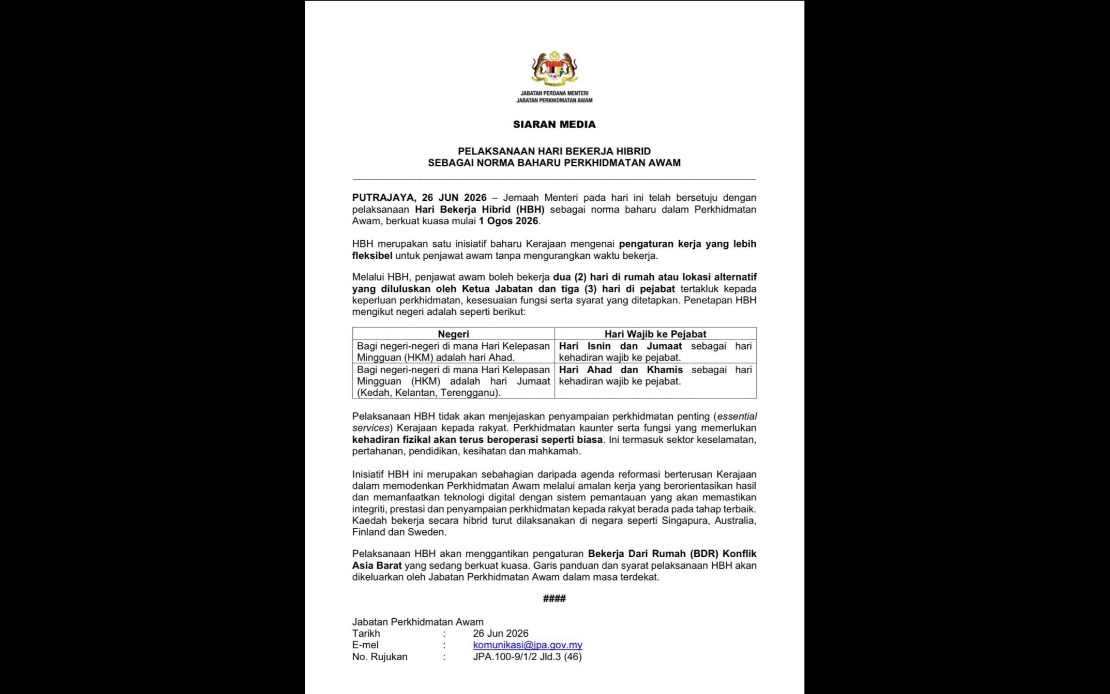
Malaysia's Cabinet has given the green light to a significant restructuring of how the country's 1.6 million civil servants will work, replacing the existing work-from-home framework with a hybrid model effective August 1. The Public Service Department announced the decision on June 26, positioning the move as a modernisation initiative that balances workforce flexibility with sustained government service delivery across the nation.
Under the new Hybrid Work Day arrangement, public sector employees will have the flexibility to work two days remotely from home or another departmentally-approved location while maintaining a three-day in-office presence each week. Critically, this restructuring does not extend working hours—civil servants will continue their standard five-day week equivalent, but with greater geographical flexibility for two-fifths of their time. Implementation remains conditional on various factors including the nature of individual roles, departmental service demands, and predetermined operational guidelines that departments must follow.
The framework represents a deliberate shift away from the pandemic-era work-from-home policies that became widespread across Malaysian government agencies. By institutionalising hybrid work as the new normal rather than a temporary measure, authorities are attempting to formalise what many departments experimented with over the past few years. The PSD's statement emphasised that this initiative forms part of a broader public service modernisation agenda, one that leverages technological advancement and results-oriented management practices to enhance operational efficiency.
Critically, the government has built protective mechanisms into the hybrid framework to prevent service degradation in essential sectors. Counter services requiring face-to-face interaction—including security and defence functions, educational institutions, healthcare facilities, and the judicial system—will maintain regular in-person operations unaffected by the new arrangement. This sectoral carve-out recognises that Malaysia's government apparatus encompasses functions that cannot be disaggregated from physical presence, from passport issuance to police operations to court proceedings.
The implementation methodology differs across Malaysia's diverse state systems, reflecting the country's federal structure and varying weekend observances. In states maintaining Saturday-Sunday weekends, Monday and Friday have been designated as compulsory office attendance days, creating a flexible mid-week working pattern. Conversely, in Kedah, Kelantan, and Terengganu—where Friday is the weekly rest day—Sunday and Thursday will become mandatory in-office days. This granular approach demonstrates the complexity of rolling out nationwide employment policies within Malaysia's constitutional framework of state-federal cooperation.
For Malaysian readers and regional observers, the significance of this policy extends beyond administrative convenience. The hybrid model signals government confidence in digital infrastructure and trust-based management, areas where Southeast Asia continues building capacity. By anchoring the framework to measurable outcomes rather than physical presenteeism, Malaysia is adopting international best practices seen in developed economies. The PSD's reference to comparable arrangements in Singapore, Australia, Finland, and Sweden suggests a conscious benchmarking against high-performing public services, even as implementation realities may differ significantly.
The monitoring mechanisms that the PSD promised to introduce will prove crucial to the arrangement's sustainability. Government agencies will need to establish performance metrics, integrity safeguards, and accountability structures that prevent the hybrid model from becoming an ad-hoc work arrangement. The department's commitment to maintaining optimal service delivery suggests that departmental heads will bear responsibility for calibrating their workforce between remote and in-office distribution based on actual performance outcomes rather than time-based presence.
From a macroeconomic perspective, the policy carries implications for Malaysia's broader digital economy strategy and urban planning. Reduced daily commuting to federal administrative centres in Putrajaya and state capitals should theoretically decrease transportation costs for civil servants while potentially reducing congestion on major thoroughfares. However, these benefits will materialise only if implemented consistently and if supporting infrastructure—reliable broadband, secure government networks, and digital collaboration tools—receives sustained investment and maintenance.
The policy's timing, effective August 1, provides sufficient lead time for departments to finalise implementation guidelines and staff preparation. The PSD's commitment to announce detailed conditions in coming weeks suggests a staged rollout rather than abrupt transition. Department heads will need to assess which roles genuinely require in-office presence and establish rotation systems for the two flexible days, a significant administrative undertaking across a sprawling public service with diverse operational requirements.
Longer-term, this policy may influence private sector practices in Malaysia, particularly among multinational corporations and knowledge-intensive industries. As government—historically a conservative employer—normalises hybrid work, private employers may face workforce expectations for similar flexibility. This could gradually reshape Malaysia's employment landscape, though cultural factors around management hierarchy and workplace presence may slow adoption compared to Western economies.
The government's framing of HBH as both employee-friendly and efficiency-enhancing suggests an attempt to manage the policy's reception across competing constituencies. Civil servants gain flexibility and reduced commuting burdens, while government maintains the fiction that no operational sacrifice occurs—a messaging balance that will face testing during implementation. Early performance data from August onwards will determine whether the arrangement fulfils its promise of modernisation without service compromises, potentially influencing regional government practices across Southeast Asia.

