More than 69,000 Malaysians representing the nation's ethnic and age diversity assembled at Dataran Putrajaya on August 31 for the country's largest Independence Day observance, transforming the capital's ceremonial grounds into a sea of patriotic expression. The gathering, which stretched across the sprawling plaza, underscored the enduring resonance of Merdeka celebrations in Malaysia's national consciousness, even as the country navigates contemporary political and economic challenges. The atmosphere bristled with festive energy as families, community groups, and citizens from across the peninsula and beyond staked their places along the parade route, many arriving before dawn to secure vantage points for the day's proceedings.
This year's commemoration carried the theme "Malaysia MADANI: Kesejahteraan Dinikmati," a phrase emphasizing shared prosperity and inclusive well-being—a messaging choice reflecting current government priorities as Malaysia confronts persistent concerns over wealth inequality and social cohesion. The MADANI framework, introduced by the Pakatan Harapan administration, attempts to reposition national development around principles of sustainability, inclusivity, and good governance. By anchoring National Day celebrations to this broader governance narrative, authorities sought to link the symbolic unity of Merdeka Day with tangible policy commitments, attempting to demonstrate that independence achieved in 1957 continues to yield tangible benefits for ordinary Malaysians.
Putrajaya's selection as host venue carried considerable symbolic weight, as the planned federal administrative capital has consistently served as the stage for major national observances. This marked the eighth occasion since 2003 that the purpose-built capital in Selangor hosted the national-level celebrations, with previous iterations in 2003, 2005, 2018, 2019, 2023, 2024, and 2025 establishing Putrajaya as the de facto ceremonial nucleus of Malaysian independence commemoration. The concentration of celebrations in the administrative centre, rather than rotating among states, reflects the centralisation of national pageantry and the political significance of controlling the narrative of independence remembrance.
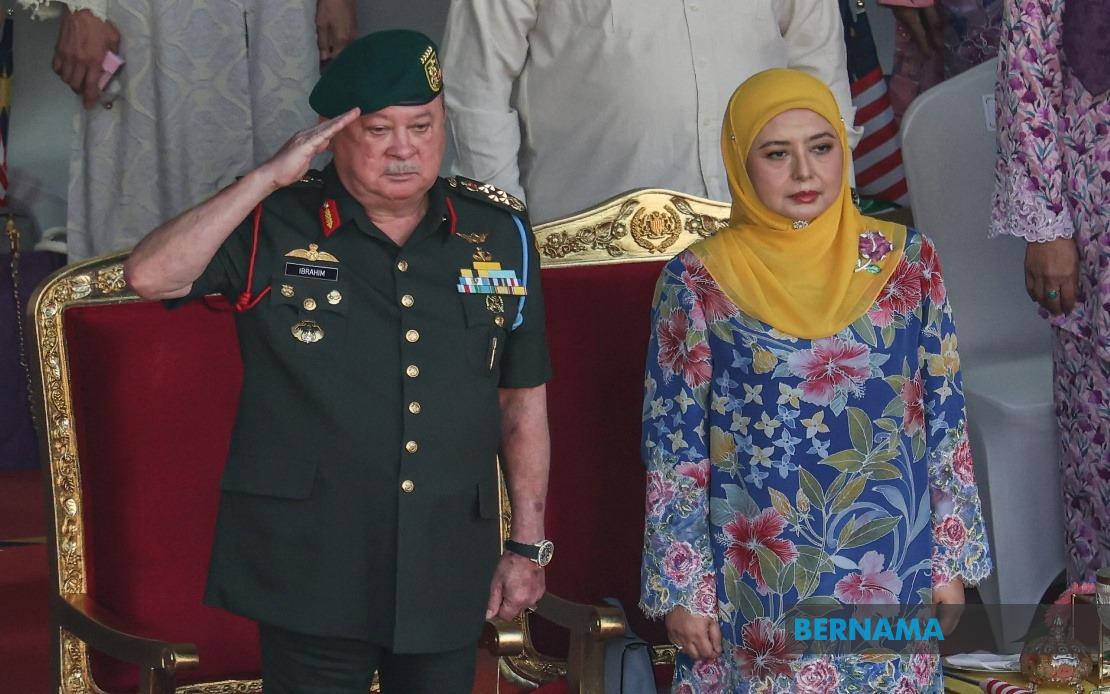
Prime Minister Datuk Seri Anwar Ibrahim, accompanied by his wife Datuk Seri Dr Wan Azizah Wan Ismail, arrived at the royal stage at 7:53 am, receiving the ceremonial greeting of the "Hormat Perdana" composition. Within minutes, the proceedings elevated substantially as Their Majesties Sultan Ibrahim and Raja Zarith Sofiah made their entrance at 8:00 am, prompting five military helicopters bearing the Jalur Gemilang to execute a synchronized flypast overhead. The dual arrival—first the Prime Minister, then the King—reflected Malaysia's constitutional hierarchy and the ceremonial protocols that govern state occasions, with the musical accompaniment of Negaraku and "Hormat Diraja" reinforcing the formal grandeur of the moment.
The morning's pageantry extended throughout the upper echelons of government, with Deputy Prime Minister Datuk Seri Dr Ahmad Zahid Hamidi, Cabinet ministers, and other state officials occupying prominent positions. Communications Minister Datuk Seri Fahmi Fadzil, in his dual capacity as chairman of the main committee overseeing both National Day and Malaysia Day celebrations, stood conspicuously among the assembled dignitaries. The presence of accredited diplomats and foreign delegates added an international dimension to the proceedings, signalling Malaysia's commitment to showcasing its democratic processes and multicultural fabric to the global community.
The formal ceremony commenced with the collective singing of Negaraku, Malaysia's national anthem, followed by the ceremonial raising of the Jalur Gemilang accompanied by a 14-gun salute—each shot representing one of Malaysia's constituent states. The firing detail, executed by the 41st Battery of the Royal Artillery Regiment under the command of Major Hafizan Mat Ghani, provided the martial punctuation that transformed the civic gathering into a military-inflected state ceremony. This fusion of civilian participation with armed forces protocol remains a hallmark of Malaysian independence observance, reflecting the military's historical role in achieving and defending national sovereignty.
The proceedings acquired a deeper civic and spiritual dimension with the recitation of the Rukun Negara, Malaysia's foundational national philosophy enshrining principles of sovereignty, democracy, constitutionalism, rule of law, and mutual respect. Led by Malaysian Fire and Rescue Department Deputy Commissioner Datuk Abdul Razak Muda, the recitation involved 69 firefighters—a deliberate numerical correspondence with the years of independence—and was rendered accessible through sign language interpretation by Nur Alyanatasha. This inclusive approach to national ceremony signals evolving consciousness within Malaysian officialdom regarding the need for celebrations to meaningfully encompass citizens with varying abilities and capacities for participation.
The emotional crescendo arrived with the sevenfold utterance of "Merdeka" that traditionally punctuates Malaysian independence observances, each cry answered by the spontaneous raising of miniature Jalur Gemilang flags throughout the assembled crowd. The repetition of the independence cry seven times carries historical significance, commemorating the original seven iterations of "Merdeka" declared by the nation's first Prime Minister Tunku Abdul Rahman on August 31, 1957. For many contemporary Malaysians, this moment provides a rare opportunity for collective expression of national belonging that transcends the ethnic, religious, and socioeconomic divisions that characterize quotidian Malaysian society.
The 69-year milestone invites reflection on Malaysia's trajectory since independence, particularly the political fragmentation and governance challenges of recent years. The return to Putrajaya for major national ceremonies, combined with the emphasis on Malaysia MADANI prosperity messaging, represents an attempt by the current Pakatan Harapan administration to recalibrate public confidence in national institutions and leadership. Yet underlying tensions—persistent regional inequality, questions about the sustainability of Malaysia's growth model, and concerns about social fragmentation—remain largely unresolved, suggesting that the patriotic effusions of National Day celebrations operate within a national context considerably more complex than the ceremonial occasions acknowledge.
For Malaysian observers and the broader Southeast Asian region, the 2026 National Day carries implications beyond ceremonial significance. Malaysia's model of constitutional monarchy, parliamentary democracy, and multicultural federalism stands as a counterpoint to authoritarian governance elsewhere in Asia, even as implementation of these principles remains contested and imperfect. The emphasis on inclusive prosperity through the Malaysia MADANI framework suggests awareness within Malaysian leadership that future national cohesion depends less on ceremonial invocations of unity and more on demonstrable improvements in economic opportunity, institutional accountability, and social equity. Whether the pageantry at Dataran Putrajaya translates into meaningful policy shifts remains the pertinent question facing Malaysia as it enters the second half of its first century of independence.

