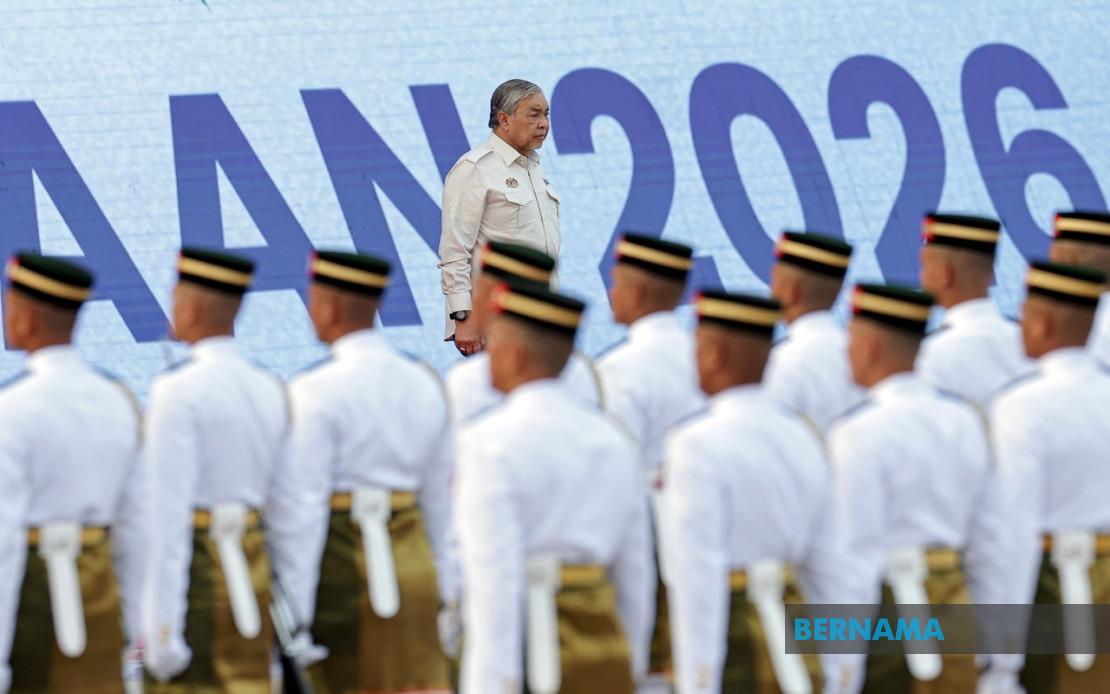
Malaysia's 2026 National Day celebration at Dataran Putrajaya has been hailed as a notable success, with Deputy Prime Minister Datuk Seri Dr Ahmad Zahid Hamidi characterising the event as surpassing previous years' festivities and providing tangible evidence of strengthening national consciousness. Speaking to media representatives following the main proceedings, Ahmad Zahid emphasised that the scale and enthusiasm demonstrated by attendees reflected a measurable uptick in patriotic sentiment across the country, marking a positive trajectory for national unity in the current political climate.
The parade and festivities drew unprecedented crowds, with organisers reporting more than 100,000 members of the public gathering at the federal administrative centre since the early hours to witness the ceremonial proceedings. The participation extended well beyond mere spectatorship, with 10,819 individuals actively participating in the main parade formation distributed across 76 contingents representing various government and civilian organisations, alongside 22 formal marching bands that provided musical accompaniment throughout the event. This substantial scale of organised participation underscores the logistical investment required to mount such a comprehensive national commemoration.
The celebration operated under the overarching theme of "Malaysia MADANI: Kesejahteraan Dinikmati," a framework that connects the government's broader governance philosophy to tangible improvements in citizen welfare and prosperity. This thematic choice reflects ongoing efforts by the administration to link patriotic observance with substantive policy commitments, attempting to demonstrate that national pride encompasses more than symbolic gestures. For Malaysian audiences, the MADANI concept has become increasingly central to how the current government frames its domestic agenda, making the National Day platform particularly significant as a venue for reinforcing this messaging.
The event secured high-level political patronage, with His Majesty Sultan Ibrahim and Her Majesty Raja Zarith Sofiah, the reigning King and Queen of Malaysia, gracing the proceedings with their formal presence. This royal attendance carries considerable symbolic weight within Malaysia's constitutional monarchy system, signifying official endorsement of the celebration's significance. Prime Minister Datuk Seri Anwar Ibrahim and the full complement of Cabinet ministers were similarly present, creating an unusually concentrated gathering of Malaysia's political leadership at a single ceremonial occasion.
Ahmad Zahid's remarks merit particular scrutiny given the competitive political environment in Malaysia, where opposition parties and critics might otherwise characterise any National Day turnout as merely routine or potentially inflated. By explicitly positioning the 2026 celebration as superior to its immediate predecessors, the Deputy Prime Minister was effectively providing a political narrative that the current administration has mobilised greater national enthusiasm than previous governments. This framing carries implications for how succeeding celebrations are evaluated and what baseline expectations might be established for future years.
The concentration of Malaysian citizens at Dataran Putrajaya reflects broader patterns in how the federal capital has become the focal point for major national observances, particularly under the current administration's tenure. The choice of venue—a specially designed public space in the administrative centre rather than historical sites or more dispersed regional celebrations—emphasises institutional continuity and governmental prominence in orchestrating national commemoration. For Southeast Asian observers, Malaysia's approach to centralised National Day celebrations contrasts with approaches adopted by neighbouring countries that often distribute festivities across multiple urban centres.
The Deputy Prime Minister's interaction with assembled crowds before addressing media representatives served as an informal validation mechanism, allowing political leadership to gauge and photograph public sentiment in real time. Such moments, increasingly documented through social media channels, provide raw material for ongoing political communication strategies. Ahmad Zahid's willingness to spend extended time mingling with ordinary citizens presents a deliberate image of political accessibility and connection to grassroots sentiment, particularly valuable during periods when government popularity faces scrutiny.
The quantification of attendance at over 100,000 people presents both organisational achievement and potential analytical challenges. Large public gathering estimates typically involve significant margins of variance, and the figure's deployment in political discourse often serves multiple purposes simultaneously—demonstrating administrative capacity, validating government policies, and providing photographic evidence of national unity. Malaysian media outlets and the broader public receiving this figure will necessarily interpret it through existing predispositions regarding government performance and national sentiment.
For the broader regional context, Malaysia's 2026 National Day representation matters because it signals how the country is positioning itself within Southeast Asia during a period of significant geopolitical flux. Strong domestic patriotic displays can be understood as projecting stability and institutional legitimacy internationally, factors that influence investor confidence, diplomatic standing, and soft power projections. The explicit framing of growing patriotism also responds to occasional international commentary regarding social divisions within Malaysian society, presenting an official counter-narrative of strengthening cohesion.
The Deputy Prime Minister's invocation of "Alhamdulillah"—an Arabic expression conveying gratitude and divine blessing—in his formal statement represents a subtle but deliberate incorporation of Islamic cultural vocabulary into official political discourse around national commemoration. This linguistic choice resonates with Malaysia's Muslim-majority demographic while simultaneously affirming that national patriotism encompasses spiritual and cultural dimensions alongside civic participation. Such rhetorical choices reflect how contemporary Malaysian political communication integrates multiple identity frameworks within ostensibly secular national narratives.
Looking forward, the benchmarking of the 2026 celebration as exceptional creates implied expectations for subsequent years. Future administrations will face implicit pressure to maintain or exceed the reported attendance and scale metrics, potentially driving escalating investment in National Day logistics and production values. This competitive dynamics around celebration quality may reflect broader trends in how governments globally are attempting to demonstrate legitimacy through public spectacle and mass mobilisation, with Malaysian officials clearly attentive to comparative performance metrics.
The broader significance of Ahmad Zahid's commentary extends beyond immediate ceremonial assessment to encompass questions about how Malaysia is cultivating national identity and cohesion during periods of rapid social change, digital communication transformation, and evolving generational attitudes toward traditional institutions. If patriotic sentiment is genuinely strengthening as the Deputy Prime Minister asserts, this development carries implications for political stability, social consensus on major policy directions, and Malaysia's capacity to navigate forthcoming regional and global challenges as a unified polity.

