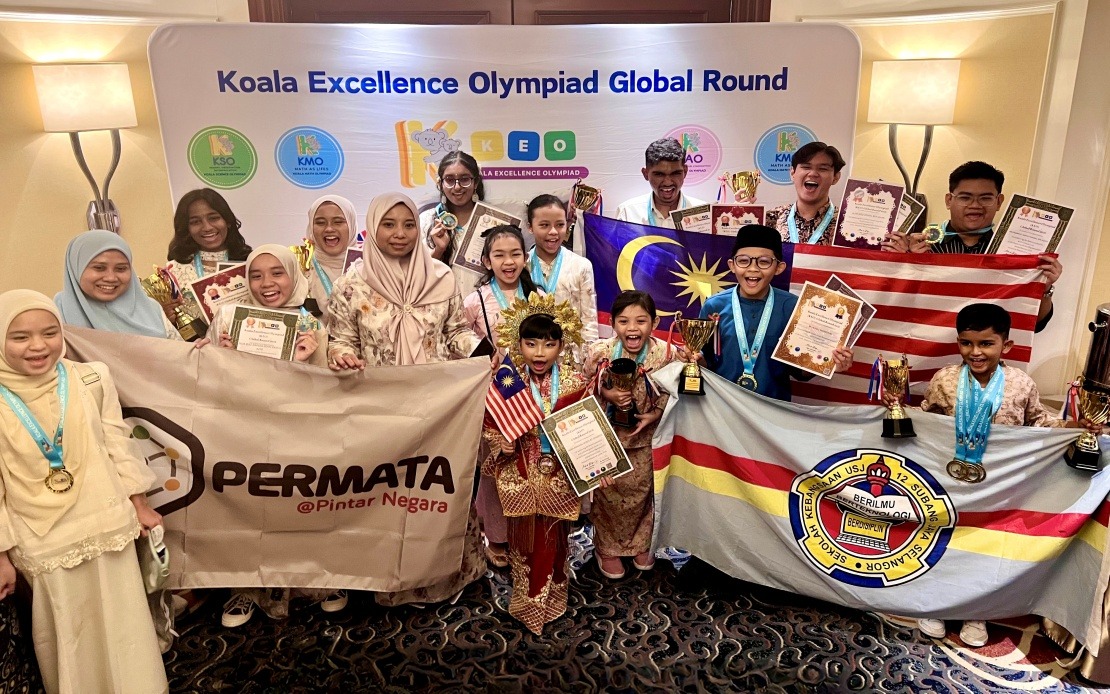
Malaysia's academic prowess received international recognition when a contingent of seventeen students returned from Macau with an impressive medal haul from the Koala Excellence Olympiad 2026, which wrapped up recently. The delegation secured a combined total of nine overall awards alongside twenty-two medals across multiple disciplines, reflecting the calibre of young talent being nurtured within Malaysia's education system. The achievements underscore the country's growing capacity to compete meaningfully in global academic forums where standards are benchmarked against international best practices.
Aidah Misran, who coordinated the Malaysian Young Scientists Organisation (MYSO) delegation and served as team leader throughout the competition, detailed the breakdown of medals secured. The contingent brought home five gold medals, complemented by six silver and eleven bronze across the various competition categories. This distribution reflects both the depth and breadth of Malaysia's competitive strength, with success spread across multiple age groups and academic disciplines rather than concentrated in isolated standout performances.
The students participating in the Koala Excellence Olympiad represented a cross-section of Malaysia's educational institutions, combining talent from both elite colleges and neighbourhood schools. The delegation comprised four students from Kolej PERMATA@Pintar Negara Universiti Kebangsaan Malaysia, six from Sekolah Menengah Kebangsaan Ungku Aziz, two from Sekolah Sultan Alam Shah, three from Sekolah Kebangsaan Convent (2) Bukit Nanas, and individual representatives from Sekolah Menengah Kebangsaan Convent Teluk Intan, Sekolah Kebangsaan USJ 12, Sekolah Kebangsaan Seri Hartamas, and Sekolah Kebangsaan Convent Sentul 1. This institutional diversity demonstrates that academic excellence in Malaysia extends beyond traditional elite schools into the mainstream education sector.
The Koala Excellence Olympiad represents a significant platform in the global academic calendar, bringing together young scholars from numerous countries to compete in English, Mathematics, Science and Arts Olympiads. Unlike traditional examinations that emphasize memorisation and rote learning, the competition was specifically designed by Australian educational experts to cultivate higher-order thinking skills. The curriculum alignment prioritizes critical analysis, innovative problem-solving, and the application of knowledge to real-world scenarios—pedagogical approaches increasingly recognized as essential for twenty-first century competitiveness.
The most celebrated Malaysian performer at this year's competition was Mukridz Mardzuki, a Year Six pupil from Sekolah Kebangsaan Seri Hartamas, who captured the overall Science Olympiad championship within the primary school category. This achievement carries particular significance as it demonstrates that scientific excellence and advanced reasoning capabilities are emerging even among younger cohorts of Malaysian students. Primary school championships in international competition carry weight because they indicate early identification and development of talent that can be cultivated through secondary and tertiary education.
Beyond outright champions, Malaysian students demonstrated competitive strength across multiple medal rankings. Sarah Isabel Maryam Ahmad Suhael from Sekolah Kebangsaan Convent (2) Bukit Nanas secured runner-up honours in the primary Science Olympiad category, while Alfie Rizq Danial Azlan from Sekolah Sultan Alam Shah achieved the same distinction in the secondary Science division. Ayra 'Adani Muhammad 'Aizat, representing Kolej PERMATA@Pintar Negara UKM, earned runner-up status in the English Olympiad, indicating that Malaysian competitiveness extends across linguistic and scientific domains.
The third-place finishers further illustrated the depth of Malaysia's contingent. Marvyn Zef Mark Philip distinguished himself particularly by securing third place across two separate categories—both Science and English Olympiads—demonstrating unusual versatility across different disciplines. Additional third-place medals went to P Prem in Science, Muhammad Khairul Mauidz Khairul Azman in Mathematics, and AK Shashini in English. This spread of recognition across multiple individual students and various subject areas suggests a well-rounded educational system producing capability across the spectrum rather than narrow specialisation.
From a regional perspective, Malaysia's performance at the Koala Excellence Olympiad carries implications for how Southeast Asian nations are perceived within the global educational landscape. International academic competitions serve as visible metrics through which countries benchmark themselves against peers, and strong performances attract international educational investment, increase student mobility, and enhance the prestige of participating institutions. Success at such platforms gradually shifts perceptions of educational quality and can influence decisions by multinational corporations and international institutions regarding where to establish regional headquarters and research centres.
The Malaysian Young Scientists Organisation's role as coordinating body reflects how institutional frameworks can effectively mobilise national talent for international competition. Coordination between MYSO, participating schools, and the competition organisers—conducted jointly with Miss Man International Group—demonstrates the logistical sophistication required to prepare students for global-standard academic competition. Such coordination infrastructure, once established, creates pathways for future participation and allows for institutional memory regarding what constitutes effective preparation for international olympiads.
Looking forward, the results from this year's Koala Excellence Olympiad should inform policy conversations regarding curriculum development and student enrichment programmes within Malaysia. The success of students from both premier institutions and neighbourhood schools suggests that talent identification and development mechanisms need not be confined to elite educational pathways. Investment in identifying mathematically and scientifically gifted students across the full spectrum of public schools could unlock latent capacity currently unrealised due to limited exposure to advanced problem-solving methodologies and international benchmark standards.
The achievement also raises questions about how Malaysia can sustain and build upon this momentum in successive competitions. International olympiad success often reflects years of systematic preparation, specialized coaching, and institutional commitment. Understanding which schools and programmes generated medal-winners can help education authorities identify and replicate effective pedagogical approaches and resource allocation strategies. The diversity of medal-winning institutions suggests multiple pathways to success rather than a single model, offering flexibility for schools operating under different resource constraints.
Finally, these seventeen students represent not merely individual accomplishments but constitute an emerging cohort of young Malaysians positioned to contribute to the nation's knowledge economy. Early success in international academic competition often correlates with later achievement in higher education and professional fields requiring advanced analytical capability. By nurturing this talent pool and ensuring continued access to challenging intellectual environments, Malaysia invests in human capital formation that drives long-term economic competitiveness and innovation capacity within the region.

