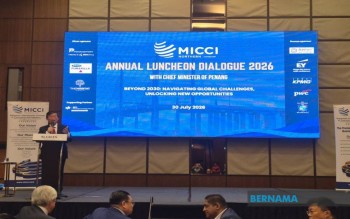
The Malaysian International Chamber of Commerce and Industry (MICCI) has issued a stark call for its member companies to accelerate spending on workforce development and technological innovation, warning that businesses failing to adapt to rapid digital transformation risk being left behind in an increasingly competitive global marketplace. Speaking at the MICCI Northern Branch Annual Luncheon Dialogue 2026 in George Town, Datuk Brian Tan Guan Hooi, chairman of the Northern Branch, emphasised that while artificial intelligence, automation and digitalisation present significant disruptive forces, they simultaneously create pathways for new industries and higher-value employment opportunities that Malaysian companies must be positioned to capture.
The challenge facing Malaysian businesses is multifaceted. Tan articulated that technological advancement is fundamentally altering the nature of employment across sectors, eliminating certain roles while simultaneously creating demand for positions that do not yet exist. This reality means that traditional approaches to workforce planning and employee development are no longer sufficient. Companies must move beyond simply ensuring staff hold relevant academic qualifications and instead build organisations where employees possess a diverse skill set encompassing technical expertise, creative problem-solving abilities, and strong communication capabilities. Equally critical is cultivating a culture of continuous learning, where adaptability and intellectual flexibility become defining features of the workforce.
The implications for Malaysia's competitive position in the region are substantial. Singapore, South Korea, and increasingly Vietnam have already begun shifting their economies toward high-value-added activities that demand precisely the kind of skilled, innovative workforce MICCI is calling for. Malaysian firms that fail to invest meaningfully in their people risk being relegated to lower-margin manufacturing and service provision, unable to compete on quality or innovation. Conversely, companies that embrace comprehensive talent development strategies position themselves to move up global value chains, capturing greater profitability and creating more rewarding employment opportunities for Malaysian workers.
Tan's remarks reflect a growing recognition within Malaysia's business community that the education and training ecosystem must align more closely with actual industry requirements. The disconnect between what educational institutions teach and what employers genuinely need has long been identified as a constraint on Malaysia's economic development. Universities and vocational training providers must engage more extensively with private sector stakeholders to understand emerging skill requirements and adjust curricula accordingly. This is particularly urgent in fields such as data analysis, cybersecurity, artificial intelligence implementation, and advanced manufacturing—areas where Malaysian demand is growing but supply remains constrained.
Innovation investment represents the second pillar of MICCI's message to member companies. Beyond developing existing capabilities, businesses must allocate resources toward research, experimentation, and the development of new products and services. In Southeast Asian economies where labour costs are rising and competing nations offer cheaper alternatives, innovation provides the differentiation mechanism that allows Malaysian companies to maintain premium positioning. This applies across sectors, from manufacturing and logistics to professional services and financial technology. Companies that innovate establish new markets, create intellectual property with lasting competitive advantages, and generate higher margins than those merely executing established business models.
The dialogue, which drew Penang Chief Minister Chow Kon Yeow as guest of honour, underscored the importance of collaborative engagement between government and industry in navigating this transformation. Tan characterised the relationship as symbiotic, with government responsible for establishing policy direction and creating enabling infrastructure while private sector entities contribute capital, expertise, and employment generation. However, this partnership functions effectively only when both sectors maintain open, honest dialogue grounded in pragmatism rather than ideology. Regular engagement between industry bodies like MICCI and government agencies helps ensure that regulatory frameworks, investment incentives, and infrastructure development remain responsive to evolving business needs.
Penang's particular relevance to this discussion extends beyond its status as a developed state. The Penang economy has historically depended on electronics manufacturing and business process outsourcing, sectors particularly vulnerable to automation and relocation to lower-cost jurisdictions. The state's future competitiveness hinges on exactly the kind of talent development and innovation ecosystem that MICCI advocates. With its relatively strong educational institutions, growing technology sector, and geographic proximity to international markets, Penang possesses the foundational elements necessary to transition toward higher-value activities—provided that businesses and government work collaboratively to build the required institutional ecosystem.
MICC's role as an institutional bridge between private enterprise and government has acquired heightened significance. Since its founding in 1837, the chamber has accumulated considerable institutional credibility and can speak with authority about industry needs. As it approaches its 190th anniversary, MICCI positions itself not as a lobbying organisation simply advancing narrow interests, but as a genuine facilitator of information exchange and solution development. This distinction matters because sustainable policy change requires genuine dialogue and shared problem identification rather than adversarial positioning.
The broader Southeast Asian context reinforces the urgency of Malaysia's response. Regional peers are investing substantially in digital infrastructure, talent development, and innovation ecosystems. Thailand's investment in artificial intelligence capability development, Indonesia's growing technology startup ecosystem, and Vietnam's emergence as a manufacturing alternative all represent competitive threats. For Malaysian firms, remaining competitive is not about matching regional neighbours skill-for-skill but rather identifying distinctive capabilities and niches where Malaysian expertise and positioning create sustainable advantages. This requires deliberate strategic thinking at both company and national levels.
For Malaysian policymakers, MICCI's message carries clear implications: the window for managed transition toward higher-value economic activity remains open but is gradually closing. Investments in technical education, research infrastructure, and innovation support systems will yield returns over years and decades. Delays in addressing skills gaps and supporting private sector innovation will result in a gradual loss of competitiveness and capability as the global economy continues its shift toward knowledge-intensive activities. The question facing Malaysia is not whether this transition will occur—it is inevitable—but whether the nation will actively shape the transition or reactively respond to disruption.
For individual businesses, the message is equally direct: talent and innovation investment is no longer discretionary or marginal but central to survival and growth. Companies that view workforce development and research spending as cost centres rather than strategic investments risk obsolescence. Conversely, those that cultivate learning organisations and commit resources to innovation position themselves to thrive across the coming decade, creating value for shareholders, opportunities for employees, and contributions to Malaysia's continued economic development.

