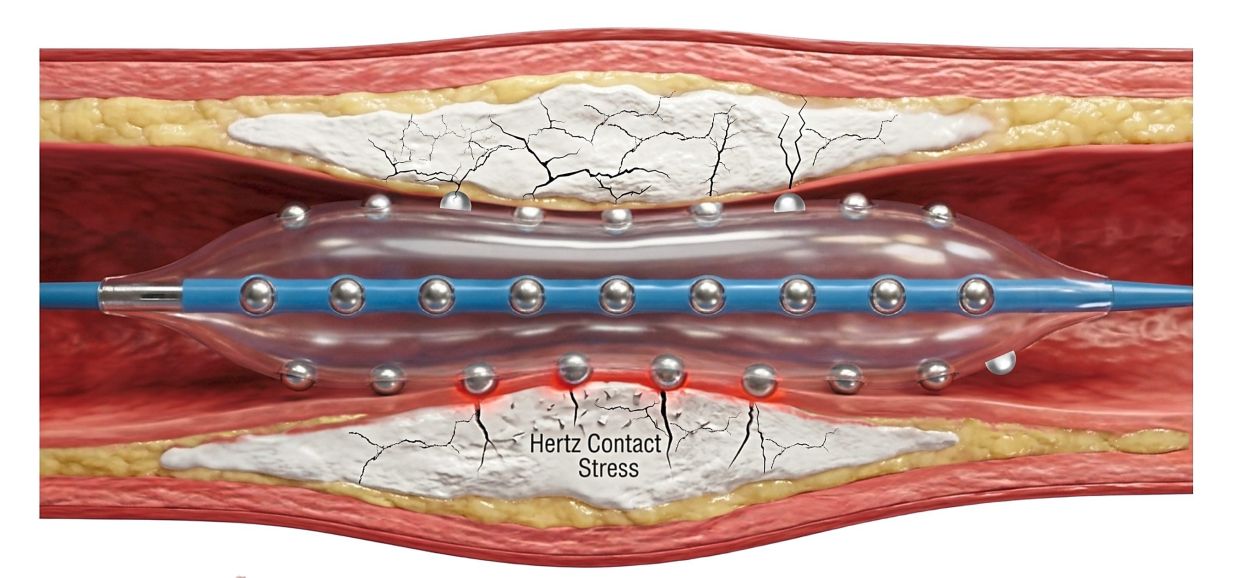
A team of Malaysian cardiologists has begun investigating a novel approach to treating one of cardiology's most stubborn challenges: the removal of severely hardened plaque deposits from coronary arteries. Led by consultant cardiologist Datuk Dr Tamil Selvan Muthusamy, the research focuses on the Hertz Contact-IVL System, an innovative device that represents a meaningful departure from conventional energy-dependent treatment methods. This development carries particular significance for Southeast Asian cardiac care, where atherosclerosis remains a leading cause of mortality and disability.
Coronary artery disease develops when plaque—a composite substance comprising fat, cholesterol, calcium, cellular debris, and fibrin—gradually accumulates along artery walls over months and years. This buildup progressively narrows the vessel lumen, restricting blood flow and oxygen delivery to cardiac tissue. When blockages become severe, the consequences can be catastrophic: myocardial infarction, heart failure, or cerebrovascular accidents. The condition affects millions across the region, yet many cases involve calcification so extensive that conventional interventions struggle to achieve optimal outcomes.
Physicians typically manage coronary atherosclerosis through a tiered approach combining lifestyle modification, pharmacological therapy, and when necessary, invasive procedures. Standard interventional techniques such as percutaneous coronary intervention, coronary artery bypass grafting, and balloon angioplasty have saved countless lives. However, these methods work through different mechanisms: soft plaque responds well to balloon expansion, which compresses the material and restores vessel patency before a metal stent maintains the newly created channel. With calcium-laden lesions, this straightforward approach encounters substantial difficulties. The rigid mineral deposits resist mechanical crushing, and attempts at forceful expansion risk vessel perforation or dissection—serious complications that can prove fatal.
For severely calcified lesions, interventionalists have turned to more aggressive techniques. Rotational atherectomy uses a spinning diamond-coated burr to abrade calcium; high-pressure balloon angioplasty applies extreme force to fracture deposits; and conventional intravascular lithotripsy employs externally generated ultrasound waves to create shock fronts that pulverize calcium. Yet each approach carries limitations that frustrate both physicians and patients. Rotational atherectomy requires operator expertise and carries risks of perforation. High-pressure balloons may damage surrounding tissue. Conventional intravascular lithotripsy, while less traumatic, has constrained pulse cycles—typically eight to twelve activations—and the bulky catheter delivery mechanism struggles to navigate vessels with severe diameter variations.
Dr Tamil Selvan elaborates on these technical constraints. The standard intravascular lithotripsy device operates on a fixed-capacity model: if engineers design a system with eight ultrasound pulses, physicians must accomplish complete calcium fracture within those eight cycles. Newer iterations offer twelve cycles, yet this represents only incremental progress. Moreover, the catheter's one-size-fits-all balloon design creates practical problems. A coronary artery frequently tapers irregularly, perhaps measuring 3.5 millimetres at its origin, narrowing to 3 millimetres midway, then further reducing to 2 millimetres distally. Selecting a balloon sized for one segment inevitably proves suboptimal for others, necessitating multiple device insertions and compounding procedural duration, radiation exposure, and contrast medium administration.
The Hertz Contact-IVL System addresses these constraints through an elegant mechanical redesign that eliminates dependence on external energy generators. Rather than relying on ultrasound technology, the device incorporates a balloon embedded with miniaturised metallic hemispheres fashioned from stainless steel. When the balloon contacts calcium deposits and physicians apply inflating pressure, the hemispherical structures create focal points of amplified force transmission. This mechanical amplification generates deep, wide fracture lines through calcified plaque whilst sparing surrounding tissue from injury. The innovation permits progressive artery expansion, enabling stent deployment with improved procedural success rates and potentially superior long-term patency.
Deliverability represents perhaps the most clinically significant advantage of the Hertz Contact-IVL design. Unlike bulkier conventional lithotripsy catheters, this streamlined catheter navigates tortuous vessel anatomy more readily. More importantly for complex lesions, physicians can effectively treat extended blockages or multiple lesions with a single balloon, dramatically reducing procedural complexity. This capability holds particular relevance in the Southeast Asian context, where healthcare resources vary considerably and procedural efficiency directly impacts patient access and outcomes.
The decision to conduct expanded local investigation reflects appropriate scientific rigor. The device's developer completed only small, multicentre feasibility studies within the United States healthcare system. These preliminary investigations, whilst encouraging, could not fully characterise safety profiles across diverse patient populations and anatomical presentations. Dr Tamil Selvan and his colleagues recognised that larger, dedicated investigations conducted in Malaysian medical centres would generate more robust evidence regarding performance characteristics, complication rates, and patient outcomes. This commitment to comprehensive evaluation before widespread adoption represents best practice in introducing novel medical technologies.
The timing of this Malaysian research programme assumes additional significance given rising atherosclerosis prevalence throughout the region. Economic development, urbanisation, dietary westernisation, and ageing demographics have combined to increase coronary artery disease incidence substantially. Many affected individuals present with advanced disease characterised by extensive calcification, partly reflecting delayed diagnosis in some healthcare settings. Improving interventional capabilities for these challenging cases directly addresses a substantial and growing clinical need. Additionally, demonstrating Malaysian expertise in pioneering advanced cardiac technologies contributes to regional medical leadership and potentially positions local institutions as centres of excellence attracting international collaboration and referrals.
Beyond immediate clinical applications, this research exemplifies how Southeast Asian medical professionals increasingly drive innovation rather than merely adopting technologies developed elsewhere. The deliberate choice to conduct larger, more rigorous investigations than those performed internationally reflects confidence in local research infrastructure and commitment to generating evidence directly applicable to regional populations. Should the Hertz Contact-IVL System prove safe and effective through these investigations, Malaysian cardiologists will have contributed meaningfully to advancing treatment options for a condition affecting millions regionally. For patients with severely calcified coronary lesions, previously categorised as high-risk for intervention, such technological advances may transform prognosis and quality of life substantially.

