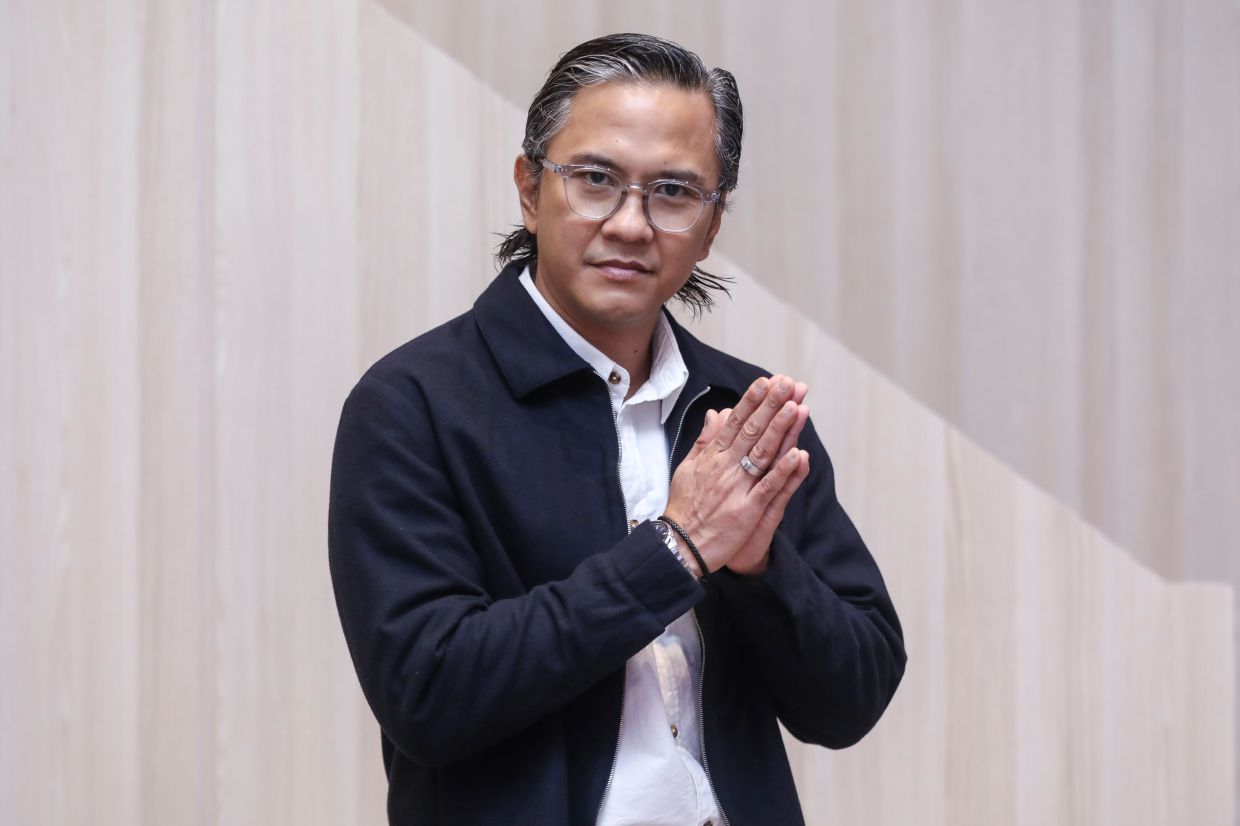
Veteran actor Beto Kusyairy has reached a career inflection point where commercial success matters far less than creative substance. The 46-year-old Malaysia Film Festival Best Actor recipient now approaches project selection through a different lens entirely, turning away from the allure of ratings and celebrity status in favour of work that challenges both himself and audiences. This philosophical shift explains his willingness to explore mediums beyond the traditional film-television divide, including radio drama, provided the underlying material and execution meet his exacting standards.
The actor's conviction that storytelling quality transcends medium has shaped his involvement with the Astro Originals eight-episode series, a dark crime narrative centred on parental suspicion and childhood tragedy. In the production, Kusyairy portrays a father whose son disappears and is subsequently discovered murdered, with the protagonist himself becoming the focal point of police investigation despite his apparent love for his child. The series weaves together fragmented memory, forensic suspicion and the psychological unravelling of grief to construct its central mystery, but the narrative framework also functions as a vehicle for examining the interconnected traumas of abuse, exploitation and generational harm.
The programme's unexpected cultural resonance has surprised even its creators. Since launch, the series accumulated 58 million video views and engaged 9.5 million users across social media platforms, translating that digital momentum into a six-week tenure within Netflix's global Top 10 rankings. Such metrics, however, represent merely the surface layer of the show's impact. What genuinely impressed Kusyairy was the nature of audience participation, which transformed from speculative theory-crafting into something considerably more profound as the narrative progressed. Viewers initially gravitated toward detective work, constructing elaborate hypotheses and debating plot mechanics in the manner of true-crime enthusiasts, yet this engagement shifted as episodes aired.
The trajectory of audience interaction revealed something significant about contemporary Malaysian consciousness. As the series delved deeper into its exploration of trauma and abuse, the comments sections and direct messages Kusyairy received transitioned from analytical to confessional. Individuals began sharing their own experiences of sexual abuse, childhood trauma and exploitation, using the fictional narrative as a catalyst for articulating personal suffering they had previously kept concealed. The actor recognised this phenomenon not as mere entertainment consumption but as a form of therapeutic expression, suggesting that viewers discovered in the drama a validation for their own untold stories and perhaps permission to finally voice what silence had previously protected.
This outpouring prompted reflection from Kusyairy regarding the broader cultural landscape surrounding abuse and exploitation in Malaysia. He observed that previous generations, constrained by concerns over family honour and social reputation, largely suppressed such conversations, creating an environment where victims remained isolated and perpetrators faced minimal accountability. The generational shift his engagement with the series demonstrated suggests contemporary Malaysians possess greater courage in confronting these realities publicly and pursuing institutional justice. This evolution represents a genuine departure from the protective silence that historically dominated discourse around sexual abuse and family trauma in Malaysian society.
The production team's original objective proved considerably more modest than the eventual cultural impact their work achieved. Creators intended simply to render the narrative with honesty, trusting that authentic storytelling would naturally generate awareness and emotional resonance among viewers. The unexpected dimension was the extent to which the series would catalyse genuine community conversation about issues traditionally considered unsuitable for entertainment media. Kusyairy articulated this distinction carefully, emphasising that the production deliberately avoided the didactic approach that typically characterises social-issue drama, whereby narratives become vehicles for explicit messaging rather than genuine storytelling.
Instead, the series demonstrated that Malaysian audiences possess sufficient maturity to engage with morally complex and emotionally turbulent material when presented with artistic subtlety and narrative integrity. The distinction matters considerably. Drama functions most powerfully not when it lectures but when it inhabits emotional truth, allowing viewers to arrive independently at their own moral reckoning. By foregrounding character psychology and the ambiguity surrounding guilt and innocence, the production created space for viewers to project their own experiences and understanding onto the narrative, transforming individual trauma into collective conversation.
Kusyairy's observations carry particular weight given the Malaysian entertainment industry's historical conservatism regarding sensitive subject matter. Local productions have traditionally navigated regulatory frameworks and cultural sensitivities through self-imposed restraint, resulting in narratives that often sanitised difficult realities. The success of his series suggests both audience appetite and systemic capacity for more honest engagement with social issues. This shift potentially signals a broader industrial transformation, with producers gaining confidence to develop properties that honour the complexity of human experience rather than defaulting to safer commercial formulations.
The actor situates his own project within a larger momentum transforming Malaysian film and television production. Technical production values have demonstrably improved, with local creators now commanding cinematic sophistication previously associated with foreign productions. Genre diversity has expanded considerably, encompassing action, comedy, psychological thrillers and horror within a distinctly Malaysian idiom rather than defaulting to foreign imports. This expansion reflects both industry maturation and audience evolution, with viewers increasingly willing to support locally-produced content that reflects their own cultural context rather than relying exclusively on international programming.
Kusyairy's invocation of Eugene Bell Jr's directive to aspire toward inspiring others reframes his participation in the series beyond personal career achievement. The actor conceptualises the project's contribution as potentially catalysing further creative ambition within the industry, encouraging writers and producers to conceive narratives that push against conventional limitations. If the series demonstrates that Malaysian audiences will engage thoughtfully with difficult material when presented with artistic integrity, then subsequent creators face fewer justifications for retreating into formulaic safety. The momentum Kusyairy identifies extends beyond individual project success toward a broader cultural permission structure that increasingly values authentic storytelling over protective conservatism.
The implications for Malaysian media production extend beyond entertainment toward questions of social processing and collective healing. When drama provides venues for discussing abuse, trauma and exploitation in ways that feel emotionally resonant rather than exploitative, it contributes to broader cultural shifts in how such issues are understood and addressed. Kusyairy's recognition that viewers felt brave enough to articulate their own experiences suggests the series functioned as more than entertainment, operating instead as a cultural mirror reflecting experiences society had previously demanded remain hidden. This phenomenon, replicated across subsequent productions willing to engage similar territory, potentially contributes to systemic change in how abuse and trauma are reported, investigated and remedied within Malaysian institutions themselves.

