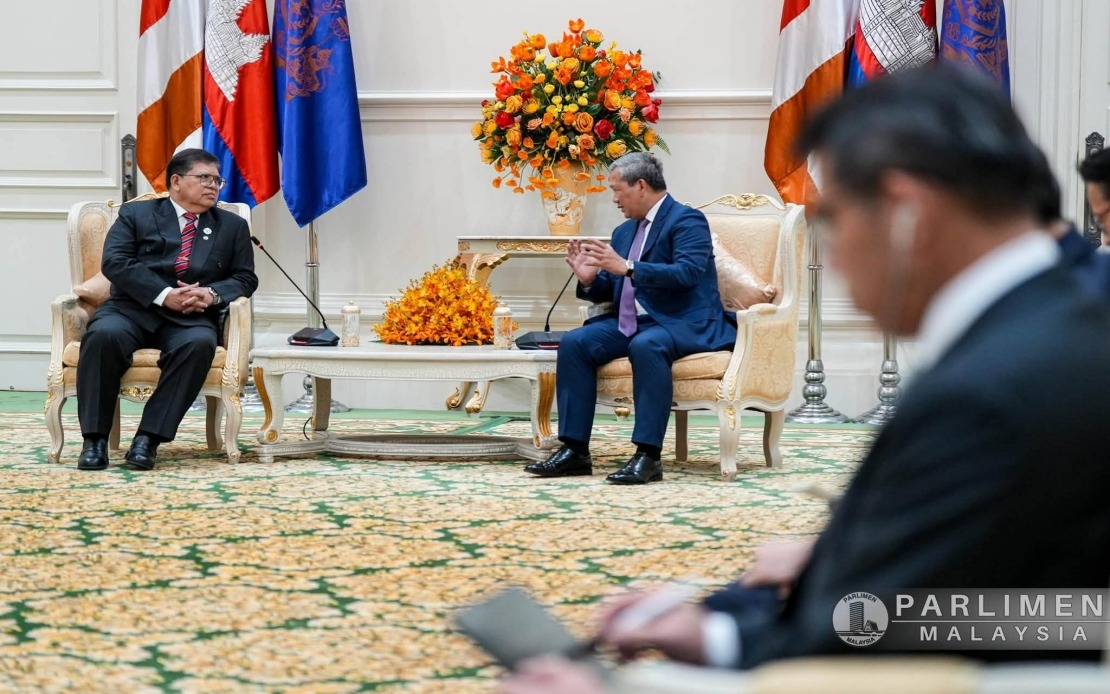
Malaysia's Dewan Rakyat Speaker Tan Sri Johari Abdul has called for sustained dialogue and diplomatic engagement to resolve the ongoing Cambodia-Thailand border dispute, positioning such efforts as essential to preserving regional stability and the unity of ASEAN. Speaking during his visit to Cambodia for the Second Inter-Parliamentary Speakers' Conference, Johari underscored that member states must resist allowing bilateral tensions to corrode the broader cooperative framework that has underpinned Southeast Asian peace for decades.
The Malaysian parliamentary leader's intervention reflects growing concern among ASEAN capitals that the Cambodia-Thailand border issue, if left unaddressed through constructive channels, risks destabilising a crucial geopolitical corridor and undermining confidence in the regional bloc's ability to manage disputes. By emphasising dialogue over confrontation, Johari is signalling Malaysia's preference for mechanisms that preserve face and allow both parties to negotiate without escalation—a pragmatic stance rooted in ASEAN's traditional consensus-seeking culture.
During his bilateral meeting with Cambodian Prime Minister Hun Manet on the margins of the conference in Phnom Penh, Johari acknowledged Cambodia's legitimate security concerns regarding developments along its border with Thailand, particularly the impact on communities residing in affected zones. This recognition carries diplomatic weight, as it validates Cambodia's grievances while simultaneously positioning Malaysia as an empathetic mediator willing to understand all perspectives. The approach contrasts with zero-sum rhetoric and instead creates space for gradual de-escalation.
Johari reiterated that ASEAN functions most effectively as a platform where member states can build mutual confidence, identify shared interests, and manage differences through constructive mechanisms rather than coercion or military posturing. This framing emphasises that resolving the border issue benefits not only Cambodia and Thailand but the entire region, as persistent instability could disrupt trade corridors, investment flows, and the seamless movement of people across Southeast Asia. For Malaysia, maintaining ASEAN cohesion is particularly important given its central role in regional trade networks and its reliance on stable neighbours.
Malaysia's commitment to supporting efforts that bring all parties back to negotiating tables reflects a deeper strategic calculation. As a middle power and respected ASEAN member, Malaysia positions itself as a stabilising force capable of facilitating dialogue without imposing solutions. This soft-power approach enhances Malaysia's standing within ASEAN and internationally, while demonstrating that disputes can be managed through institutional frameworks rather than military means—a message particularly valuable for smaller nations concerned about power imbalances.
Beyond the border issue, the Johari-Hun Manet meeting explored avenues for deepening Malaysia-Cambodia bilateral cooperation across multiple sectors. Parliamentary exchanges and institutional linkages form the foundation of sustained engagement, allowing legislators from both countries to build personal relationships and understand each other's policy priorities. Such people-to-people connections often prove more durable than high-level political agreements, as they create constituencies within parliaments invested in maintaining friendly relations.
Youth engagement emerged as a priority area during discussions, with both leaders recognising that generational investment in exchange programmes and collaborative initiatives builds long-term goodwill and reduces the likelihood of future conflicts. When young Malaysians and Cambodians interact through economic, social, and inter-parliamentary forums, they develop nuanced understandings of each other's cultures and concerns, creating bridges across borders that survive political fluctuations. The emphasis on youth empowerment also signals confidence in both nations' futures and commitment to stability.
Technical and Vocational Education and Training (TVET) cooperation represents a particularly forward-looking dimension of the Malaysia-Cambodia relationship. As both economies seek to develop skilled workforces capable of competing in global manufacturing and services sectors, institutional exchanges and industry collaboration create mutual benefits. Malaysian expertise in TVET, built over decades of industrial development, can enhance Cambodia's capacity to train workers for higher-value-added sectors, while Cambodian labour represents an opportunity for Malaysian companies investing in the country.
Johari's appreciation for Cambodia's facilitation of Malaysian business operations underscores an often-overlooked driver of regional stability: economic interdependence. When Malaysian companies invest in Cambodia and contribute to local employment and tax revenues, both governments develop incentives to maintain peaceful relations. This economic dimension complements diplomatic engagement, as disruptions caused by border conflicts would impose tangible costs on both economies and the business communities operating across the frontier.
The Malaysian speaker's commitment to continuing close cooperation serves notice that Malaysia intends to remain actively engaged in supporting regional peace architecture. In a context where external powers increasingly compete for influence in Southeast Asia, Malaysia's advocacy for ASEAN-centred solutions and dialogue-based dispute resolution reinforces the regional bloc's centrality to managing tensions. This stance also implies that Malaysia may be willing to facilitate confidence-building measures or back Track Two initiatives involving academics, former officials, and civil society figures exploring creative solutions to the border impasse.
For Malaysia itself, maintaining stability in Cambodia and Thailand is strategically vital. Both nations are key trading partners and investment destinations, and instability in either would ripple through Malaysian supply chains and financial markets. Moreover, border conflicts can trigger refugee flows and human trafficking, issues that place direct demands on Malaysian resources and governance capacity. By prioritising dialogue, Johari is ultimately advocating for policies that protect Malaysian interests while advancing regional public goods.
The Second Inter-Parliamentary Speakers' Conference itself represents an important institutional mechanism for fostering dialogue at the legislative level, a tier of governance often overlooked in traditional diplomatic channels. Parliamentary speakers wield considerable influence over domestic political narratives and legislative agendas, making their commitment to constructive engagement particularly valuable. When parliamentary leaders from ASEAN nations converge and collectively affirm the importance of dialogue, they signal to their legislatures and publics that regional cooperation remains the preferred path forward.
Moving forward, the effectiveness of Malaysia's diplomatic stance will depend on whether Cambodia and Thailand themselves commit to sustained engagement and whether ASEAN collectively reinforces messages favouring dialogue over escalation. Malaysia's role as a respected voice within the bloc positions it well to remind member states that regional peace is a collective responsibility and that bilateral disputes, however significant, must not be allowed to fracture ASEAN's unity. In an uncertain geopolitical environment, this message resonates powerfully across Southeast Asia.

