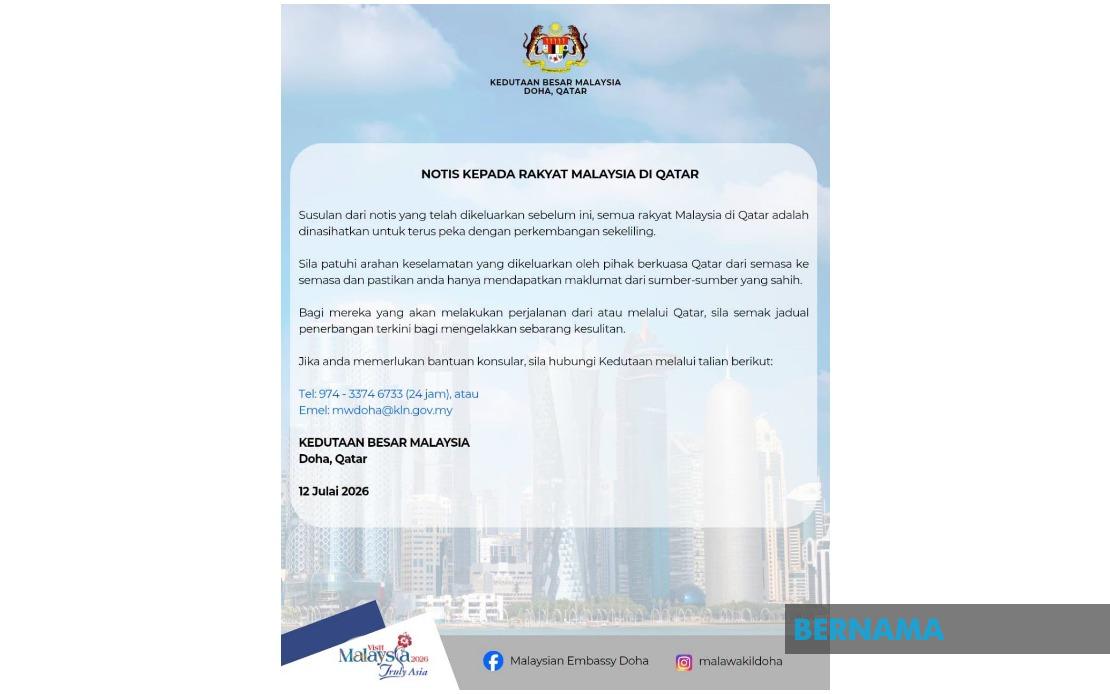
The Malaysian Embassy in Doha has issued a security alert for Malaysian nationals residing in or transiting through Qatar, instructing them to remain watchful and adhere to all safety protocols established by local authorities. The advisory, posted on the embassy's official social media channels, comes in response to intensifying military confrontations between the United States and Iran that have reverberated across the Gulf region. Malaysians in the country are urged to maintain constant situational awareness and to rely only on verified information sources when monitoring developments in the region.
Amidst ongoing tensions, the embassy has activated its full consular support network for citizens who may require assistance. Those needing help can reach the embassy's round-the-clock hotline at +974-3374 6733 or contact staff via email. The embassy has also reminded Malaysians planning to travel from or through Qatar to check updated flight schedules regularly, as air traffic disruptions remain a possibility given the volatile security environment.
The fresh hostilities stem from an escalation this week in which the Iranian military attacked a commercial vessel navigating the Strait of Hormuz. Following this incident, Iran's Islamic Revolutionary Guard Corps navy announced an indefinite closure of the strategic waterway, declaring that no foreign vessels would be permitted passage until US military interventions in the region cease completely. The US military responded with its third round of strikes against Iranian targets within a single week, significantly raising the stakes in an already precarious standoff.
The Strait of Hormuz represents one of the world's most critical maritime chokepoints, through which a substantial portion of global oil trade flows. Any prolonged disruption to shipping in this channel threatens not only regional stability but also the global energy market and supply chains worldwide. For Malaysia, a significant oil and gas exporter with major shipping interests throughout the Middle East, the closure carries direct economic implications and presents logistical challenges for Malaysian vessels operating in the region.
The current escalation is particularly striking given that Tehran and Washington had appeared to be moving toward de-escalation in June, when they signed a Pakistan-brokered memorandum of understanding aimed at terminating a conflict that had intensified since late February. This agreement was envisioned as a framework to establish a comprehensive peace settlement, explicitly addressing three critical issues: an immediate cessation of hostilities across all theatres, the removal of US naval blockades on Iran, and the restoration of open passage through the Strait of Hormuz.
Despite the formal accord reached just weeks earlier, both powers have resumed direct military action, suggesting that significant trust deficits remain between the two sides and that numerous unresolved issues continue to complicate efforts toward lasting reconciliation. The breakdown of the June understanding underscores the fragility of diplomatic progress in the region and raises concerns about the prospects for any negotiated settlement that can hold once the immediate pressures ease.
For Southeast Asian nations like Malaysia, the situation exemplifies the vulnerability of regional interests to great power rivalries that lie beyond direct national control. Malaysian trade, energy security, and the safety of maritime shipping all depend on stable conditions in the Middle East, yet the country possesses limited leverage to influence the calculations of either the United States or Iran. This dependence has prompted Malaysian diplomatic missions across the Gulf to intensify monitoring of the situation and to ensure that nationals are adequately protected.
The embassy's advisory also reflects broader concerns about potential secondary effects of the US-Iran conflict on civilian populations and commercial activity throughout the region. Even countries not directly involved in the hostilities face risks from missile strikes, naval incidents, and the general disruption of normal economic activity. Qatar, as a major regional player and home to a significant American military presence, faces particular exposure to any escalation of the conflict.
Malaysian nationals working in Qatar represent a diverse group spanning various sectors, from energy and finance to education and healthcare. Many are employed by international corporations or serve in diplomatic capacities. Ensuring their security while maintaining normal operational capabilities presents a balancing act for both the Malaysian Embassy and the Qatari government, which has sought to maintain its own diplomatic distance from the competing US-Iran narrative.
The timing of the embassy's alert coincides with growing international concern about whether the June memorandum of understanding can be salvaged or whether the region is entering a more volatile phase of confrontation. As of now, no high-level diplomatic initiatives have been announced to restart the stalled negotiations, leaving the situation in a dangerous holding pattern where military miscalculation or deliberate escalation could trigger far wider conflict.
Malaysia's approach of advising caution while maintaining strong links with both the United States and Iran reflects the delicate balancing act required of non-aligned nations navigating great power competition. The government has emphasized that Malaysian nationals should not become involved in the conflict and should prioritize their personal safety above all other considerations. This pragmatic stance underscores the reality that for most Malaysians abroad, the primary concern is their own security and ability to continue their work or studies without interruption.

