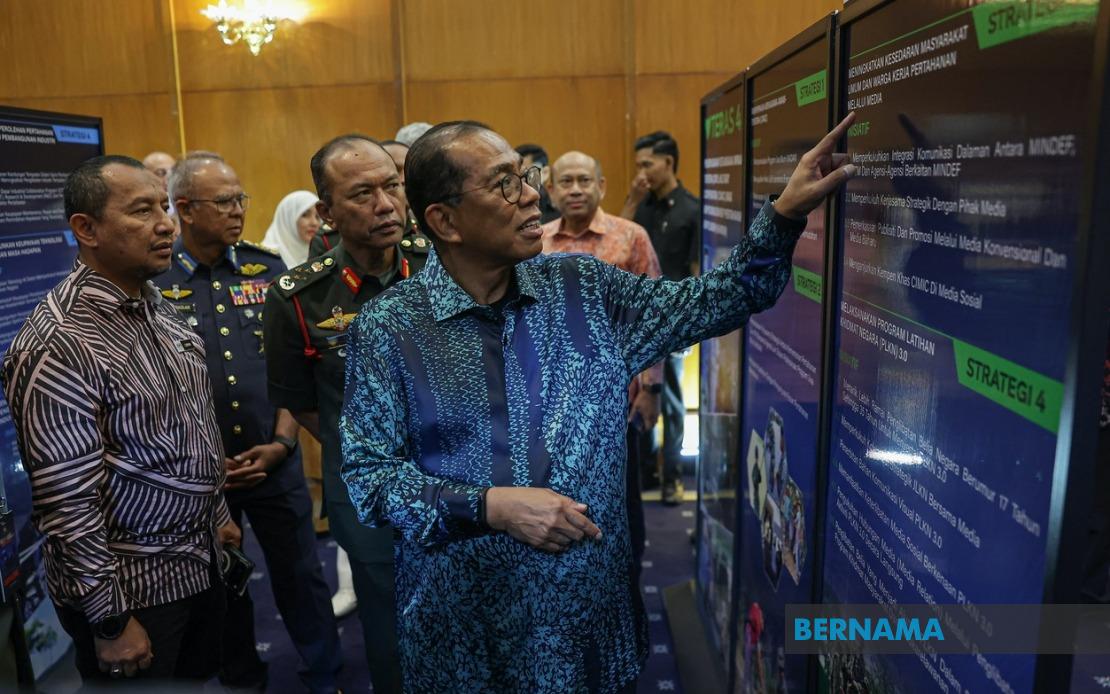
Malaysia's Defence Ministry has taken a significant step to fortify the nation's security posture by introducing two critical planning documents designed to guide defence policy and military development over the next five years. Defence Minister Datuk Seri Mohamed Khaled Nordin announced the launch of the National Defence Strategic Plan (PSPN) and the Defence Capacity Blueprint (RTKP) 2026-2030 at a ceremony in Kuala Lumpur on June 25, positioning these frameworks as essential tools for navigating an increasingly complex and uncertain security environment.
The timing of this strategic refresh reflects genuine regional and global concerns that extend beyond Malaysia's borders. The defence ministry's decision to develop these complementary documents stems from recognition that the existing Defence White Paper, while foundational, requires periodic adaptation to remain relevant. The minister emphasised that the world faces mounting geopolitical instability, rapid technological transformation particularly around artificial intelligence and automation, and a proliferation of non-traditional security threats that defy conventional military responses. These observations resonate throughout Southeast Asia, where nations grapple with maritime disputes, cyber-warfare capabilities, and transnational criminal networks.
The strategic planning process involved a comprehensive mid-term review of the Defence White Paper, during which officials identified gaps in Malaysia's current defence framework and areas requiring enhanced responsiveness. This analytical exercise produced the PSPN, which establishes seven foundational pillars guiding military and defence development. Among these pillars are the operational readiness of the Malaysian Armed Forces, systematic enhancement of defence technologies and capabilities, personnel welfare standards including provisions for veterans, and dedicated investment in defence innovation and technological advancement. This multi-faceted approach acknowledges that modern defence challenges cannot be addressed through hardware procurement alone.
Parallel to the PSPN's strategic direction, the Defence Capacity Blueprint serves a distinctly practical function. While the PSPN articulates the destination Malaysia's defence establishment seeks to reach, the RTKP addresses the means of reaching those objectives. The blueprint systematically examines and strengthens capacity across interconnected domains: financial resources and budgetary allocation, human capital development and recruitment, technological expertise and research capabilities, and inter-agency coordination mechanisms. This distinction between vision and execution reflects sophisticated planning that acknowledges the implementation gap plaguing many national strategies.
The minister articulated a particularly important principle embedded within both documents: defence is not exclusively a Defence Ministry responsibility but represents a whole-of-government and whole-of-society undertaking. This conceptual shift carries significant implications for Malaysian governance and public engagement with security matters. By framing national defence as a broader societal concern, the ministry implicitly calls for coordination across civilian government agencies, private sector participation in defence-related industries, academic institutions conducting security research, and informed public understanding of defence challenges. For Southeast Asia, where many nations compartmentalise security decisions within military establishments, this integrated approach could offer valuable lessons.
The Defence Capacity Blueprint's emphasis on financial resources addresses a perennial constraint for Malaysian defence planners. Sustaining military modernisation while managing competing budgetary priorities demands strategic resource allocation. By explicitly incorporating financing into the capacity framework, the ministry acknowledges that technological capabilities and personnel readiness ultimately depend on sustainable funding mechanisms and efficient expenditure management. This recognition may signal future defence budget requests grounded in detailed capacity assessments rather than incremental adjustments.
Human capital development represents another critical capacity component receiving explicit attention. Modern defence operations demand specialised expertise in cyber warfare, unmanned systems, intelligence analysis, and complex joint operations. The blueprint's focus on human capital, leadership development, and professional competencies reflects understanding that technological superiority depends fundamentally on personnel capable of operating, maintaining, and innovating around advanced systems. For Malaysian institutions involved in military education and professional development, these strategic priorities provide clear guidance for curriculum and training emphases.
The ministry's mention of recent equipment acquisitions and forthcoming deliveries provides concrete context for these strategic documents. The three ANKA Medium Altitude Long Endurance Unmanned Aircraft Systems received in March and now operational at Labuan Air Base represent precisely the type of defence technology advancement the strategic plan addresses. These surveillance and reconnaissance systems enhance Malaysia's ability to monitor maritime zones and monitor territorial integrity—capabilities increasingly essential in Southeast Asia's contested waters. The prospective arrival of FA-50M light combat aircraft, maritime patrol aircraft, and additional Littoral Mission Ships indicates that Malaysia is actively modernising across multiple defence domains.
For Malaysian policymakers and defence planners, the PSPN and RTKP represent more than bureaucratic planning documents. They constitute a strategic roadmap acknowledging that Malaysia must operate effectively within a regional and global security environment marked by rapid change and mounting complexity. The emphasis on adaptation, innovation, and inter-agency coordination suggests learning from both national experience and international best practices. The strategic acknowledgment of non-traditional threats alongside conventional military concerns reflects realistic assessment of twenty-first-century security challenges.
The regional implications of Malaysia's strategic defence planning deserve consideration. In Southeast Asia, where multiple nations face similar geopolitical pressures and technological disruption, Malaysia's integrated approach to defence capacity building may influence neighbouring countries' strategic thinking. The explicit linking of technology development, personnel welfare, and inter-agency coordination creates a model potentially adaptable to other ASEAN members addressing comparable security challenges. Furthermore, Malaysia's emphasis on the whole-of-society dimension of defence suggests increasing recognition throughout the region that security and prosperity remain interconnected national concerns demanding coherent, sustained governmental and societal commitment.
Implementation will ultimately determine whether the PSPN and RTKP achieve their intended strategic impact. The documents themselves represent intellectual capital and institutional commitment, but realising their objectives requires consistent resource allocation, effective inter-agency collaboration, and sustained political will across budget cycles. The Defence Ministry's articulation of clear strategic pillars and capacity requirements provides measurable benchmarks against which progress can be assessed. For Malaysia and the broader region, these planning documents signal serious engagement with the security challenges defining the contemporary strategic landscape.

