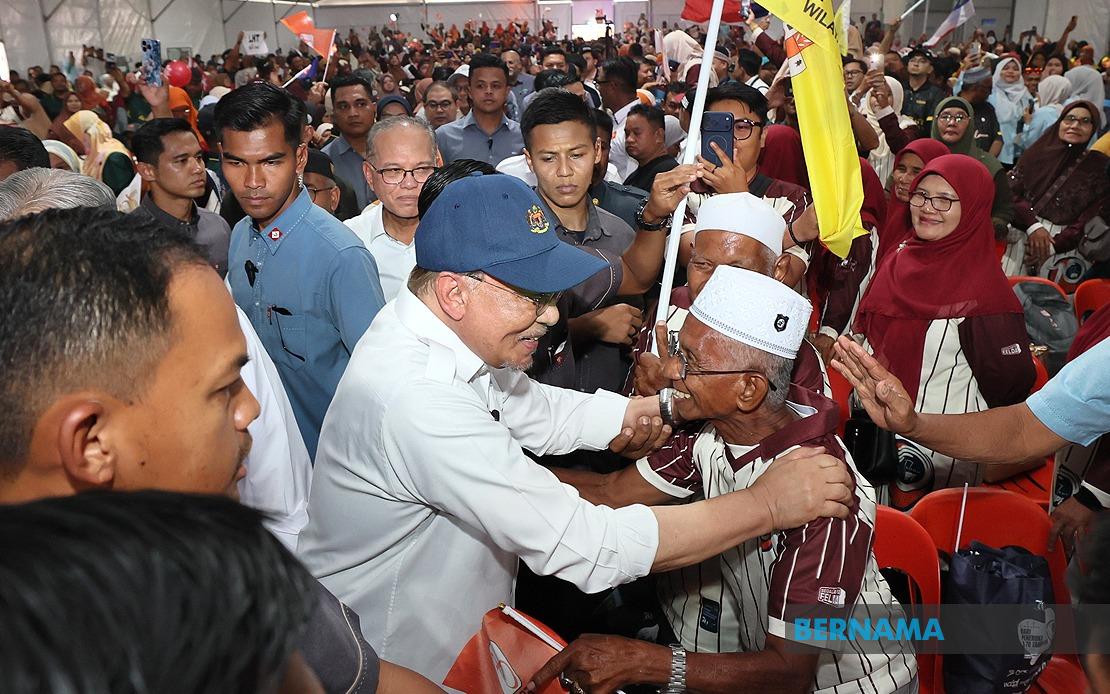
The Malaysian government has intensified its commitment to improving conditions within FELDA communities by rolling out a comprehensive development package worth more than RM29 million, underscoring a broader policy shift toward modernising rural agricultural settlements that have historically formed a significant pillar of the nation's agrarian economy. Prime Minister Datuk Seri Anwar Ibrahim unveiled these measures during celebrations marking both FELDA Settlers' Day and the Federal Land Development Authority's 70th anniversary at Tun Abdul Razak Stadium in Jengka, demonstrating that federal support for these longstanding communities remains a policy priority despite shifting economic landscapes.
The centrepiece of the initiative targets digital transformation across FELDA settlements, with RM15.85 million allocated to enhance digital literacy capabilities among residents in 317 eligible FELDA communities. This investment acknowledges a critical gap in technological adoption within many rural FELDA areas, where digital skills remain unevenly distributed and younger generations face competitive disadvantages in increasingly digitalised employment markets. By systematically expanding digital competency, the government aims to unlock economic opportunities for FELDA residents while positioning these communities as participants in Malaysia's broader digital economy ambitions.
Complementing the technology focus, the government has committed RM10 million toward rehabilitating 370 primary and secondary schools situated within FELDA areas, addressing longstanding infrastructure deficiencies that have constrained educational quality in these settlements. Educational facilities in many FELDA regions have deteriorated over decades due to deferred maintenance budgets, and this targeted investment signals recognition that educational infrastructure forms the foundation for intergenerational advancement. The school repair initiative carries particular significance for younger FELDA residents seeking to improve academic outcomes and broaden their future prospects beyond traditional agricultural livelihoods.
Healthcare access, another persistent challenge in rural FELDA communities, receives attention through an additional RM3 million allocation to support FELDA MAYA Squad healthcare teams. These mobile or semi-mobile healthcare units extend medical services to dispersed settler populations who often experience geographic barriers to accessing conventional health facilities. Strengthening these teams addresses chronic health service gaps that disproportionately affect elderly FELDA settlers and their families, many of whom have spent decades contributing to agricultural production in remote areas.
Milah Yoot, a 73-year-old FELDA Chemplak settler in Segamat, Johor, who recently received the 2025 Outstanding Woman Settler Award, articulated a perspective widely shared among elder FELDA residents regarding the legitimacy of government support. Speaking during the anniversary celebrations, she emphasised that current policy initiatives represent tangible recognition of settlers' decades-long contribution to Malaysia's agricultural development, while stressing the responsibility of younger FELDA generations to leverage these opportunities for self-advancement. Her comments reflect broader sentiment within FELDA communities that government backing acknowledges a social contract underpinning the relationship between the state and settlement populations.
Younger FELDA residents express cautious optimism about these initiatives, recognising their potential to create pathways for remaining within their communities while improving living standards. Haron Sulaiman, a 66-year-old FELDA Jerangau Barat settler in Ajil, Terengganu, specifically highlighted how digital literacy programmes could catalyse economic dynamism among FELDA youth, enabling them to pursue income-generating activities beyond conventional palm oil cultivation. His perspective underscores recognition that contemporary FELDA challenges require multifaceted responses extending far beyond traditional agricultural support.
A particularly significant dimension of the package involves proposed legislative amendments to the Land (Group Settlement Areas) Act 1960, which would allow FELDA settlers to construct multiple housing units on single residential lots they own. Muhammad Farizul Hafiz Awang, a 36-year-old FELDA Panching Utara resident in Kuantan, identified housing access as a fundamental constraint limiting younger FELDA generations' ability to establish independent households and build permanent roots within their settlements. Current legislation restricting housing development on individual plots has effectively locked younger residents into dependency relationships and prevented wealth accumulation through property development, thereby constraining intergenerational mobility.
The proposed legislative reform carries profound implications for FELDA settlement demographics and economic structures. By enabling multiple housing units per lot, the government would facilitate younger settlers' capacity to construct homes for expanding families, potentially reverse rural-to-urban migration among FELDA youth, and create opportunities for rental income or property-based entrepreneurship. This regulatory adjustment recognises that rigid colonial-era planning frameworks, while appropriate when FELDA first began operations, have become obstacles to contemporary settlement development and must adapt to changing socioeconomic realities.
These cumulative initiatives reflect a strategic recalibration of FELDA policy toward addressing structural disadvantages that have accumulated across the organisation's seven decades of operation. Whereas earlier FELDA programming emphasised production maximisation and commodity cultivation, contemporary policy increasingly acknowledges that settler welfare, intergenerational opportunity, and community modernisation require diversified interventions spanning technology, education, healthcare, and housing. This conceptual shift aligns FELDA development philosophy with broader Malaysian policy recognition that sustainable rural prosperity demands comprehensive community investment rather than narrow sectoral focus.
The initiatives announced during the 70th anniversary celebrations also carry symbolic significance within Malaysia's political economy. FELDA settlements have historically represented flagship examples of government-directed rural development and social mobility, providing pathways for landless farmers to acquire productive assets and build stable livelihoods. Contemporary challenges to FELDA—including volatile commodity prices, environmental pressures on palm cultivation, and youth out-migration—necessitate policy evolution demonstrating sustained government commitment to these communities despite external headwinds. The anniversary package communicates that FELDA remains integral to national rural policy rather than a legacy institution awaiting gradual obsolescence.
For Malaysian readers observing FELDA developments, these initiatives merit attention as indicators of broader government approaches to rural welfare and agricultural community support. As Malaysia navigates economic transformation and sustainability imperatives, FELDA communities occupy a distinctive position requiring policy attention that balances historical obligations to settler populations with forward-looking economic diversification. The combination of digital literacy investment, educational infrastructure rehabilitation, healthcare support, and housing reform demonstrates recognition that sustainable FELDA futures depend on multidimensional development strategies acknowledging both contemporary resident aspirations and community-specific challenges that generic national policies may overlook.

