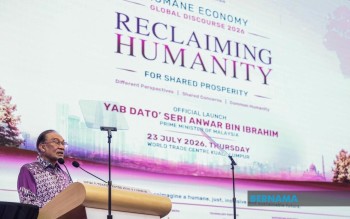
Malaysia's government is preparing to commence work on Budget 2027 during August, with the spending blueprint scheduled for presentation to parliament in early October, Prime Minister Datuk Seri Anwar Ibrahim announced today. Speaking as both premier and Finance Minister at the Humane Economy Global Discourse in Kuala Lumpur, Anwar outlined the administration's intention to develop the next major fiscal framework with considerable lead time ahead of its formal introduction.
At the heart of the government's budgetary philosophy lies a fundamental reorientation of how economic success should be measured and pursued. Anwar rejected the notion that economic performance should be evaluated purely through headline growth statistics or consumption volumes, arguing instead that the true purpose of fiscal policy must centre on elevating the material circumstances and wellbeing of ordinary Malaysians. This conceptual shift carries significant implications for how government spending priorities will be allocated and evaluated across sectors ranging from healthcare to housing and employment.
The Prime Minister articulated a vision where economic activity serves as a vehicle for human advancement rather than an end in itself. He contended that prosperity divorced from improvements in how citizens live—their wages, job satisfaction, access to shelter, health services, and educational opportunities—represents a hollow achievement. This framing suggests that Budget 2027 will likely emphasize distributional outcomes and quality-of-life metrics alongside conventional economic indicators, potentially reshaping ministerial spending proposals and departmental performance assessments.
Anwar identified several crucial tests that policymakers should apply when evaluating major fiscal decisions. Each initiative, he suggested, warrants examination of whether it expands or restricts economic opportunity, whether it fortifies or destabilizes family units and social cohesion, and critically, whether it regards citizens as active participants in national development or merely as labour inputs for wealth generation. These principles suggest the upcoming budget may feature enhanced scrutiny of policies affecting employment conditions, entrepreneurship access, and community resilience.
The government's budgetary framework, according to the Prime Minister, cannot function in isolation from broader policy architecture. Budget 2027 will interact with ongoing initiatives in semiconductor manufacturing, energy transition strategies, and digital infrastructure development. This integrated approach underscores recognition that fiscal allocations must align coherently with industrial development priorities and technological advancement trajectories to yield meaningful results for citizens.
The administration is also signalling that the moral dimension of governance warrants equal consideration alongside economic metrics when formulating spending proposals. Anwar's remarks indicate that Budget 2027 deliberations will incorporate ethical reasoning about how public resources should be distributed and whether policies serve dignified living conditions, personal security, and purposeful engagement in civic and economic life. This philosophical framework may influence ministerial budgetary requests and inter-departmental resource allocation negotiations during the formulation process.
Equally significant is Anwar's assertion that genuine prosperity must manifest in tangible household improvements. Elevated wages and employment quality, affordable housing options, accessible healthcare systems, world-class education provision, and authentic pathways for social advancement represent the concrete outcomes against which budget success should ultimately be judged. This emphasis suggests departments managing these portfolios may receive sympathetic consideration during budget negotiations, with ministers expected to justify spending through demonstrable impacts on these outcomes.
The Prime Minister further connected budgetary philosophy to environmental and intergenerational responsibility. Sustainability in the government's lexicon means avoiding the transfer of ecological, fiscal, or social liabilities to future generations, suggesting Budget 2027 may incorporate enhanced mechanisms for assessing long-term consequences of spending decisions. Whether allocating resources to renewable energy, infrastructure resilience, or environmental remediation, departments will need to demonstrate how their proposals contribute to intergenerational equity.
Innovation too, in Anwar's formulation, requires purpose beyond technological advancement for its own sake. He contended that innovation should broaden human capacity and expand capabilities across society rather than deepening inequality or concentrating benefits among narrow segments. This framework implies that Budget 2027 might feature enhanced support for innovation initiatives demonstrating inclusive growth characteristics, particularly in areas serving smaller enterprises, rural communities, and disadvantaged populations.
The August commencement of budget formulation provides ample time for inter-ministerial consultation and for economic agencies to incorporate latest forecasting data and policy adjustments into their proposals. The early October tabling allows parliament adequate time for committee review before the standard budget season culminates in December passage, maintaining Malaysia's established fiscal calendar while accommodating thorough legislative scrutiny.
For Malaysian citizens and businesses, the philosophical orientation outlined by the Prime Minister signals that Budget 2027 will emphasize tangible improvements in household purchasing power, employment quality, and access to essential services over aggregate growth targets. Regional investors and observers will likely monitor whether the government's stated principles translate into concrete allocational shifts when departmental proposals are compiled and prioritized during the formulation phase over the coming weeks.

