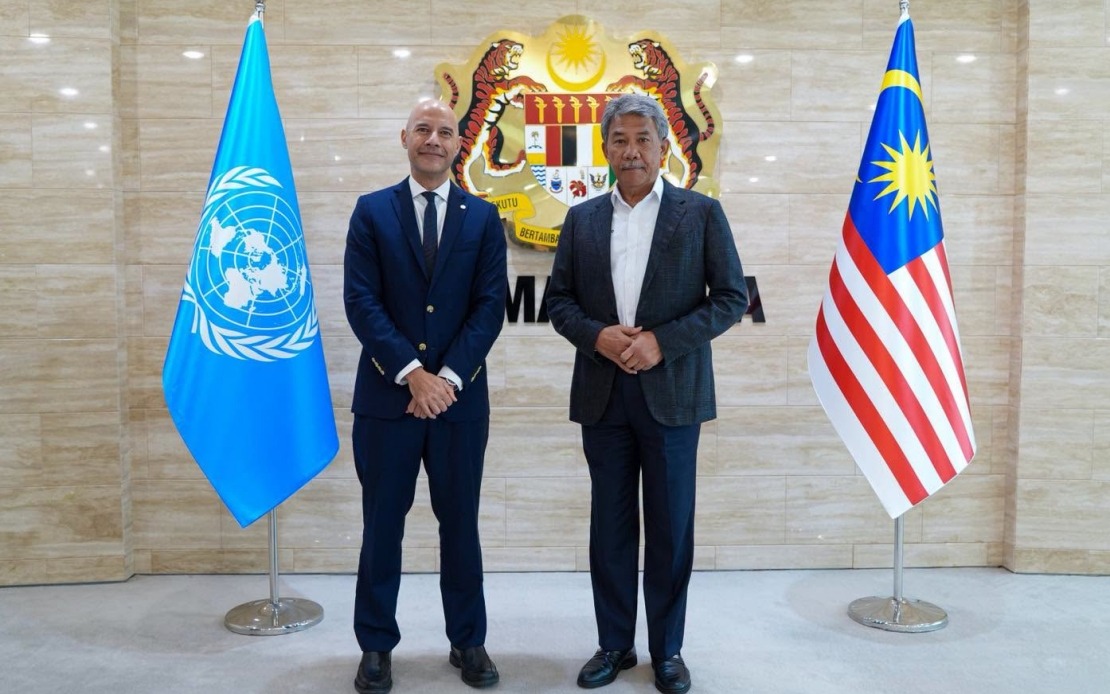
Foreign Minister Datuk Seri Mohamad Hasan received United Nations Resident Coordinator Nikolas Myint at the Foreign Ministry headquarters in Kuala Lumpur on Wednesday, signalling Malaysia's continued engagement with the global multilateral system. The courtesy call, held at Wisma Putra, represents a routine but symbolically important diplomatic exchange as Myint settles into his expanded regional role covering three Southeast Asian nations.
Myint, who was appointed by UN Secretary-General António Guterres on May 31, 2026, carries responsibility for coordinating United Nations operations across Malaysia, Singapore and Brunei. This tri-nation remit underscores the United Nations' desire to streamline its administrative footprint in Southeast Asia while maintaining substantive engagement with some of the region's most developed economies. The appointment of a single coordinator for multiple countries reflects both operational efficiency and the UN's recognition of these nations' interconnected challenges and shared development priorities.
During their discussion, both sides explored avenues for deepening cooperation between Malaysia and the United Nations system, covering areas aligned with the country's broader development agenda. Mohamad's public remarks highlighted Malaysia's appreciation for the UN's work in tackling multifaceted global issues, from climate change and sustainable development to humanitarian crises and peacekeeping operations. For Malaysia, which has long positioned itself as a bridge between developed and developing nations, such engagement remains crucial to advancing its interests within international forums.
The Foreign Minister emphasised that Malaysia intends to maintain close working relationships with Myint's office and with individual UN agencies operating on Malaysian soil. This commitment reflects the practical reality that numerous UN bodies—including programmes focused on development, humanitarian affairs, environment and human rights—maintain active presences in Malaysia. Effective coordination between these agencies and Malaysia's government ministries ensures that international initiatives align with national priorities and that resources are deployed efficiently to address shared concerns.
For Malaysian stakeholders, the strength of bilateral UN relations carries tangible implications. UN agencies support implementation of the Sustainable Development Goals across sectors including healthcare, education, poverty reduction and environmental protection. A well-functioning partnership ensures that these initiatives complement rather than duplicate government efforts and that funding mechanisms are accessible to Malaysian organisations. The Foreign Ministry's formal acknowledgement of Myint's appointment and its public commitment to collaboration signals that Kuala Lumpur views this relationship as a priority.
The timing of this meeting also reflects broader regional dynamics. Southeast Asia faces mounting pressures from geopolitical tensions, climate-related disasters, irregular migration and transnational crime. The United Nations, through its various agencies and programmes, plays a coordinating role in addressing these challenges across borders. By engaging proactively with the UN Resident Coordinator, Malaysia positions itself to influence how international resources and expertise are mobilised to address regional problems that affect Malaysian citizens and the wider Southeast Asian community.
Myint's appointment to oversee Malaysia, Singapore and Brunei suggests the UN's confidence in his ability to manage complex relationships with governments that have different political systems, economic models and international orientations. Singapore's role as a major financial hub and entrepôt, Brunei's energy wealth, and Malaysia's size and regional influence create a diverse portfolio requiring diplomatic skill and nuanced understanding. The successful coordination of UN operations across these three nations will require balancing their distinct priorities while identifying areas of common interest, particularly on transnational issues like maritime security, pandemic preparedness and climate adaptation.
From Malaysia's perspective, maintaining productive ties with the UN system provides several strategic advantages. First, it ensures Malaysian voices are heard in global policy discussions affecting Southeast Asia. Second, it facilitates access to technical expertise and best practices in governance, development and humanitarian response. Third, it creates opportunities for Malaysian organisations—both governmental and non-governmental—to participate in UN-supported projects and programmes. Fourth, it reinforces Malaysia's credibility as a responsible UN member state committed to international cooperation and the multilateral rules-based order.
The courtesy call also occurs against a backdrop of Malaysia's varied engagements with UN mechanisms. Malaysia has served on the UN Security Council, participates actively in the General Assembly, contributes to UN peacekeeping operations and hosts regional offices of numerous UN bodies. Malaysian civil society also engages extensively with the UN system through accreditation to major conferences and participation in advocacy networks. A well-resourced and effective UN Resident Coordinator can amplify these connections and ensure coherent UN engagement with Malaysia across all levels.
Looking forward, the relationship between Malaysia and Nikolas Myint's office will likely focus on several substantive areas. Climate action and environmental protection align with Malaysia's stated development priorities and the UN's Sustainable Development Goals. Social development indicators, including health, education and poverty reduction, remain crucial for Malaysia's progress towards upper-middle-income and eventually high-income status. Disaster risk reduction and climate resilience have become increasingly urgent given Southeast Asia's vulnerability to typhoons, floods and other climate-related hazards. Additionally, the UN's role in promoting human rights, rule of law and good governance provides frameworks within which Malaysia continues to calibrate its international positioning.
The Foreign Minister's public statement reflects a measured and professionally diplomatic tone appropriate to Malaysia's role as a middle power navigating complex international relationships. By framing the partnership as mutually beneficial and connected to national development aspirations, Mohamad situated the UN engagement within Malaysia's broader strategic narrative. This approach allows Malaysia to derive practical benefits from UN cooperation while maintaining the independence and agency that comes with middle-power status in international affairs.

