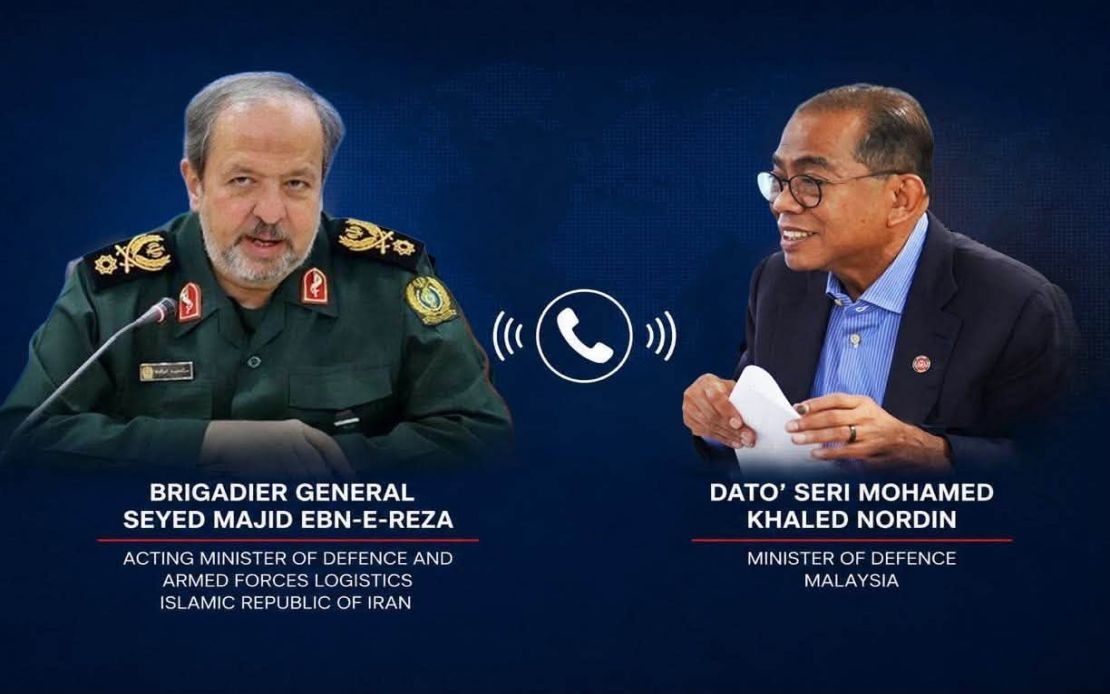
Malaysia has signalled a commitment to broadening its defence partnership with Iran, moving beyond rhetoric towards concrete institutional arrangements. Defence Minister Datuk Seri Mohamed Khaled Nordin conveyed this intention during discussions with Iran's Acting Minister of Defence and Armed Forces Logistics, Brigadier General Seyed Majid Ebn-e-Reza, underscoring the two nations' intention to translate their long-standing diplomatic relations into more tangible military cooperation.
The cornerstone of Malaysia's proposed expansion is a Memorandum of Understanding on defence cooperation, which Kuala Lumpur hopes to finalise in the coming months. Such an instrument would provide a formal framework governing bilateral defence exchanges, technology sharing, and coordinated military operations. The MoU reflects a strategic shift in Malaysia's approach to Iran, treating the relationship as more than episodic diplomatic engagement and instead embedding it within structured institutional channels that typically characterise defence partnerships between aligned nations.
A significant dimension of Malaysia's outreach involves extending an invitation to Iran to participate in the Langkawi International Maritime and Aerospace Exhibition next year. LIMA represents one of Southeast Asia's premier defence and aerospace showcases, attracting global military delegations and defence contractors. Iranian participation would provide Tehran with a regional platform to demonstrate its indigenous defence technologies while offering Malaysian defence establishments and industries direct exposure to Iranian military innovations. For Malaysia, the exhibition functions as a multilateral engagement tool that can facilitate broader defence networking while maintaining plausible deniability regarding exclusive bilateral military alignment.
The timing of these initiatives reflects Malaysia's navigation of complex geopolitical pressures in the Middle East. While maintaining its position as a moderating voice in international forums, Malaysia has acknowledged the humanitarian costs of ongoing regional conflicts. Defence Minister Mohamed Khaled conveyed condolences to Iran over casualties among military personnel and civilians affected by West Asian instability, demonstrating Malaysia's awareness of the human dimensions underlying the region's security challenges. This expression of sympathy extends beyond formulaic diplomacy, suggesting genuine concern for conflict amelioration.
Simultaneously, Malaysia has positioned itself as an advocate for peaceful resolution mechanisms in the Middle East. The Defence Minister explicitly championed the continuation of dialogue and diplomatic channels as the preferred pathway towards regional stability, rather than military escalation. This positioning aligns Malaysia with its historical foreign policy orientation of supporting multilateral diplomacy and mediation efforts, even while deepening bilateral defence relationships with individual Middle Eastern actors.
Maritine security features prominently in Malaysia's defence calculations regarding Iran, particularly concerning the strategic Strait of Hormuz. Through which roughly one-third of global seaborne oil trade transits, the strait remains critical to regional and global economic stability. Malaysia has credited Iran with maintaining secure passage and demonstrating restraint during periods of heightened tension. The Defence Minister's specific commendation of Iranian cooperation in facilitating maritime transit indicates that Malaysia views Iran as a stabilising force capable of protecting international waterways despite broader regional turbulence. This recognition carries particular weight given Malaysia's own significant maritime interests and its dependence on unobstructed sea lanes for trade and energy security.
Iran's independent defence industrial capabilities have earned Malaysian appreciation, with the Defence Minister specifically highlighting Tehran's technological self-sufficiency and resilience. Rather than characterising Iran as a dependent actor requiring external security guarantees, Malaysia acknowledges Iran's capacity for autonomous defence development. This acknowledgment suggests Malaysia views the prospective partnership not as patron-client relationship but as engagement between equals possessing distinct capabilities that could complement each other in regional security architecture.
From a Southeast Asian perspective, Malaysia's overture towards Iran reflects the region's broader pragmatism in managing great power competition and Middle Eastern instability. Unlike Western powers that have maintained adversarial postures towards Tehran, or gulf states locked in direct rivalry with Iran, Malaysia operates from geographic distance and strategic autonomy. This positioning permits Malaysia to engage Iran on its own terms without the historical baggage or immediate security threats that constrain other regional actors. The defence cooperation initiative thus represents Malaysia leveraging its diplomatic flexibility and non-aligned status to cultivate relationships across diverse regional actors.
The proposed defence framework also carries implications for Malaysia's role within the Association of Southeast Asian Nations and broader Asian security architecture. ASEAN's official doctrine of remaining neutral in external conflicts creates space for individual members to pursue bilateral relationships. Malaysia's Iran engagement, however, must be calibrated carefully to avoid perceptions that it compromises ASEAN consensus or suggests unequal commitment to the regional bloc's collective security interests. The emphasis on maritime security and commercial passage protection helps frame the cooperation in terms of shared stability interests rather than ideological or military-strategic alignment.
Looking forward, the success of Malaysia's defence cooperation initiative with Iran depends substantially on international circumstances and the trajectory of Middle Eastern tensions. Should regional conflicts escalate dramatically, Malaysia's defence relationships could face pressure from Western allies and gulf state partners concerned about perceived Iranian alignment. Conversely, if regional tensions stabilise and diplomatic solutions advance, Malaysia's proactive engagement with Iran could position the country advantageously as a credible interlocutor between different regional factions. The formalisation of defence cooperation through an MoU signals Malaysia's conviction that such engagement serves Malaysia's long-term strategic interests despite near-term diplomatic sensitivities.

