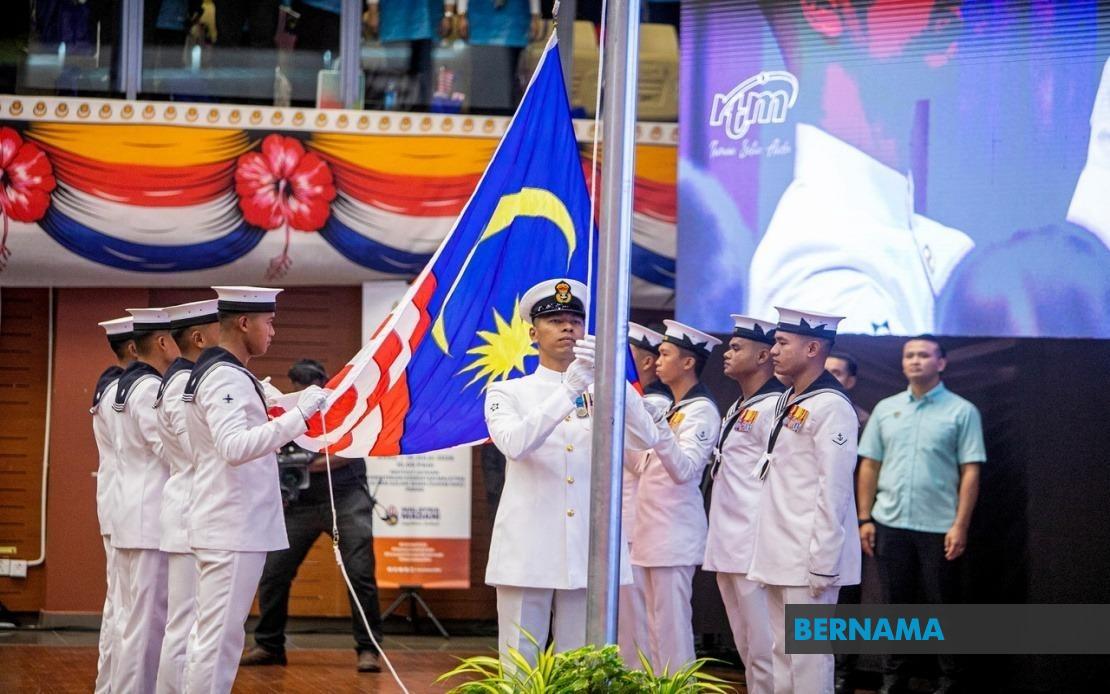
The Jalur Gemilang raising ceremony has made its ceremonial return, marking a significant moment for Malaysia's patriotic calendar as Prime Minister Datuk Seri Anwar Ibrahim presided over the official launch of the 2026 National Month and Fly the Jalur Gemilang campaign in Ipoh today. The revival of this iconic ritual, which had been absent for the past two years, underscores the government's renewed emphasis on national unity and civic pride during a period when Malaysia approaches its independence celebrations.
The event took place at the Sultan Azlan Shah Ministry of Health Training Institute in Tanjung Rambutan, creating a formal setting that blended institutional authority with patriotic symbolism. By situating the ceremony within a health ministry training facility, organisers integrated the flag-raising with a workforce development context, suggesting that national pride extends into professional spheres and institutional identity. This choice of venue reflects a broader contemporary approach to nationalism in Malaysia, where patriotic gestures are woven into everyday institutional functions rather than confined to ceremonial spaces alone.
During the proceedings, Prime Minister Anwar officially inaugurated the nationwide campaign before ceremonially transferring the Jalur Gemilang to a nine-member Royal Malaysian Navy contingent from Lumut Base, led by Chief Petty Officer Mohamad Razif Aliff Md Yusof. This symbolic handover carried particular significance, as it positioned the military as custodians and ambassadors of national identity during the campaign period. The gesture of passing the flag to uniformed personnel carries deep resonance in Malaysian political culture, where the armed forces have historically occupied a central role in national symbol management and civic ceremonies.
The flag itself, measuring 1.82 metres by 3.65 metres, was hoisted with full ceremonial accompaniment as attendees sang Negaraku, the national anthem. The synchronisation of the flag's ascent with the anthem created a multisensory patriotic experience, engaging both visual and auditory dimensions of national symbolism. For Malaysian audiences familiar with such ceremonies, this combination represents the core ritual vocabulary through which the nation affirms its collective identity and cohesion.
The ceremony incorporated additional patriotic elements designed to deepen emotional and philosophical investment in national values. Muhammad Ammar Mohd Asri, a trainee at the institute, recited the Rukun Negara pledge, embedding constitutional principles directly into the ceremonial framework. This inclusion of a young citizen in a formal governmental ceremony serves to transmit patriotic values across generational lines, positioning the next generation as active participants rather than passive observers in Malaysia's national project.
The Fly the Jalur Gemilang campaign itself represents an annual institutional effort to encourage widespread display of Malaysia's national flag as a tangible expression of patriotism and unity. The campaign addresses a practical reality in Malaysian public life: the visibility of national symbols in domestic spaces often fluctuates, and organised campaigns attempt to sustain and regularise this symbolic presence. By framing flag-flying as a deliberate campaign rather than an organic cultural practice, authorities acknowledge that maintaining national symbolic saturation requires sustained institutional effort.
A notable cultural addition to this year's National Month celebrations is the official theme song, "Aku Berjanji," composed and performed by established Malaysian artist Faizal Tahir. The song became available for public download through the Merdeka360 portal from 12.30 pm onward, making it immediately accessible to citizens wishing to engage with the campaign's cultural dimension. The creation of dedicated theme music for national celebrations reflects Malaysia's approach to patriotic expression, where popular culture and government messaging intersect to reach broader audiences than formal ceremonies alone.
The National Month celebrations themselves will unfold across multiple weeks, building momentum toward dual culminating events on August 31 and September 16, when Malaysians commemorate National Day and Malaysia Day respectively. This extended campaign period contrasts with singular celebratory moments, instead constructing an arc of patriotic intensity that gradually intensifies as these dates approach. For Malaysian citizens, particularly schoolchildren, this prolonged engagement with national symbolism structures the emotional and cognitive landscape of late summer.
The decision to revive the Jalur Gemilang raising ceremony after a two-year absence carries implications beyond ceremonial restoration. The hiatus itself, likely attributable to pandemic-related restrictions, represented a break in continuity for an established ritual practice. The ceremony's return signals governmental determination to restore normal patriotic rhythms and reassert the visibility of state-sanctioned national symbolism in public consciousness. This reinstatement occurs within a broader Malaysian context where political contestation over national symbols, historical narratives, and the proper expression of patriotism remains an active element of public discourse.
For Southeast Asian observers, Malaysia's deliberate cultivation of national patriotic campaigns reflects wider regional trends in which governments employ symbolic nationalism to reinforce social cohesion amid economic pressures and political fragmentation. The integration of military participation, youth involvement, popular music, and distributed digital access demonstrates a sophisticated multimedia approach to patriotic messaging. This strategy acknowledges that modern citizens engage with nationalism through multiple simultaneous channels rather than through formal ceremonies alone.
The campaign's emphasis on flag display carries particular meaning in Malaysia's specific context, where diverse citizen communities with varying historical relationships to national symbols must collectively affirm belonging to the same political entity. By encouraging widespread Jalur Gemilang visibility, the campaign creates a visual commons of patriotic expression, making national identity materially present in neighbourhoods, buildings, and public spaces where Malaysian citizens routinely move. This spatial dimension of patriotism transforms abstract concepts of national unity into concrete, visible phenomena that shape daily experience.
Looking ahead to the August and September celebrations, Malaysian institutions across governmental, educational, and private sectors will likely escalate their own patriotic programming in response to the campaign's launch. The revived ceremony in Ipoh serves as a catalyst and authoritative signal that National Month celebrations warrant serious institutional commitment. For Malaysia's citizenry, this extended period offers multiple occasions to reaffirm collective identity and express emotional investment in the nation's continued unity and prosperity.

