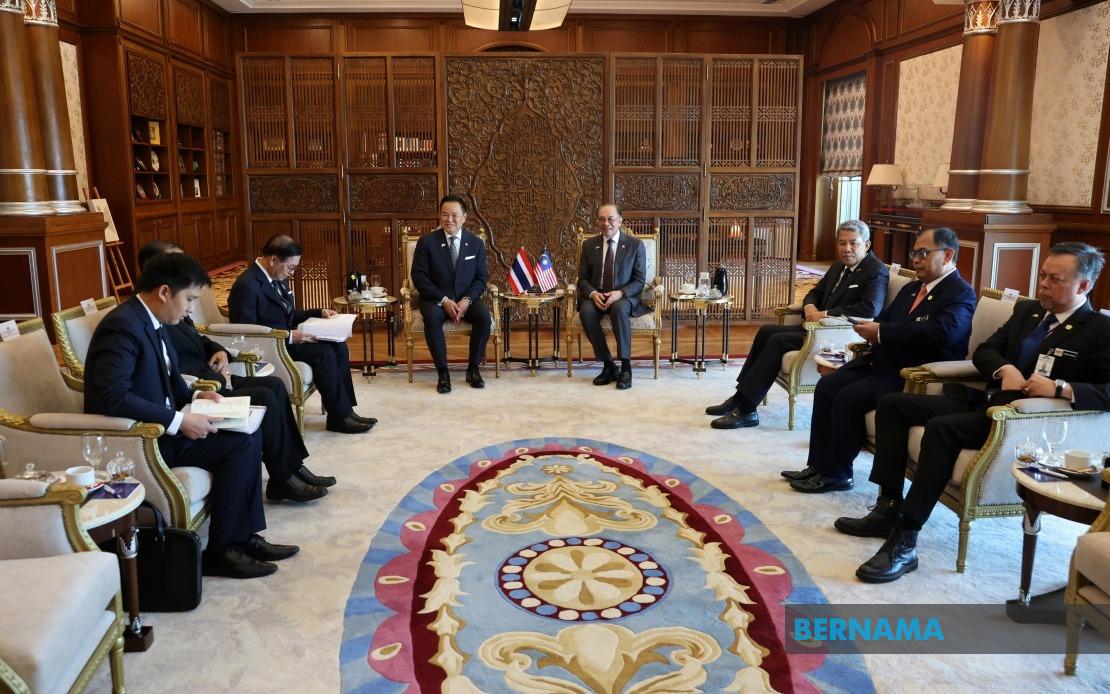
Malaysia has doubled down on its preference for diplomatic solutions to the Myanmar crisis, with Prime Minister Datuk Seri Anwar Ibrahim spotlighting Thailand's potential to broker meaningful progress on the issue that has preoccupied ASEAN since the 2021 military coup. Speaking alongside visiting Thai Prime Minister Anutin Charnvirakul at a joint media appearance in Putrajaya on Thursday, Anwar underscored that Malaysia sees dialogue and engagement as the only viable pathway to defuse tensions in the neighbouring country, while emphasising that the Myanmar people themselves must retain agency over their nation's trajectory.
The timing of Anutin's visit—his first bilateral trip to Malaysia following his reappointment in March 2026—reflects the deepening coordination between Kuala Lumpur and Bangkok on pressing regional matters. Beyond the ceremonial elements, the talks signalled Malaysia's strategic thinking on how to leverage Thailand's unique position as Myanmar's immediate neighbour and trusted partner to unlock potential breakthroughs where other actors have made limited headway. For Malaysia, which chairs regional discussions regularly and maintains close ties across Southeast Asia, the ability to work through Thailand offers a pragmatic avenue to influence events without appearing to impose solutions from outside.
Anwar's public endorsement of Anutin's perspectives on Myanmar carries particular significance, suggesting an alignment between the two governments on fundamental principles. Malaysia's stated position—that resolution must come through engagement rather than isolation or pressure tactics—mirrors approaches that have gained traction in some ASEAN capitals, though consensus on Myanmar strategy remains elusive. By vocally appreciating Thailand's stance, Anwar essentially validated an approach that prioritises dialogue with all stakeholders, including the military junta, as opposed to blanket condemnation or sanctions that might entrench positions further.
The Myanmar situation has festered as ASEAN's most vexing challenge, with the bloc's Five-Point Consensus framework struggling to gain meaningful traction despite repeated reaffirmations of commitment. The framework calls for cessation of violence, dialogue, humanitarian assistance, and a visit by an ASEAN envoy—objectives that have proven difficult to operationalise given the junta's resistance and fragmentation among opposition forces. Malaysia's emphasis on allowing Myanmar's people to determine their own future reflects awareness that external mediation, however well-intentioned, ultimately requires buy-in from domestic actors with entrenched interests and competing visions for the country.
Thailand's centrality to any Myanmar resolution stems from geography and history. As the primary conduit for humanitarian flows, refugee movements, and cross-border commerce, Bangkok wields considerable informal leverage despite its own political complexities. Moreover, Thailand's experience navigating its own internal tensions makes it a somewhat credible interlocutor with Myanmar's military establishment, which views external interference with deep suspicion. By publicly elevating Thailand's role, Anwar signalled that Malaysia recognises this reality and is willing to work through Bangkok rather than attempting to catalyse change through larger multilateral pressure.
The bilateral visit also addressed a separate but related regional concern: the Thailand-Cambodia border disputes that periodically flare into diplomatic crises. Anwar's remarks about appreciating Thailand's commitment to maintaining peace suggested Malaysia views these territorial questions as interconnected with broader regional stability. A Thailand embroiled in escalating border tensions would have diminished capacity and political space to engage constructively on Myanmar. By publicly supporting Thai efforts at peaceful border management, Anwar reinforced Malaysia's interest in ensuring that no Southeast Asian power becomes distracted by localised conflicts from the larger project of collective problem-solving.
For Malaysian readers, the implications extend beyond diplomatic niceties. A Myanmar in perpetual crisis generates refugee flows that eventually reach Malaysian shores, disrupts trade patterns along essential routes, and creates security vacuums that non-state actors can exploit. Malaysia's role as an ASEAN anchor state means it has genuine stakes in Myanmar's trajectory and cannot remain passively uncommitted. By positioning Thailand as the key regional actor while Malaysia plays a supporting role, Anwar adopted a sensible division of labour—one that respects Thai capabilities while allowing Malaysia to maintain its broader diplomatic portfolio across the region without overextending itself.
The practical manifestation of Malaysia-Thailand cooperation materialised the following day, Friday July 10, when Anwar and Anutin jointly inaugurated a crucial cross-border infrastructure project: the opening of a road connecting Malaysia's Immigration, Customs, Quarantine and Security Complex in Bukit Kayu Hitam, Kedah, with Thailand's corresponding Customs, Immigration and Quarantine Complex in Sadao. This ceremony underscored that bilateral ties extend far beyond rhetorical alignment on regional crises to encompass concrete improvements in connectivity and trade facilitation. The symbolism of jointly opening a border crossing while discussing Myanmar and other regional challenges demonstrated that Malaysia-Thailand relations function across multiple registers simultaneously.
The infrastructure development carries economic resonance for both nations. Improved customs procedures and seamless transit reduce transaction costs for businesses, enhance competitiveness for regional supply chains, and generate employment around border zones. For Malaysia, which sits astride crucial Southeast Asian trading corridors, efficient border infrastructure directly translates to competitive advantage in attracting and retaining manufacturing and logistics operations. The joint ceremonial opening reinforced that Malaysia and Thailand view border areas not as barriers but as gateways, a refreshing perspective given historical tensions between these neighbouring economies.
Looking ahead, the success of Thailand's role in Myanmar mediation will largely depend on factors beyond Malaysia's or even Thailand's unilateral control. The junta's willingness to entertain dialogue, the opposition's capacity to present unified negotiating positions, and the broader geopolitical context—including interests of China and India—all shape feasibility. Yet Malaysia's reaffirmation that engagement remains preferable to isolation, coupled with explicit support for Thailand's intermediary efforts, establishes at least a diplomatic framework within which progress might eventually occur. For a region weary of conflict and economic disruption, that incremental repositioning towards dialogue holds modest but genuine significance.

