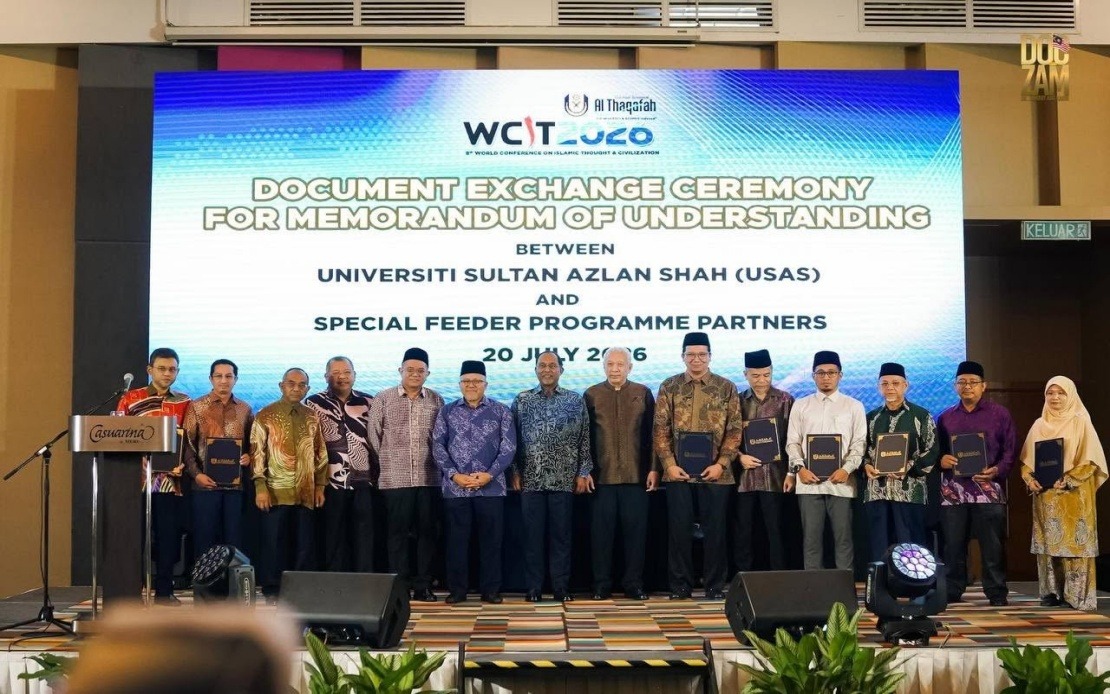
Malaysia is positioning itself as a vital platform for fostering international intellectual exchange and advancing higher education excellence, particularly within the Islamic world, according to Higher Education Minister Datuk Seri Dr Zambry Abdul Kadir. Speaking at an event linked to the 8th World Conference on Islamic Thought and Civilisation (WCIT2026), the minister emphasised the country's aspirations to function simultaneously as a bridge for dialogue, a centre of learning innovation, and a collaborative partner in constructing a knowledge ecosystem grounded in inclusivity, progress, and shared values.
The WCIT2026 conference, which commenced in Kuala Lumpur, represents a flagship gathering designed to convene researchers, intellectuals, and thinkers from numerous nations to exchange perspectives and establish transnational research networks. The event underscores Malaysia's strategic positioning in the broader Islamic world as a location capable of hosting substantive conversations on contemporary challenges facing both Muslim-majority societies and humanity at large. More than 180 delegates, scholars, and thought leaders attended the inaugural dinner, signalling strong international participation and interest in Malaysia as a venue for such dialogue.
In his remarks, Zambry articulated a vision for the Islamic ummah that departs from romanticising historical achievements and instead emphasises forward-looking development rooted in empirical knowledge, rigorous research, technological innovation, and principled governance. He contended that the strength of Islamic societies in the 21st century depends fundamentally on building competitive, world-class higher education institutions capable of producing original scholarship and solutions to global problems. This framing reflects Malaysia's own national strategy of positioning itself as a regional education hub and suggests the government views the WCIT2026 as an opportunity to demonstrate this commitment in practice.
A central theme of Zambry's address focused on the universal character of knowledge as a resource that transcends national, civilisational, and ideological boundaries. He articulated the principle that education should remain insulated from the distorting pressures of partisan politics, interstate conflict, and technological determinism. This stance carries particular resonance in Southeast Asia, where Malaysia operates within a diverse, multireligious context and has historically sought to position itself as a pluralist Islamic nation. The assertion that knowledge belongs to all humanity rather than to specific nations or belief systems suggests an effort to frame the conference's outcomes as having relevance beyond the Islamic sphere.
Zambry drew parallels to historical episodes of cultural destruction—the sacking of Baghdad, the fall of Granada during the Spanish Reconquista, the siege of Sarajevo, and the ongoing Palestinian conflict—to illustrate how the physical destruction of educational and cultural institutions represents not merely the loss of buildings but the erasure of civilisational futures. By invoking these examples, he positioned universities and libraries as repositories not just of accumulated knowledge but of a society's capacity to imagine and construct its own trajectory. This rhetorical move frames investment in higher education as an existential necessity for Islamic societies and aligns education policy with broader geopolitical and cultural concerns.
The three-day conference format suggests intensive programming designed to generate substantive outcomes. Zambry expressed hope that WCIT2026 would produce concrete resolutions and innovative proposals that contribute measurably to the advancement of the Islamic world and the broader international community. The emphasis on tangible deliverables—rather than mere symbolic gathering—indicates the Malaysian government views the conference as serving practical functions: catalysing collaborative research initiatives, identifying policy recommendations, and building institutional networks that can outlast the event itself.
For Malaysian stakeholders, the conference demonstrates the government's commitment to elevating the country's profile within Islamic intellectual circles and positioning Malaysian universities as credible venues for advanced research and dialogue. Universiti Sultan Azlan Shah (USAS), which helped organise the inaugural dinner, benefits from association with a significant international gathering. More broadly, Malaysia's role as conference host reflects its diplomatic strategy of maintaining relevance within Organisation of Islamic Cooperation networks while simultaneously maintaining its secular constitutional framework and multicultural society.
The timing and framing of the WCIT2026 also speaks to Malaysia's engagement with global discussions about civilisational dialogue, particularly in an era of heightened geopolitical tension between Western and Islamic-majority regions. By hosting a conference focused on Islamic thought addressing contemporary challenges, Malaysia positions itself as neither a Western nor an exclusively Islamic nation but rather as a neutral ground where intellectuals can engage substantively with universal problems. This aligns with Malaysia's longstanding foreign policy emphasis on non-alignment and bridge-building.
Zambry's emphasis on integrity-driven leadership within higher education institutions touches on a significant concern across the Islamic world regarding governance, institutional autonomy, and academic freedom. The reference to competitive higher education systems suggests Malaysia recognises that Islamic societies must not only generate knowledge but do so according to international standards of rigour and openness. This framing acknowledges that Islamic thought remains relevant to global intellectual discourse only insofar as it engages seriously with contemporary scholarship and methodologies rather than retreating into insular or nostalgic frameworks.
For regional policymakers and education sector stakeholders, Malaysia's commitment to hosting and advancing WCIT2026 signals an expectation that higher education will serve as a vehicle for addressing civilisational challenges. The conference provides a platform for Malaysian researchers and institutions to showcase their contributions to Islamic thought while simultaneously networking with leading scholars globally. Success in hosting and facilitating substantive outcomes could enhance Malaysia's standing as a knowledge economy and reinforce its attractiveness to international students and collaborative research partners.
The conference also reflects Malaysia's recognition that geopolitical influence increasingly depends on soft power dimensions including educational reputation, cultural production, and intellectual leadership. By positioning itself as a centre for Islamic thought and civilisational dialogue, Malaysia cultivates influence within the broader Muslim world while demonstrating to the international community its capacity to facilitate respectful, sophisticated engagement across religious and cultural lines. This multi-directional diplomacy has become characteristic of Malaysian statecraft in recent years.

