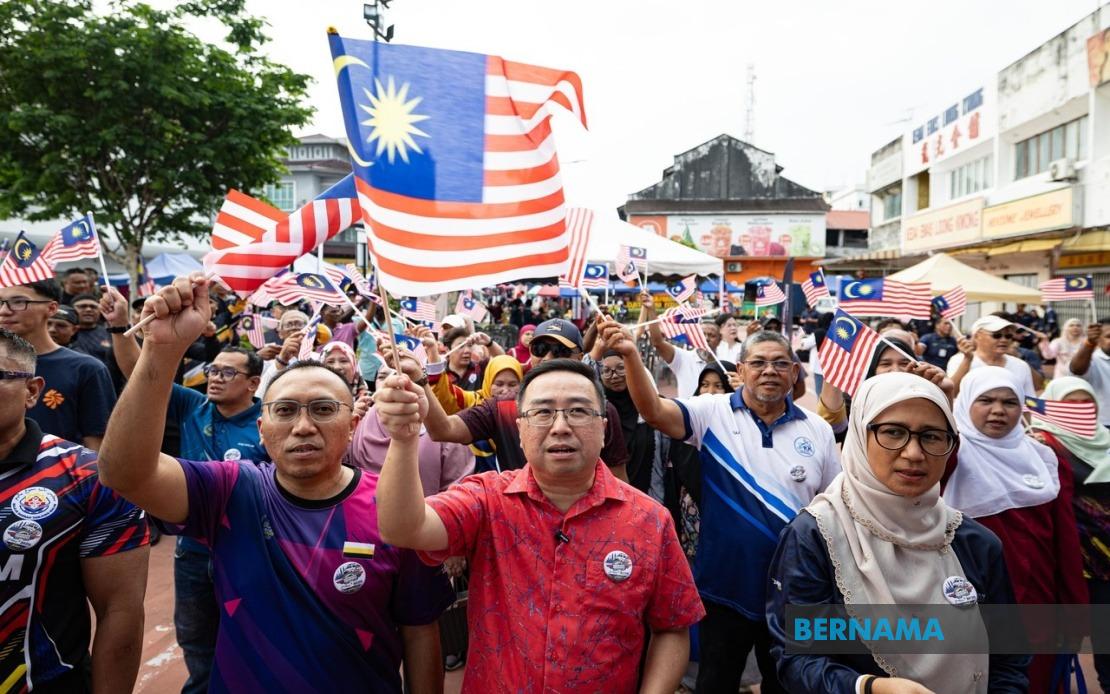
Malaysia's political culture must mature beyond the divisive framework of identity politics if the nation is to achieve lasting unity, according to Science, Technology and Innovation Minister Datuk Chang Lih Kang. Speaking on the eve of Malaysia's independence anniversary, Chang articulated a vision of nationhood grounded not in coercion or exclusion, but in shared belonging and genuine citizen investment in the country's trajectory. His intervention arrives at a moment of persistent polarisation, where public conversations increasingly fracture along communal and religious lines, raising questions about whether Malaysia's foundational pluralist principles remain workable in contemporary politics.
Chang's central argument rests on a stark observation: a genuinely strong and united Malaysia cannot be forged by silencing voices or weaponising fear. Instead, sustainable national cohesion demands institutional frameworks that operate with rigour, neutrality and equitable application. This means state institutions must deliver services and enforce law without regard to ethnicity, creed, party affiliation or socioeconomic standing. The minister frames such institutional integrity not as a technocratic nicety but as fundamental to whether citizens from diverse backgrounds perceive themselves as genuine stakeholders in Malaysia's future. Without this perception—without the lived experience of fair treatment across bureaucratic interactions—rhetorical appeals to unity ring hollow.
The instrumental deployment of race and religion for electoral mobilisation represents a particular concern for Chang. When political actors weaponise communal identity to consolidate support, they risk calcifying society into rival interest blocs, each convinced that competing groups capture disproportionate state resources. This zero-sum framing corrodes the social fabric by replacing civic identity with adversarial ethnic consciousness. Chang's warning reflects an underlying anxiety among governance reformers that Malaysia's plural society cannot indefinitely sustain this pattern without systemic fracture. The Southeast Asian context amplifies this concern: neighbouring democracies have experienced communal violence with devastating consequences, a cautionary reminder for Malaysian policymakers.
Good governance emerges as Chang's proposed bulwark against such descent. This formulation extends beyond conventional anti-corruption rhetoric. Rather, Chang positions institutional strength and professionalism as the primary defence against the divisive mobilisation of identity categories. When state institutions function impartially, they delegitimise arguments that political outcomes favour particular communities. When public services operate transparently according to established criteria, they undercut conspiratorial narratives about systemic discrimination. This perspective inverts conventional developmental thinking: good governance is not merely instrumental for economic efficiency, but foundational to social cohesion in plural societies.
Chang's remarks on patriotism and the national flag illustrate the granular implications of his philosophy. He advocates distinguishing between inadvertent errors and deliberate provocations, contending that excessive enforcement of flag protocols against good-faith mistakes erodes rather than reinforces patriotic sentiment. Citizens become apprehensive about expressing national pride, paradoxically dampening the civic sentiment authorities ostensibly seek to protect. The minister's framework emphasises proportionality: intent, context and circumstances should modulate official response. Education and guidance precede punishment for unintentional lapses, while malicious incitement remains appropriately serious. This calibration reflects a particular view of state authority—one exercised with restraint and wisdom rather than reflexive coercion.
The role of government agencies, in Chang's conception, transcends the arrest-and-punish paradigm. Instead, state actors should function as educators and guides within civil society, helping citizens understand national values rather than merely enforcing compliance. This reframing carries profound implications for how enforcement agencies—particularly those tasked with national security or religious matters—should calibrate their interventions. In Malaysia's context, where such agencies sometimes operate with minimal oversight, Chang's emphasis on proportional, educative approaches contrasts sharply with documented instances of heavy-handed enforcement. Whether institutional culture can accommodate this philosophical shift remains an open question.
Chang invokes Sultan Perak Sultan Nazrin Shah's pronouncements on Islamic thought to ground his argument in royal endorsement. The Sultan's distinction between unity forged through authentic shared belonging versus unity imposed through coercion parallels Chang's own framework. This rhetorical move—anchoring progressive governance arguments in traditional authority—may prove significant in Malaysian political discourse, where sultans carry substantial symbolic weight. It suggests that inclusive, proportionate governance need not be positioned as departing from traditional values but rather as their authentic expression. This framing potentially creates political space for reformers to advance institutional reforms without appearing to challenge monarchical or religious foundations.
The minister's vision privileges diversity as a source of national strength rather than a problem requiring management. Cultural, linguistic, religious and traditional heterogeneity should enrich rather than threaten national identity. This orientation demands substantive inclusion: minorities must possess genuine voice in national decisions, not mere token representation. It requires that policies reflect plural interests rather than privileging particular communities. Operationalising this vision—converting it from rhetorical aspiration into institutional practice—demands more than ministerial pronouncements; it requires sustained political commitment across government structures often resistant to pluralist reform.
Chang's question to Malaysians—what Malaysia are we creating for the next generation—redirects conversation from nostalgic recitation of patriotic sentiment toward forward-looking institutional evaluation. This temporal reorientation matters. It moves discussion beyond defensive postures or commemorative rhetoric toward generative questioning about the country's future trajectory. For young Malaysians, particularly those from minority communities, the answer depends substantially on whether institutions deliver impartial governance, whether political leaders resist identity mobilisation, and whether the state operates proportionately. Chang's intervention suggests that such future orientation increasingly animates governance discourse among senior Malaysian officials.
The cautionary edge of Chang's remarks—his warnings against excessive patriotic enforcement, against identity-based political mobilisation, against heavy-handed state intervention—implies diagnosis of existing pathologies within Malaysian governance. These are not abstract philosophical positions but responses to observable patterns of political behaviour and institutional practice. His call for maturity in understanding nationhood implicitly critiques current politics as immature, divisive and coercive. Whether such direct critique from a serving minister signals broader elite consensus on governance reform or represents an isolated reformist voice remains significant. The receptiveness of political leadership across the spectrum to these arguments will substantially determine whether Malaysian governance evolves toward the inclusive, proportionate model Chang envisions.
Sustaining unity in a diverse society ultimately depends on whether citizens believe the state treats them fairly and respects their dignity. Chang's framework—emphasising institutional impartiality, proportionate governance, educative rather than purely punitive authority, and diversity as national asset—aligns with established research on social cohesion in plural democracies. Whether Malaysia's political system can genuinely institutionalise these principles, particularly when elite interests may benefit from identity-based polarisation, poses the central challenge. Chang's articulation of this vision represents necessary but insufficient condition for its realisation; implementation requires sustained institutional reform and political commitment across Malaysian government.

