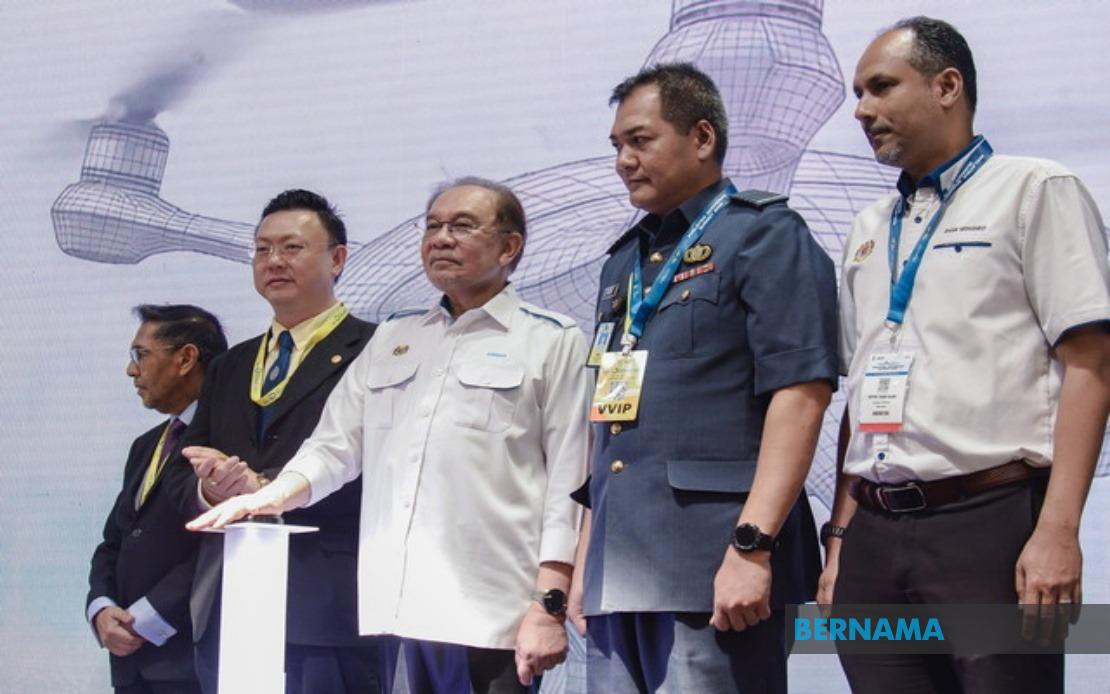
Prime Minister Datuk Seri Anwar Ibrahim has sounded an urgent call for Malaysia to prioritise the unmanned aerial vehicle sector as a cornerstone of future economic growth, signalling at the MyDrone Expo 2026 closing ceremony in Sepang that the nation risks falling behind without swift action on drone technologies and their supporting ecosystems.
Anwar emphasised that the UAV industry represents far more than a niche defence application—it functions as a convergence point between artificial intelligence, digital transformation, and practical economic opportunity. His remarks come at a pivotal moment when nations across the Asia-Pacific region are racing to establish dominance in emerging technology sectors that promise substantial returns in the coming decades.
The three-day MyDrone Expo 2026, jointly organised by the World UAV Federation Malaysia Chapter and the Malaysia UAV Development Association, demonstrated considerable industry momentum locally. The event attracted more than 100 exhibition booths and drew thousands of participants and delegates from 46 countries, indicating that Malaysia's drone ecosystem has already begun attracting international attention despite remaining underdeveloped compared to competitors like China, South Korea, and Singapore.
Globally, the stakes for Malaysia's competitiveness are considerable. The worldwide UAV market is projected to surpass USD55 billion by 2030, while the broader low-altitude economy—encompassing everything from aerial logistics to environmental monitoring—is increasingly driving investment and innovation across developed and developing nations alike. For a middle-income country seeking to upgrade its economic structure, such a trajectory represents a genuine opportunity window that may not remain open indefinitely.
Anwar's framing of drones within a broader digital economy context reflects understanding that isolated technological advances rarely drive sustained growth. Instead, success requires integrated ecosystems where regulatory certainty, funding mechanisms, research infrastructure, and skilled talent pools operate in concert. The Prime Minister has consequently directed Cabinet ministers, policymakers, research institutions, and relevant agencies to provide comprehensive regulatory and ecosystem support rather than token endorsements.
The government's stated policy approach spans multiple dimensions of industrial development. Beyond traditional defence and aerospace applications, the administration explicitly endorses civilian commercial uses including agricultural monitoring and plantation productivity enhancement—sectors where Malaysian enterprises could develop competitive advantages given the nation's agricultural footprint across palm oil, rubber, and specialty crops. Such applications offer near-term commercialisation opportunities that can generate revenue and employment while building foundational industry capabilities.
RegulatoryFramework modernisation represents another critical pillar. Current aviation regulations in many jurisdictions, including Malaysia, were developed for conventional manned aircraft and poorly accommodate drone operations at scale. Modernising these frameworks requires sophisticated balancing between safety imperatives, airspace management, privacy protection, and commercial viability. Nations that achieve this balance effectively gain first-mover advantages in attracting drone manufacturers, operators, and service companies seeking jurisdictions offering clarity and reasonable restrictions.
Research funding and testing infrastructure equally demand attention. Malaysian universities and research institutions possess emerging strengths in AI and quantum computing, but drone-specific applied research facilities remain limited. Establishing dedicated certification and testing centres would enable local companies to validate products without overseas dependence while creating skilled employment in engineering and technical domains. Such facilities could eventually attract regional companies seeking ASEAN-based testing capabilities.
Talent pipeline development requires deliberate cultivation. Anwar's reference to existing AI and quantum computing faculties suggests a model for drone sector workforce development—dedicated university programmes producing engineers, operators, and technicians with specialised knowledge. This parallels strategies deployed successfully by Singapore and South Korea, where coordinated government-university-industry initiatives created talent ecosystems that attracted multinational investment.
Private-sector collaboration offers particular promise given Malaysia's established manufacturing capabilities and position within global supply chains. Drone production encompasses electronics assembly, composite materials, software development, and systems integration—domains where Malaysian firms already possess relevant expertise. Government support enabling partnerships between established manufacturers and drone developers could accelerate commercialisation while leveraging existing competitive advantages.
The regional context adds urgency to Malaysia's drone initiative. ASEAN nations collectively represent vast agricultural, logistics, and infrastructure monitoring opportunities, yet none has yet established regional leadership in drone technologies. Malaysia's geographic position, established manufacturing base, and growing tech sector presence position it to develop ASEAN-focused capabilities rather than merely importing foreign solutions. Success requires sustained commitment across successive government administrations and budget cycles—a challenge given Malaysia's history of technology initiatives that lost momentum through political transitions.
Anwar's emphasis on speed reflects genuine competitive dynamics. The drone sector remains relatively early in its development cycle, meaning late movers can still establish viable positions through focused investment and strategic partnerships. However, windows of opportunity in emerging technologies typically close as leading nations consolidate advantages. Malaysia's advantage lies in recognising that drone development intersects with multiple existing national priorities including agricultural modernisation, digital economy goals, and manufacturing sector upgrading—creating rationale for sustained support beyond typical technology fads.

