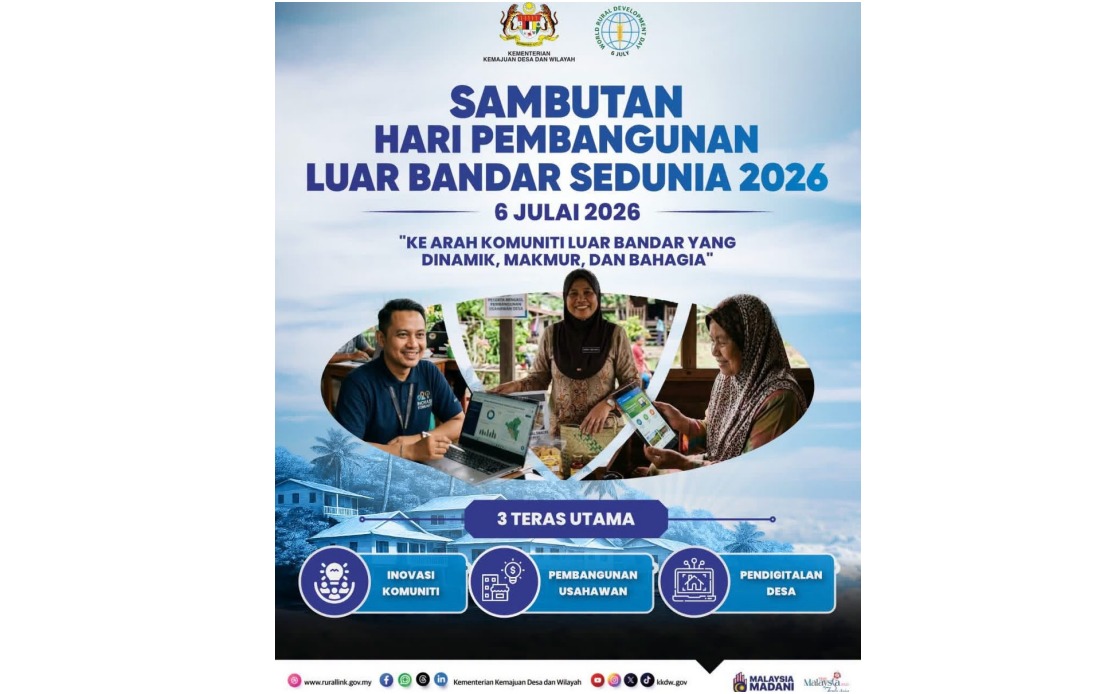
Malaysia steps into a new chapter of rural development policy tomorrow as the nation celebrates the World Rural Development Day for the first time, with the ceremony taking place at Tun Abdul Razak Stadium in Jengka, near Maran in Pahang. The inaugural domestic observance arrives just months after the United Nations General Assembly formally established the global occasion in September 2024, designating July 6 as the annual commemoration date. By hosting this celebration in 2026, Malaysia joins an emerging cohort of countries implementing the United Nations initiative that aims to spotlight the critical role of rural communities in national progress and the pursuit of broader sustainable development objectives.
Deputy Prime Minister and Minister of Rural and Regional Development Datuk Seri Dr Ahmad Zahid Hamidi will formally launch the celebration, underscoring the government's emphasis on rural affairs as a cornerstone of national policy. The event carries significant symbolic weight, as it represents an institutional recognition of the often-overlooked contributions that agricultural and village-based communities make toward achieving Malaysia's development aspirations and international sustainability commitments. The Ministry of Rural and Regional Development has positioned the occasion under the banner "Toward Vibrant, Prosperous and Happy Rural Communities," a formulation that reflects contemporary thinking about rural transformation as something more nuanced than simple agricultural productivity or infrastructure provision.
At the centre of tomorrow's programme lie three interconnected strategic pillars that the Ministry has identified as essential to reshaping rural Malaysia in an increasingly digital and knowledge-based economy. Community innovation stands as the first thrust, acknowledging that rural solutions often emerge from local actors who understand their own contexts better than distant policymakers. Rural digitization constitutes the second prong, addressing a persistent gap between urban and rural access to broadband, online services and digital skills that has constrained economic opportunities for decades. The third dimension centres on rural entrepreneur development, recognising that sustainable prosperity requires not subsidy-dependent communities but rather self-reliant individuals capable of building viable enterprises.
These three pillars operate in concert to expand the economic foundations of rural life beyond traditional reliance on agriculture, forestry and extraction. By promoting digital infrastructure and connectivity, the government seeks to eliminate geographic constraints that have historically isolated rural entrepreneurs from national and global markets. Strengthening community innovation capacity ensures that rural residents can identify and capitalise on opportunities specific to their localities rather than waiting for external investors or government schemes. Supporting rural entrepreneurship creation transforms the dynamic from one of dependency to one of agency, where farming families or village inhabitants view themselves as potential business owners rather than wage labourers or subsistence cultivators.
The celebration will incorporate several award ceremonies and major announcements that showcase existing rural development initiatives and their outcomes. The Rural Aspiration Award MADANI will recognise outstanding achievements in rural progress, while the Felda Plan Excellence Award highlights successful outcomes from Malaysia's long-established land settlement scheme. The formal launch of the My Rural Insight Journal signals a commitment to documenting rural development experiences and research, potentially creating a resource for practitioners and policymakers seeking evidence-based approaches. Simultaneously, Felcra Bhd's announcement of Interim Distributable Profit Distribution 1/2026 provides concrete financial returns to participants in cooperative agricultural enterprises, demonstrating the material benefits that can accrue from collective rural ventures.
For Malaysian observers, the timing and substance of this inaugural celebration warrant closer attention given the evolving pressures facing rural economies. Malaysia's rural population has steadily declined as younger people migrate to cities seeking employment and opportunities, leaving behind ageing populations and declining rural service provision. The government's emphasis on digitization and entrepreneurship suggests recognition that traditional rural development approaches—focused primarily on infrastructure and commodity production—have proven insufficient to reverse this trend. By pivoting toward innovation and digital engagement, policymakers acknowledge that rural Malaysia must compete for talent and investment in twenty-first-century terms, not twentieth-century frameworks.
The United Nations' establishment of World Rural Development Day in 2024 reflected broader international acknowledgment that rural development cannot be treated as peripheral to sustainable development agendas. The designation emerged from the institution of the Centre on Integrated Development for Asia and the Pacific (CIRDAP), an Asia-focused body that recognises the continent's particular challenges and opportunities in rural transformation. For Southeast Asia more broadly, the date carries particular resonance given that the region remains substantially rural despite rapid urbanisation, and rural poverty and inequality continue to shape political stability and social outcomes across the region. Malaysia's participation in this global observance positions it alongside other developing nations addressing similar pressures.
The geographic location of Malaysia's first celebration carries its own significance. Pahang remains one of Malaysia's largest and most economically diverse states, encompassing both established agricultural zones and frontier development areas. Jengka, specifically, sits within the Pahang Region and represents the kind of intermediate settlement where rural development policy intersects with broader economic integration. Holding the ceremony in Tun Abdul Razak Stadium rather than in Kuala Lumpur or another major urban centre signals that the government views this as fundamentally about the rural constituencies themselves, not an urban celebration of rural progress.
The inclusion of exhibition booths from KKDW and partner agencies indicates that tomorrow's event functions not merely as ceremonial occasion but as practical forum where rural communities can engage directly with government resources and development programmes. This hands-on dimension addresses a persistent challenge in Malaysian governance where rural residents often struggle to navigate bureaucratic systems or remain unaware of available support schemes. By bringing programme administrators, resource providers and target beneficiaries into the same physical space, the Ministry creates opportunity for information flow and relationship-building that formal channels often fail to achieve.
Looking forward, Malaysia's commitment to annual observance of World Rural Development Day suggests institutional embedding of rural development as a permanent policy priority rather than cyclical concern. The first celebration's emphasis on innovation, digitization and entrepreneurship sets a template for future iterations while allowing space for evolution as circumstances change. For Malaysian policymakers, regulators and development practitioners, the occasion provides an annual checkpoint for assessing rural transformation progress and recalibrating strategies. For rural communities themselves, the recognition implicit in a United Nations-designated day and a national government celebration may catalyse greater self-regard and confidence in pursuing development initiatives from the village level.

