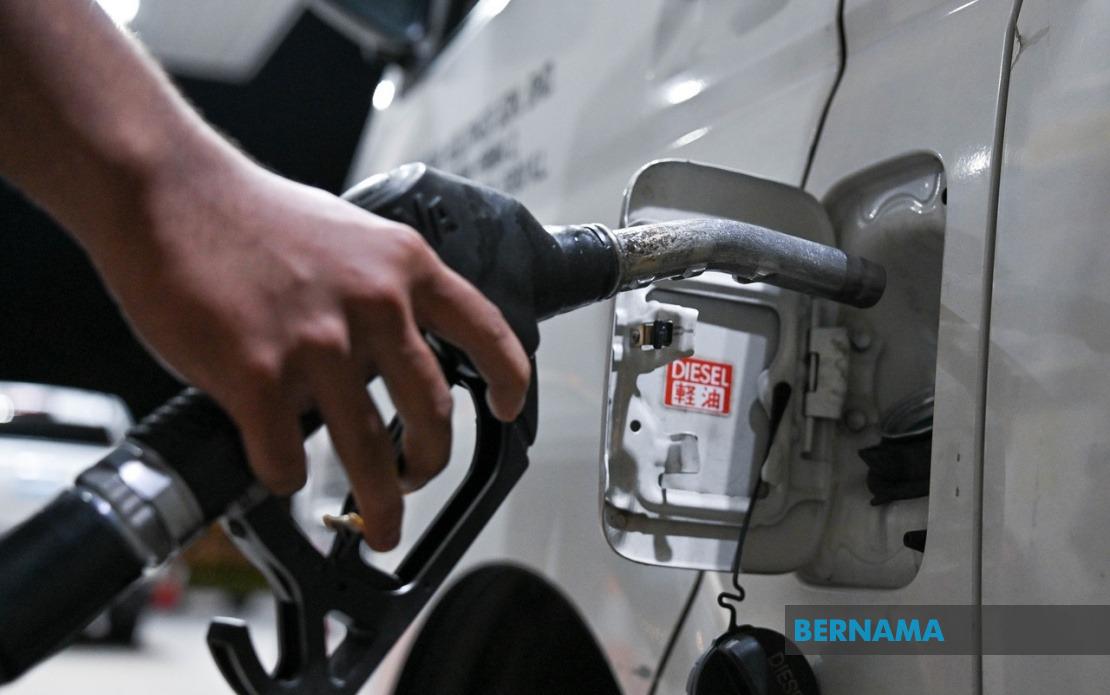
The Ministry of Domestic Trade and Cost of Living (KPDN) has terminated its directive limiting diesel sales to commercial vehicles in Sabah, Sarawak, and the Federal Territory of Labuan, effective immediately. The decision dismantles tiered purchase caps that previously capped transactions at 50 litres, 100 litres, or 150 litres depending on vehicle classification, marking a significant shift in how the government manages fuel distribution across Malaysia's eastern territories.
The revocation stems from Prime Minister Datuk Seri Anwar Ibrahim's announcement on June 21 unveiling the standardised BUDI Diesel Programme, which consolidates subsidised diesel pricing nationwide at RM2.10 per litre. This uniform pricing structure represents a departure from the previous regional variation that had characterised Malaysia's fuel subsidy framework, particularly affecting states where diesel prices had been artificially maintained at different thresholds to manage demand and control government expenditure.
According to KPDN's Director-General of Enforcement Datuk Azman Adam, the cancellation of the March 27, 2026 directive reflects the government's confidence in new safeguarding mechanisms introduced to prevent subsidy leakage and misuse. Rather than relying on volume restrictions to control consumption, the administration has pivoted toward identity-based verification as the primary instrument for ensuring only eligible beneficiaries access subsidised fuel at the capped rate.
The centrepiece of this revised approach is a MyKad-based purchasing system now operational at petrol stations throughout the three territories. This mechanism requires consumers to present their national identification card at the point of sale, allowing the system to cross-reference their eligibility status in real time against government databases. The shift from quantitative restrictions to identity verification represents a technological modernisation of Malaysia's subsidy administration, moving away from the crude instrument of volume caps toward granular, data-driven targeting.
For commercial transport operators and logistics companies operating across Sabah, Sarawak, and Labuan, the removal of purchase limits theoretically offers greater operational flexibility. Previously, heavy-vehicle operators faced constraints when refuelling at controlled-price pumps, necessitating multiple transactions or visits to accumulate sufficient fuel. The elimination of these thresholds should streamline procurement processes, though effectiveness depends on petrol station infrastructure capacity and the reliability of the MyKad verification system itself.
The BUDI Diesel Programme's nationwide standardisation addresses a longstanding source of complexity for interstate commerce. Sabah and Sarawak, as geographically remote regions with substantial transportation distances, had previously experienced different diesel pricing environments that created logistical inefficiencies. By establishing uniform pricing across the federation, the government aims to reduce administrative burden while maintaining fiscal discipline through technological controls rather than administrative quotas.
Datuk Azman emphasised that all fuel retailers holding scheduled controlled goods licenses in the three territories must immediately recognise the directive's obsolescence and adjust their operational protocols accordingly. This administrative guidance carries implicit warning: continued enforcement of the old purchase limits risks non-compliance penalties and regulatory sanctions, as retailers would effectively be contravening government policy by maintaining restrictions no longer formally in effect.
The government's articulated rationale frames the new mechanism as superior to volume-based controls in three dimensions: targeting precision, operational efficiency, and equity. Officials contend that identity verification more accurately restricts subsidies to intended beneficiaries than blanket volume caps, which apply uniformly regardless of consumer circumstances. Additionally, transaction efficiency improves when consumers can purchase required quantities in single visits rather than fragmenting purchases across multiple transactions to navigate previous volume limitations.
For Malaysian consumers more broadly, the policy shift reflects broader philosophical positioning within the Anwar administration regarding subsidy architecture. Rather than abandoning price controls—politically fraught given their entrenched place in Malaysian governance—the government has opted to preserve nominal capping while fortifying administrative mechanisms. This approach acknowledges subsidy programmes' political salience whilst attempting to improve fiscal outcomes through technological infrastructure rather than economically painful removal of protections.
Implementation success hinges critically on MyKad system reliability and petrol station network preparedness. Technical glitches or delayed system integration could generate consumer frustration, particularly in more remote areas where alternative fuel options remain limited. Transport operators dependent on consistent fuel availability may experience service disruptions during the transition period as stations calibrate their procedures to incorporate identity verification into transaction workflows.
The policy carries implications beyond immediate fuel distribution. It signals the administration's broader commitment to digitally-enabled governance, positioning MyKad as an increasingly central credential for accessing subsidised goods and services. As the government extends identity-verification mechanisms across subsidy programmes, citizens can expect heightened digital integration into consumption of government-protected benefits, with corresponding privacy and data-security considerations.
Regional economic competitiveness also enters the calculus. Sarawak and Sabah, with energy-intensive resource extraction industries and substantial transportation networks, benefit from fuel pricing certainty. Standardisation at RM2.10 per litre provides cost predictability for logistics operators and industrial enterprises, potentially enhancing investment attractiveness in sectors sensitive to energy inputs. However, if the MyKad verification system experiences widespread failures or creates transaction bottlenecks, operational costs could increase through inefficiency rather than decrease through standardised pricing.
The directive's cancellation represents the visible manifestation of Malaysia's subsidy evolution, replacing visible administrative constraints with invisible technological ones. Citizens no longer confront explicit purchase limits at fuel pumps, but instead encounter digital gatekeeping through MyKad verification. This transition embodies contemporary approaches to subsidy targeting, exchanging transparent but crude rationing mechanisms for sophisticated data infrastructure, with outcomes dependent ultimately on implementation rigour and system reliability across the nation's distributed petrol station network.

