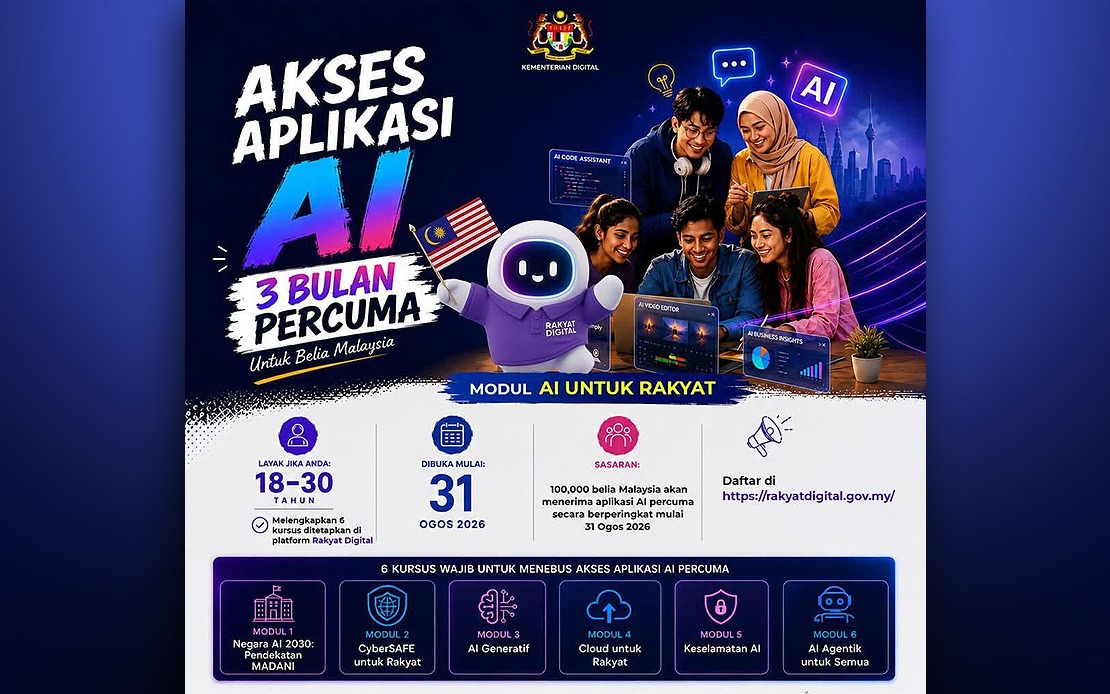
Malaysia's Digital Ministry has unveiled an ambitious new scheme to democratise access to artificial intelligence technology among the nation's youth, rolling out the AI for the People programme as part of a broader push to build digital competency across the population. The initiative, announced by Prime Minister Datuk Seri Anwar Ibrahim during the 2026 National Day Premier Address celebrations in Putrajaya, will operate until 2027 and aims to enrol 100,000 Malaysians between 18 and 30 years old. Registrations opened today through the Rakyat Digital portal, the government's centralised digital learning platform accessible at rakyatdigital.gov.my, with participation rolling out in phases to manage the expected volume of interest.
At the heart of the programme lies a structured educational pathway comprising six specialised modules that participants must successfully complete to unlock their benefits. The curriculum spans both foundational and advanced artificial intelligence concepts, beginning with AI Nation 2030: The MADANI Approach, which contextualises Malaysia's strategic vision for responsible AI development. Participants then progress through CYBERSAFE for the People, addressing the critical intersection of digital safety and AI literacy—a particularly relevant concern as AI adoption accelerates across Malaysian organisations and households. The programme subsequently covers Generative AI, equipping learners with practical knowledge of large language models and content generation tools that are reshaping workplace productivity globally.
The remaining three modules—AI Security, Agentic AI for All, and Cloud for the People—reflect Malaysia's ambition to develop a workforce conversant in enterprise-grade AI infrastructure and emerging autonomous AI systems. This comprehensive structure suggests the government's recognition that meaningful AI literacy extends beyond consumer-facing applications to encompass the technical and governance frameworks underpinning responsible deployment. Rather than offering superficial awareness, the curriculum appears designed to provide young Malaysians with substantive competencies that could translate into career advantages in a rapidly digitalising economy.
Upon successful completion of all six modules, participants gain access to a three-month complimentary subscription to a curated selection of premium artificial intelligence applications and software. The initial slate of tools reflects a deliberate mix of local and international providers, signalling Malaysia's openness to both regional tech ecosystems and global innovation leaders. Young Malaysians will gain free access to YTL AI Labs' IlmuChat platform, positioning a local technology champion prominently within the initiative. Alibaba's Wonderclip and MuleRun offerings provide alternatives for image and workflow automation, while Google's Gemini Enterprise grants exposure to one of the world's most advanced large language models in its commercial configuration.
The Digital Ministry has committed to progressively expanding the roster of available tools as the programme evolves, indicating that the initial list represents merely a foundation rather than a ceiling. This staged approach reflects both the practical realities of negotiating licencing agreements with technology providers and the strategic flexibility required to keep the curriculum aligned with rapidly advancing AI capabilities. For young Malaysians, this expansion pathway means that early programme participants will encounter an increasingly rich ecosystem of tools as they progress through their learning journey, potentially encouraging retention and deepening engagement with AI technology.
From a policy perspective, the AI for the People initiative represents a deliberate effort to translate Malaysia's AI Nation 2030 vision—the government's strategic framework for responsible, inclusive artificial intelligence development—into tangible individual opportunities. Digital Ministry secretary-general Datuk Fabian Bigar emphasised that the scheme aims to ensure young people not only comprehend artificial intelligence conceptually but can actively experiment with professional-grade tools used across creative industries, education, business process automation and research. This practical engagement marks a departure from purely theoretical technology education, recognising that hands-on experience with enterprise software builds both confidence and concrete digital skills that employers increasingly value.
The targeting of 18 to 30-year-olds reflects a deliberate focus on Malaysia's demographic dividend—the cohort entering their prime working years when early exposure to cutting-edge technology can meaningfully influence career trajectories and earning potential. For Malaysia, competing within Southeast Asia's increasingly tech-driven economy, ensuring this population possesses genuine AI literacy and familiarity with professional tools offers a competitive advantage. Countries throughout the region are similarly investing in digital upskilling, making inclusive, high-quality access to AI training a differentiating factor in talent attraction and retention.
The programme's scope and ambition also signal the Digital Ministry's strategic priority within Malaysia's broader governance structure. By linking AI literacy to the Rakyat Digital portal and coordinating delivery through MyDIGITAL Corporation, the government has embedded the initiative within existing infrastructure rather than creating parallel bureaucratic structures. This integration suggests sustainability, as the programme can leverage established digital learning systems and administrative capacity rather than requiring entirely new institutional frameworks.
For Southeast Asian observers monitoring technology policy trends, the initiative demonstrates Malaysia's conviction that AI access should not be confined to privileged populations with resources for private training and software licensing. The commitment of substantial government resources to provide free tools and instruction reflects a belief that inclusive digital capability strengthens the entire economy. Given Malaysia's aspirations to position itself as a regional AI innovation hub, ensuring broad-based competency among the youth population creates a larger talent pool from which companies—both Malaysian and multinational—can recruit.

