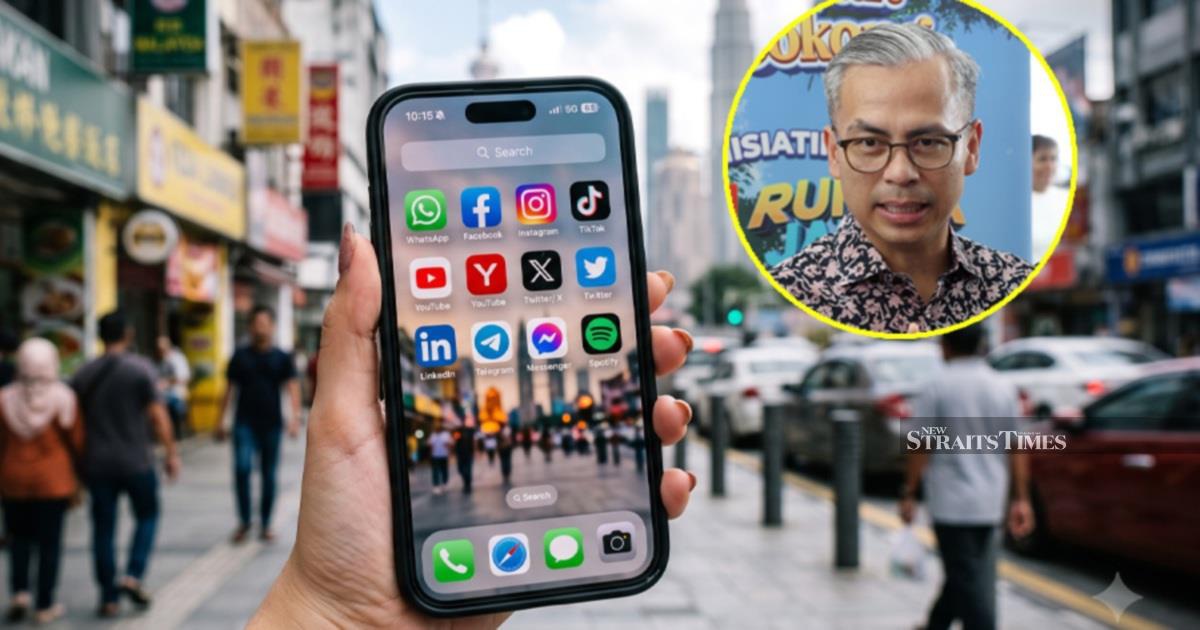
Communications Minister Datuk Seri Fahmi Fadzil has announced the detection of more than 1,800 fraudulent social media accounts operating within Malaysian digital spaces, with a significant portion deployed to distribute inflammatory content centred on race, religion, and royalty—issues historically sensitive within the nation's multiethnic and multireligious context.
The discovery represents a growing challenge for Malaysian authorities navigating the intersection of national security, communal harmony, and digital governance. Fake accounts have become a preferred tool for bad actors seeking to polarise public opinion without accountability, allowing users to evade identification while promoting divisive narratives. The scale of 1,800 accounts underscores the systematic nature of these operations rather than isolated instances of online mischief.
The focus on 3R content—race, religion, and royalty—is particularly noteworthy given Malaysia's constitutional and social sensitivities around these domains. Article 153 of the Federal Constitution enshrines special protections for Bumiputera rights and Islam's position, while Article 36 grants the rulers constitutional authority. These frameworks exist precisely because these subjects have historically been flashpoints for communal tension. The weaponisation of 3R topics through coordinated fake accounts suggests deliberate efforts to test social cohesion and potentially trigger broader conflict.
Fahmi's disclosure comes as Southeast Asian governments intensify scrutiny of inauthentic behaviour online. The region has faced repeated waves of disinformation campaigns, from election interference attempts to coordinated attacks on minority communities. Malaysia, with its demographic complexity and recent political volatility, remains particularly vulnerable to such tactics. Foreign actors, domestic opposition groups, and commercial entities all maintain incentives to manipulate Malaysian public discourse through automation and deception.
The technical architecture underpinning these operations typically involves bot networks, compromised accounts, and coordinated posting schedules designed to amplify specific narratives while evading platform detection systems. Modern disinformation campaigns often combine automation with authentic-looking profiles, creating networks that appear organic to casual observers. The sophistication of such operations has grown considerably, with operators using artificial intelligence to generate profile pictures and craft contextually appropriate engagement patterns.
Malaysia's detection capabilities have improved markedly in recent years, though gaps remain. The Communications Ministry works alongside the Malaysian Communications and Multimedia Authority, law enforcement agencies, and social media platforms themselves. However, the discovery of 1,800 accounts suggests that current detection mechanisms, whether algorithmic or manual, continue to lag behind the sophistication and scale of inauthentic activity. Platforms including Facebook, Instagram, and TikTok maintain their own enforcement efforts, but their effectiveness varies significantly across different regions and content categories.
The targeting of 3R content carries particular strategic implications. By amplifying divisive messages around these touchstones of Malaysian identity, coordinated inauthentic networks can simultaneously sow discord, undermine public trust in institutions, and create the appearance of grassroots support for extremist positions. A single inflammatory post about religious practices or royal prerogatives, when amplified through hundreds of coordinated fake accounts, can generate the impression of overwhelming public sentiment—influencing both algorithm recommendations and real-world political calculations.
Fahmi's announcement reflects broader governmental concern about digital threats to national stability. Unlike traditional mass media, which required significant capital and faced regulatory oversight, social media platforms enable rapid, decentralised distribution of content at minimal cost. The anonymity afforded by fake accounts removes one of the traditional deterrents against spreading inflammatory material. Malaysian law provides some recourse through the Communications and Multimedia Act as well as provisions against seditious speech, but enforcement remains challenging when perpetrators operate behind multiple layers of digital obfuscation.
The implications extend beyond immediate security concerns. Trust in online spaces depends partly on the reasonable expectation that interactions involve authentic participants engaged in good faith. When fake accounts proliferate, they degrade the epistemic integrity of social media platforms—making it increasingly difficult for ordinary users to distinguish genuine public opinion from manufactured consensus. This erosion of trust can weaken democratic deliberation and make citizens more susceptible to narratives that appeal to tribal identity and existing prejudices.
Addressing the challenge requires multifaceted responses. Platform accountability remains essential, with social media companies needing stronger incentives to detect and remove inauthentic behaviour at scale. Regulatory frameworks must evolve to impose meaningful penalties for coordinated disinformation while respecting legitimate speech. Public media literacy initiatives can help Malaysians recognise hallmarks of inauthentic networks. Equally important is international cooperation, as many disinformation campaigns originate from or are coordinated across borders, demanding coordinated responses from regional governments.
The detection itself represents a small victory, but the underlying problem—the continued proliferation of fake accounts and coordinated inauthentic networks—shows no signs of abating. As platforms grow and technology becomes more accessible, the barriers to launching large-scale disinformation campaigns continue to lower. Malaysia's communications authorities face the task of remaining perpetually ahead of evolving techniques, a challenge requiring sustained investment in expertise, technology, and interagency coordination.

