Malaysia is taking centre stage in regional digital governance discussions this week as the International Regulatory Conference 2026 opens in Kuala Lumpur, reflecting the country's deepening commitment to establishing robust frameworks for an increasingly complex technological landscape. The two-day gathering, orchestrated by the Malaysian Communications and Multimedia Commission (MCMC), brings together regulators, policymakers, and industry stakeholders from across seven nations to tackle urgent questions about how governments and platforms can balance innovation with protection in an era dominated by artificial intelligence and pervasive online connectivity.
The conference theme—Shaping the Next Digital Era: Regulation, Resilience and Trust—captures a tension that defines Malaysia's current regulatory moment. The nation recently activated the Online Safety Act 2025 (ONSA) on January 1 of this year, marking a significant step towards domestically-driven policy frameworks rather than relying solely on international precedent or industry self-regulation. This legislative milestone, coupled with mounting concerns about AI-driven content manipulation and exploitation, has positioned Malaysia as a serious player in Southeast Asia's evolving conversation about digital governance. Communications Minister Datuk Seri Fahmi Fadzil's formal opening signals government commitment to these discussions, while MCMC Commission member Derek John Fernandez's keynote will help establish intellectual foundations for the substantive debates to follow.
Child protection emerges as a paramount concern in the conference's opening dialogue, titled Online Safety by Design: Platform Accountability and Child Protection in an Age of User Vulnerability. The session, steered by MCMC deputy managing director Eneng Faridah Iskandar, assembles a formidable panel including SUHAKAM's children's commissioner Dr Farah Nini Dusuki, UNICEF Malaysia's child protection chief Saskia Blume, and Australian High Commissioner Danielle Heinecke. Their collective presence underscores recognition that digital harms—from grooming and exploitation to algorithm-driven bullying—demand cross-sectoral expertise and international coordination. For Malaysian stakeholders, this discussion carries particular weight given the nation's substantial youth population and growing evidence that digital natives face unprecedented vulnerability to predatory behaviour enabled by platforms designed with engagement rather than safety as the primary metric.
Parallel conversations address the architectural and philosophical foundations underpinning digital futures. A session titled Sovereign Data, Empowered Citizens examines data sovereignty and privacy protection as Malaysia accelerates its digital economy ambitions. Moderated by MCMC's chief of National Sovereign AI Cloud Che Juhan Che Mat, the panel features telecommunications and technology executives including Maxis's cloud solutions head Chin Kok Loon, T&G Digital's chief regulatory officer Foo Yeong Jin, and Ericsson's security chief Dr Connie McIntosh. This discussion reflects growing geopolitical sensitivities about where data flows, who controls it, and how citizen information can be protected while enabling economic innovation. For Malaysia and other Southeast Asian nations, balancing these imperatives is crucial—they cannot afford to alienate technology companies through excessive localization requirements, yet cannot ignore domestic interests in data security and sovereignty.
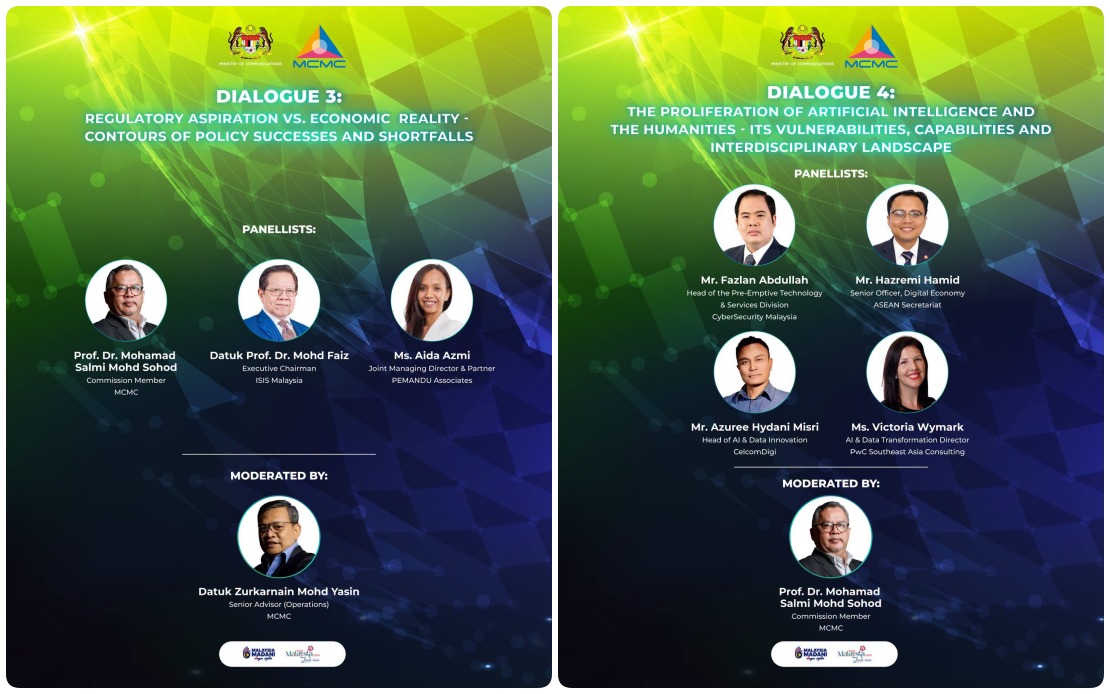
The afternoon programme pivots towards a pressing paradox: how regulators can foster innovation while preventing systemic harm and market failure. The session Regulatory Aspiration vs Economic Reality acknowledges that policy goals often collide with commercial realities and technological constraints. Drawing on expertise from the Institute of Strategic & International Studies (ISIS) Malaysia and PEMANDU Associates, this discourse promises hard-edged analysis of where regulatory ambitions have succeeded and where they have stumbled. Malaysian policymakers will likely find this particularly instructive as they calibrate ONSA implementation and contemplate future refinements.
The conference's exploration of artificial intelligence reflects international anxiety about the technology's societal implications. A session titled AI and the Humanities examines how AI development intersects with vulnerabilities, capabilities, and the need for multidisciplinary governance. Participants from the ASEAN Secretariat, PwC Southeast Asia Consulting, Universiti Kebangsaan Malaysia, CelcomDigi, and CyberSecurity Malaysia will grapple with philosophical and practical questions about AI governance. This framing—positioning AI not merely as an engineering or commerce problem but as a humanities challenge—signals maturation in how policymakers approach technological governance. For Malaysian regulators, such holistic thinking is essential if they are to anticipate and mitigate harms that purely technical or economic lenses might miss.
The conference's second day shifts attention to frontier technologies that will shape the next decade of digital infrastructure and society. Quantum technology receives focused attention through a session featuring IBM Quantum Asia Pacific and Japan's sales leadership alongside academic representatives from Universiti Teknologi Malaysia, Universiti Malaya, and Universiti Kebangsaan Malaysia. Quantum computing's potential to revolutionize cryptography and computational power presents both immense opportunity and existential risk for data security paradigms—a concern that links directly to Malaysia's sovereign data and privacy ambitions. Similarly, sessions on robotics regulation and autonomous ecosystems acknowledge that tomorrow's challenges cannot be adequately addressed through yesterday's frameworks.
The conference also addresses a subtler but pervasive challenge: digital dependency and its psychological, epistemic, and social consequences. A session titled Digital Dependency and Human Autonomy examines mental wellbeing, knowledge integrity, and boundaries in always-on societies. This reflects acknowledgment that regulatory frameworks must encompass not just platform accountability and data protection but also human flourishing and societal resilience in the face of technologies designed to capture and sustain attention. For Malaysia, where social media penetration is exceptionally high and digital platforms play outsized roles in political discourse, this conversation carries particular salience.
The IRC 2026 represents the third iteration of what has become an established forum, having debuted in 2024. This continuity suggests that Malaysia's MCMC has successfully positioned the conference as a credible venue for serious policy dialogue—neither a purely academic exercise nor an industry cheerleading event, but a genuine space for contending with hard questions about how digital futures should be governed. The participation of over seven nations' representatives—regulators, policymakers, and industry leaders—validates this positioning and creates spillover benefits for Malaysia's regional influence.
Deputy Communications Minister Teo Nie Ching will formally close the conference tomorrow afternoon, bringing together insights from two days of intensive discussion. The challenge now lies in translating conference conclusions into concrete policy adjustments, enforcement strategies, and international coordination mechanisms. Malaysia's implementation of ONSA demonstrates regulatory ambition, but that ambition will be tested as the legislation encounters real-world complexity, industry resistance, and inevitable conflicts between competing regulatory and commercial interests. The IRC 2026 thus functions not only as a platform for sharing current thinking but as a critical moment for Malaysia to benchmark its own approach, learn from international peers, and solidify its position as a thoughtful and sophisticated actor in global digital governance—a role that carries both responsibility and opportunity for a nation positioned at the intersection of advanced technology adoption and developing-market realities.

