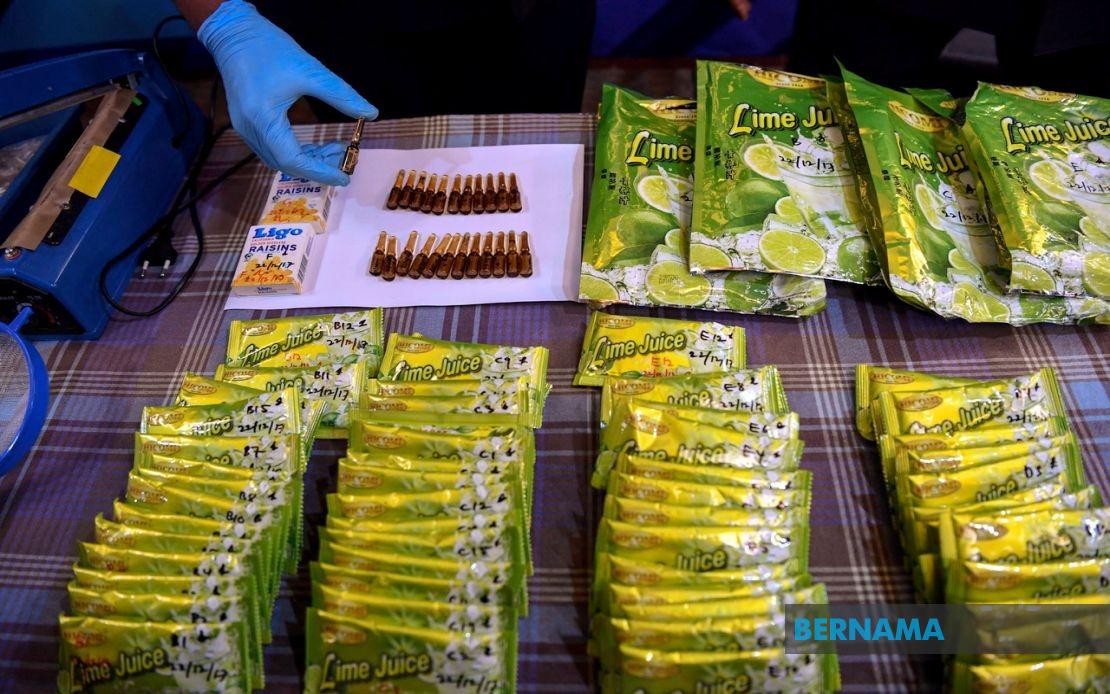
The Home Ministry has declared synthetic drugs a critical national security issue, with Home Minister Datuk Seri Saifuddin Nasution Ismail warning that methamphetamine, psychoactive pills colloquially known as "piu-piu," and fentanyl present an unprecedented challenge to public safety and social stability. The concern centres on the potency and addiction potential of these substances, which authorities link directly to escalating criminal activity and deteriorating community health across the country.
Drug enforcement data reveals the scale of the problem. Between 2023 and June 2026, the Royal Malaysia Police recorded 238,704 arrests nationwide for synthetic drug-related offences, underscoring both the prevalence of trafficking networks and the considerable resources devoted to enforcement operations. This figure represents a sustained and intensive policing effort, though the continued high arrest numbers also suggest the drugs remain widely available despite enforcement pressure.
In response, authorities have launched coordinated multi-agency campaigns including Operation Tapis and Operation Tapis Khas, mobilising the police alongside the National Anti-Drugs Agency and Royal Malaysian Customs Department. These operations span urban centres, rural communities, and remote areas, recognising that drug distribution networks penetrate all geographic segments of Malaysian society. The geographic spread of operations acknowledges a significant shift in trafficking patterns, with drugs no longer confined to major cities but increasingly present in less populated regions where detection and enforcement may prove more challenging.
Technological innovation has become central to Malaysia's enforcement strategy. Drones and surveillance camera networks now provide real-time intelligence on suspected trafficking activity, enabling authorities to identify supply routes and distribution points with greater precision than traditional methods. These technologies represent a modernisation of drug enforcement infrastructure, though their effectiveness depends on sustained funding and technical expertise, areas where regional capacity varies considerably.
Legislative adaptation remains a key priority. The Home Ministry is pursuing amendments to the Dangerous Drugs Act 1952 to explicitly schedule newly emerging synthetic drugs and New Psychoactive Substances under the Act's controlled categories. This legal evolution is necessary because manufacturers continuously modify chemical formulations to circumvent existing prohibitions—a pharmaceutical cat-and-mouse game that requires regular legislative updates to maintain legal frameworks' relevance. Without such amendments, enforcement agencies risk pursuing substances through increasingly tenuous legal interpretations.
Beyond enforcement, the government emphasises prevention through community engagement. Between 2023 and June 2026, authorities conducted 1,144 drug prevention programmes nationwide, targeting public awareness and community resistance to drug use. This preventive orientation reflects international best practice recognising that enforcement alone cannot address demand-side factors driving substance abuse. Such programmes typically address underlying vulnerabilities—youth unemployment, social isolation, mental health challenges—that make individuals susceptible to drug use.
Sarawak presents a particularly complex case study. In the first half of 2026 alone, authorities arrested 7,097 individuals on drug-related charges, including 342 traffickers and 1,314 individuals in possession. The state also accounted for 5,441 drug user arrests during this period, indicating substantial user prevalence. These figures become more meaningful when considering Sarawak's geographic remoteness and dispersed population, factors that complicate enforcement logistics and create enforcement blind spots where trafficking networks operate with reduced scrutiny.
The monetary value of seized assets in Sarawak—RM53.73 million across 418.01 kilogrammes of drugs—demonstrates the financial stakes driving trafficking operations. Syndicate asset seizures totalling RM1.95 million illustrate law enforcement's efforts to dismantle trafficking infrastructure by targeting financial flows and proceeds. However, the continued discovery of significant drug quantities suggests trafficking networks retain substantial operational capacity despite asset confiscation, indicating either regeneration of seized supplies or establishment of new supply chains.
Enhanced forensic capabilities address a critical enforcement gap. Upgraded laboratory facilities can now profile emerging synthetic drug variants, including fentanyl analogues and synthetic opioids, enabling faster identification and targeted enforcement. Fentanyl deserves particular attention given its potency—typically 50 to 100 times stronger than morphine—making even minute quantities lethal. Forensic profiling allows authorities to trace manufacturing origins and distribution patterns, potentially disrupting supply chains upstream rather than merely intercepting street-level sales.
The Dangerous Drugs (Special Preventive Measures) Act 1985 provides authorities tools for intervention beyond criminal prosecution. Detention powers under this legislation allow treatment and rehabilitation for individuals identified as high-risk offenders, though effectiveness depends on rehabilitation programme quality and post-release support systems. In Sarawak specifically, 13 individuals were detained under these provisions in the first half of 2026, suggesting selective application focused on identified priority cases.
Section 39C of the Dangerous Drugs Act 1952, under which 131 hardcore addicts faced action in Sarawak, provides mechanisms for compulsory treatment addressing chronic dependency. These provisions represent a public health intervention philosophy alongside punitive measures, acknowledging addiction as a condition requiring therapeutic intervention rather than purely criminal sanction. Implementation outcomes—treatment completion rates, relapse statistics, long-term recovery measurements—remain critical assessment indicators insufficiently discussed in official statements.
The synthetic drug challenge mirrors broader Southeast Asian trends. Thailand, Myanmar, and Indonesia face comparable methamphetamine and fentanyl trafficking pressures, with shared geographic and porous borders enabling cross-border supply networks. Malaysia's enforcement intensification must therefore coordinate with regional partners, recognising that unilateral action cannot address internationally organised trafficking networks. ASEAN-level cooperation mechanisms, though improving, remain inadequately resourced for comprehensive supply chain disruption.
Looking forward, Malaysia's strategy faces inherent limitations. Supply-side enforcement, however technologically sophisticated, cannot eliminate demand in a region with growing urbanisation, youth underemployment, and mental health challenges. Sustainable progress requires simultaneous demand reduction through addiction treatment expansion, prevention education evolution, and addressing socioeconomic vulnerabilities predisposing individuals toward drug use. The Home Ministry's intensified operations represent necessary enforcement escalation, yet lasting success requires complementary public health, educational, and social policy coordination extending beyond law enforcement remits.

