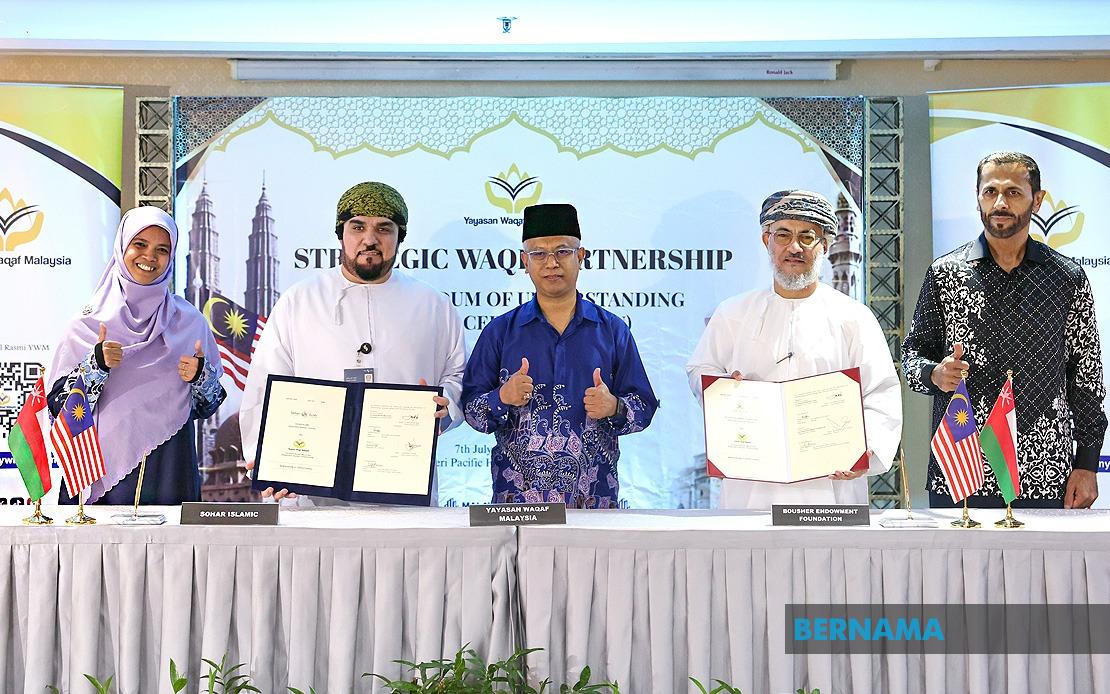
Malaysia has reinforced its standing as a centre of excellence in Islamic social finance through a landmark agreement with two major Omani institutions, marking a significant diplomatic and economic achievement for the Malaysian waqf sector. The Malaysian Waqf Foundation (YWM) signed a memorandum of understanding with Sohar Islamic and the Boushar Endowment Foundation, establishing a framework for collaborative advancement in waqf asset management, governance structures and innovative Islamic finance mechanisms. This bilateral arrangement, formalized in Kuala Lumpur on July 7, signals Malaysia's transition from importing Islamic financial expertise to exporting it across the Gulf Cooperation Council region.
Deputy Minister in the Prime Minister's Department (Religious Affairs) Marhamah Rosli underscored the strategic importance of this collaboration, emphasizing that it reflects international acknowledgement of Malaysia's capacity to construct a comprehensive, forward-thinking and results-oriented waqf infrastructure. She characterized the partnership as transcending bilateral commercial interest, asserting instead that it carries substantial implications for Malaysia's reputation and influence within the broader Muslim world. The presence of Mohamed Najeeb Al Bulushi, Deputy Head of Mission of the Sultanate of Oman to Malaysia, during the signing ceremony emphasized the diplomatic weight both nations attribute to deepening waqf cooperation.
The arrangement extends beyond knowledge exchange to include technological transfer and institutional benchmarking. YWM chief executive Dr Ridzwan Bakar, who has been appointed as Waqf Adviser to Oman, emphasized the significance of Malaysia's position as a trusted consultant rather than a recipient of external guidance. This represents a symbolic reversal of traditional dynamics whereby Malaysia has conventionally sought expertise from established Islamic finance centres. The involvement of Fahad Akbar Al Zadjali from Sohar Islamic and Malik Hilal Al Yahmadi from the Boushar Endowment Foundation demonstrates commitment at institutional leadership level from the Omani side.
The pathway to this collaboration reveals deliberate Malaysian diplomatic strategy in the Islamic finance space. Ridzwan disclosed that relationship-building occurred through structured visits undertaken in 2023 and 2024, during which YWM identified synergies between Malaysia's waqf development model and Oman's institutional requirements. The receptive response from Omani authorities subsequently transformed these exploratory discussions into formal advisory arrangements, with Malaysia repeatedly invited to provide strategic counsel on waqf infrastructure expansion. This methodical approach contrasts with opportunistic partnerships and reflects comprehensive understanding of the Omani institutional landscape.
Malaysia's waqf expansion strategy extends beyond Oman to encompass the broader Gulf region. Ridzwan outlined YWM's international network development, which includes ongoing partnerships with Kuwait, Qatar and the United Arab Emirates. This geographically diversified approach positions Malaysia as a transcontinental facilitator of waqf innovation rather than a niche provider serving specific markets. The pattern of deepening engagement across multiple Gulf states suggests strategic positioning as the preferred partner for jurisdictions seeking to modernize waqf governance and expand Islamic social finance infrastructure.
The economic dimension underpinning this collaboration centres on attracting capital flows into Malaysia from Arab sources. Ridzwan identified productive waqf asset development as a vehicle for channelling strategic investments from Gulf countries into the Malaysian economy. The Malaysian waqf model, characterized by systematic asset development prior to revenue distribution, creates investment opportunities that appeal to institutional investors from wealthy Gulf economies. By positioning Malaysia as both a centre for waqf expertise and an attractive destination for Islamic investment, YWM leverages the country's geographic and institutional advantages.
YWM's existing investment infrastructure demonstrates operational readiness to capitalize on this expanded international engagement. The foundation currently manages three investment products through Kenanga Investors, which serve as conduits for mobilizing international capital into Malaysian waqf development initiatives. These vehicles provide both the technical architecture and regulatory framework necessary to facilitate cross-border Islamic finance flows. The existence of established investment mechanisms removes implementation barriers that might otherwise constrain international partnerships, enabling relatively rapid scaling of collaborative initiatives.
The broader implications for Malaysia's domestic waqf sector merit consideration alongside international expansion. Ridzwan articulated a vision wherein waqf development functions as an economic strengthening mechanism before revenue streams reach beneficiaries. This approach prioritizes asset accumulation and sustainable growth over immediate distribution, potentially generating substantially larger long-term benefits for target populations. The model explicitly encompasses not only traditional asnaf categories but also B40 and M40 income groups, suggesting evolution of Malaysia's understanding of waqf's role in addressing socioeconomic inequalities across broader demographic segments.
Marhamah's emphasis on Malaysia exporting rather than importing expertise carries political significance for public messaging around national capability and regional influence. The deputy minister framed the Oman partnership as emblematic of Malaysia's transition toward leadership positions within Islamic finance architecture, rather than following externally determined trajectories. This narrative supports broader government positioning of Malaysia as a consequential player in global Islamic finance governance and Islamic institutional development, distinct from characterizations of Malaysia as a regionally significant but internationally peripheral economy.
The collaboration framework establishes precedent for additional partnerships within the Gulf region and potentially beyond. Successful Oman engagement creates replicable models for similar arrangements with other jurisdictions, while demonstrating to potential partners that Malaysia possesses both institutional sophistication and sustained commitment to waqf development. The appointment of senior YWM leadership as formal advisers to foreign governments establishes Malaysia's expertise as marketable international commodity, creating revenue streams while simultaneously enhancing national prestige and soft power.
Regional context amplifies this partnership's significance. Southeast Asian nations generally possess less developed waqf infrastructure compared to Gulf states, limiting Malaysia's opportunities for south-to-north knowledge transfer within the region. The Oman collaboration instead positions Malaysia as a bridge between Southeast Asian Islamic finance frameworks and Gulf institutional approaches, creating potential for triangular partnerships benefiting the wider Muslim world. This geographic and institutional positioning enhances Malaysia's relevance as specialized provider rather than generic Southeast Asian economy.
Longer-term implications extend to Malaysia's candidacy for hosting regional Islamic finance institutions and regulatory bodies. Demonstrated expertise in waqf governance, combined with successful international partnerships, strengthens arguments for locating new Islamic finance infrastructure in Malaysia. The country's trajectory from expertise importer to exporter, evidenced by the Oman collaboration, supports narratives of institutional maturation and technical sophistication necessary for hosting regional financial architecture.

