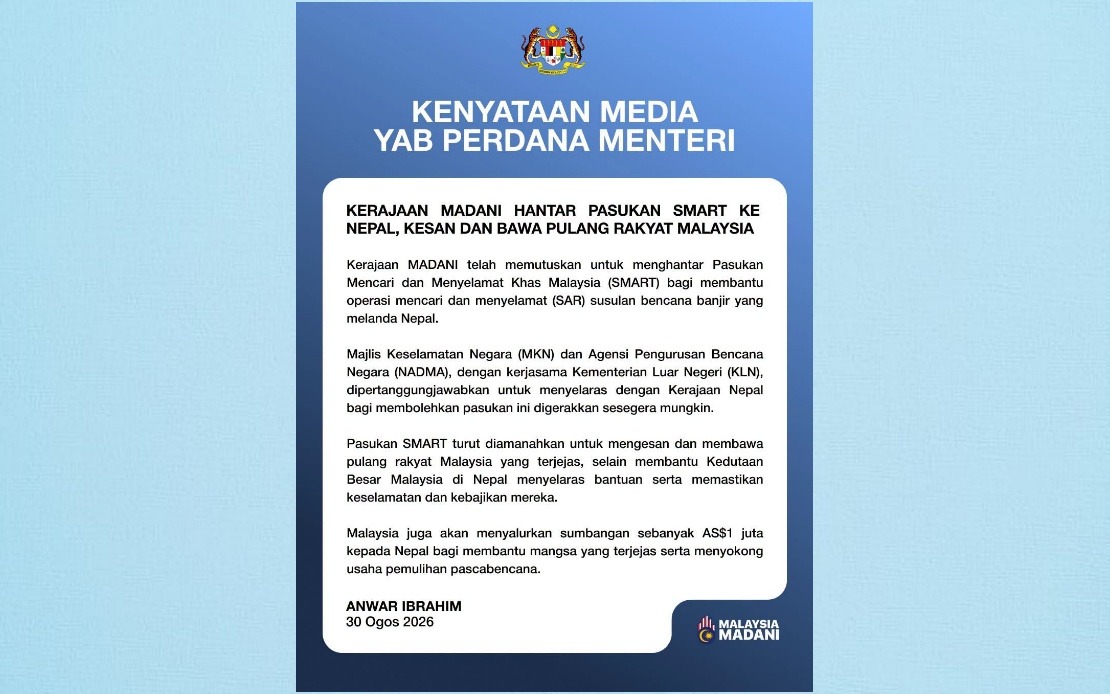
Malaysia has mobilized its disaster response capabilities to assist Nepal following severe flooding and landslides that swept through the Himalayan nation on August 26, decimating the Rasuwa district. Prime Minister Datuk Seri Anwar Ibrahim announced that the government has authorized the deployment of the Special Malaysian Disaster Assistance and Rescue Team (SMART) to undertake search and rescue operations in collaboration with Nepalese authorities. The decision reflects Malaysia's commitment to regional humanitarian assistance and demonstrates the MADANI Government's proactive approach to international disaster management.
Coordinating the response involves multiple Malaysian institutions operating in tandem to ensure swift and effective deployment. The National Security Council (MKN) and the National Disaster Management Agency (NADMA) have been assigned responsibility for liaising with Nepal's government, while the Foreign Ministry plays a crucial supporting role in facilitating diplomatic channels and logistical arrangements. This multi-agency coordination underscores the complexity of mounting international rescue operations, requiring seamless communication across security, disaster management, and diplomatic frameworks to authorize and execute the mission efficiently.
Beyond immediate rescue operations, SMART personnel have been tasked with locating Malaysian nationals caught in the disaster and ensuring their safe return home. The Foreign Ministry previously confirmed that 55 Malaysians remain uncontactable following the catastrophe, raising concerns about their welfare and survival. This dual mandate—conducting broader search and rescue activities while simultaneously prioritizing the safety of Malaysian citizens—reflects the team's specialized training and the government's responsibility to protect its nationals abroad during crises.
The Malaysian Embassy in Nepal will work alongside the SMART deployment to coordinate comprehensive humanitarian assistance, with the diplomatic mission serving as a crucial liaison point between rescue teams, the Nepalese government, and affected communities. Embassy personnel will be instrumental in verifying the status and whereabouts of Malaysian citizens, facilitating communication with families in Malaysia, and ensuring that rescue efforts align with Nepalese authorities' priorities and ground conditions. This embassy-based coordination model has proven effective in previous regional disasters, as embassies possess existing relationships, language capabilities, and on-ground knowledge essential for rapid response.
Financially, Malaysia's commitment extends beyond personnel deployment. Prime Minister Anwar Ibrahim announced that Malaysia would contribute US$1 million to Nepal, representing a significant humanitarian pledge aimed at addressing immediate relief needs and supporting longer-term post-disaster recovery initiatives. This financial contribution complements the SMART deployment, providing resources for shelter, medical care, food supplies, and infrastructure rehabilitation—assistance that will likely prove critical given the remote mountainous terrain of the affected regions and the challenges of delivering aid in disaster-struck areas.
The Rasuwa district floods represent one of Nepal's most severe weather-related disasters in recent memory, with flash flooding and triggered landslides causing extensive casualties and infrastructure damage. The district's mountainous geography, characterized by steep terrain and limited road access, has historically complicated disaster response efforts and made rescue operations particularly challenging. Malaysian teams deploying to the region will face logistical constraints typical of high-altitude disaster zones, including difficult terrain, limited communication infrastructure, and weather-dependent helicopter access to remote communities.
Malaysia's rapid response capability stems from SMART's established expertise and regional standing in disaster management. The team has responded to multiple regional emergencies, building operational experience and establishing working relationships with governments and international organizations across Southeast Asia. This experience base enables SMART to mobilize quickly, deploy appropriately scaled resources, and coordinate effectively with host nation authorities—advantages that prove decisive in time-sensitive rescue operations where the first days and hours determine survival rates.
The deployment also underscores the increasing frequency and severity of climate-related disasters affecting South Asian mountainous regions. Nepal's vulnerability to flash flooding stems from monsoon patterns, glacial snowmelt, and terrain susceptibility to landslides, creating recurring humanitarian challenges. Malaysia's willingness to provide specialized assistance reflects broader regional awareness that disaster resilience requires cross-border cooperation and the pooling of technical expertise and resources across national boundaries.
For Malaysian readers, this response demonstrates how their government mobilizes resources to assist nationals in distress while contributing to regional stability and humanitarian norms. The deployment involves Malaysian personnel accepting risks to help foreign populations, embodying values of international cooperation and human solidarity that extend beyond bilateral diplomatic relationships. Simultaneously, the response highlights the importance of disaster preparedness and regional coordination mechanisms that enable rapid mobilization of specialized teams when calamities strike neighboring countries.
The Nepalese government's acceptance of Malaysian assistance reflects the practical reality that major disasters overwhelm national response capacities, particularly in developing nations with limited specialized equipment and trained personnel. International collaboration becomes essential for maximizing rescue success rates and minimizing suffering. Malaysia's contribution, alongside assistance from other nations, represents the global pooling of resources and expertise that defines modern humanitarian response to large-scale disasters.
As the SMART team prepares deployment, their mission extends beyond technical rescue operations to encompassing broader humanitarian objectives. Beyond extracting survivors and locating missing persons, the team's presence provides psychological reassurance to affected communities and demonstrates international solidarity during catastrophic events. This combination of practical rescue capability and symbolic international support proves invaluable for disaster-stricken regions seeking to restore stability and hope amid devastation.

