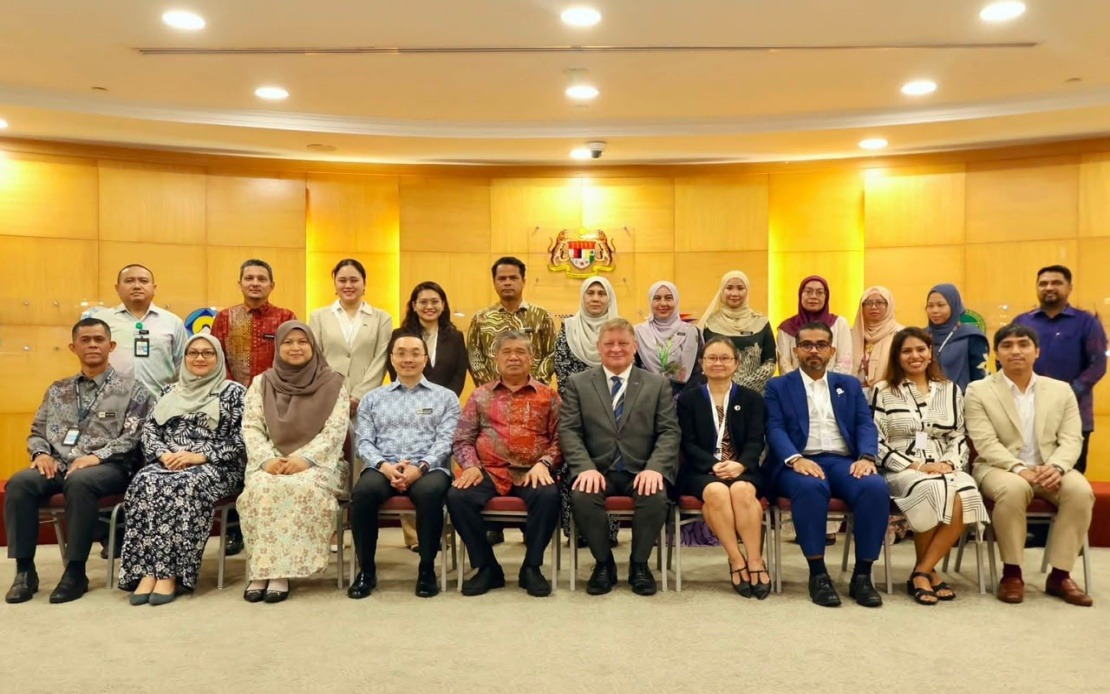
Malaysia is intensifying its engagement with European agricultural and business interests as the country seeks to modernise its agri-food sector and strengthen its resilience against global supply chain disruptions. Datuk Seri Mohamad Sabu, the Minister of Agriculture and Food Security, met with Chris Humphrey, executive director of the EU-ASEAN Business Council, and accompanying delegates at Wisma Tani in Putrajaya on August 6, signalling the government's commitment to leveraging European expertise and investment in transforming the nation's farming landscape.
The discussions encompassed a broad agenda reflecting Malaysia's strategic agricultural priorities for the coming years. Central to the conversation was progress on the National Agro-Food Policy 2.0 (DAN 2.0), a comprehensive framework designed to ensure food security while promoting efficiency and sustainability across the farming sector. The policy represents a significant departure from conventional agricultural practices, emphasising the integration of cutting-edge technologies and data-driven approaches that can dramatically improve crop yields, reduce waste, and optimise resource use at scale.
Artificial Intelligence and technological innovation emerged as key themes in the bilateral discussion. The adoption of AI-powered tools and advanced agricultural systems has become increasingly critical for countries seeking to compete in global food markets while managing environmental constraints and climate volatility. For Malaysia, a tropical nation vulnerable to weather extremes and increasingly stringent international environmental standards, the embrace of such technologies offers pathways to boost productivity without expanding land use or escalating resource consumption. The EU has established itself as a leader in agricultural technology innovation, and the partnership presents opportunities for Malaysian farmers to access world-class solutions and training.
Beyond crop production, the meeting highlighted the importance of strengthening Malaysia's livestock sector, particularly the domestic dairy industry. The local dairy supply chain has long faced challenges related to productivity, cost competitiveness, and reliance on imported feed and genetic stock. Reinforcing this segment is essential not only for food self-sufficiency but also for rural development and farmer livelihoods. European dairy companies and technology providers have decades of experience managing modern, efficient production systems, and knowledge transfer in areas such as herd management, animal welfare, and product processing could substantially elevate Malaysian capabilities.
Animal health and biosecurity standards were another substantive focus area. As global trade in agricultural products intensifies and disease risks evolve, maintaining and continuously upgrading biosecurity protocols is non-negotiable. Compliance with international sanitary standards protects both Malaysian consumers and export markets. The EU operates under some of the world's most rigorous animal health frameworks, and closer alignment on these standards through cooperative capacity building would position Malaysian producers to meet exacting buyer requirements and access premium markets. This is particularly important given Malaysia's aspirations to expand agricultural exports across Asia and beyond.
Minister Mohamad underscored the significance of the European Union as a strategic partner for Malaysia's agricultural transformation. The EU's commitment to sustainable farming practices, circular economy principles, and climate-responsive agriculture aligns with Malaysia's own policy direction. As a major global economy with substantial purchasing power and stringent market entry requirements, the EU represents both a demanding standard-setter and a valuable partner in elevating Malaysian agri-food competitiveness. The minister's framing of EU partnership as essential to addressing interconnected challenges—food security, climate adaptation, and supply chain resilience—reflects a sophisticated understanding of how these issues interact in an interdependent world.
A crucial dimension of the engagement involves capacity building for Malaysian farmers and agricultural enterprises. The EU delegation and Malaysian government both recognised that technology and policy frameworks alone are insufficient; sustained investment in human capital and knowledge dissemination is vital. European companies operating in agricultural inputs, equipment, digital solutions, and services are positioned to sponsor training programmes, establish demonstration farms, and facilitate peer learning networks that would help local farming communities adopt best practices. Such initiatives also create commercial opportunities for EU firms while building local expertise that enhances Malaysia's competitive advantage.
Trade facilitation and market access discussions formed an implicit backdrop to the bilateral talks. Both sides reiterated their commitment to the Malaysia-European Union Free Trade Agreement (MEUFTA) negotiations, which remain ongoing. A successful trade agreement would significantly lower barriers to Malaysian agricultural exports entering European markets and conversely enable greater flows of European agricultural machinery, technology, and value-added products into Malaysia. The agreement would also serve as a framework for addressing regulatory harmonisation and standards alignment, reducing friction in bilateral commerce and enhancing predictability for businesses on both sides.
The minister took the opportunity to extend an invitation to the EU-ABC delegation to participate in the Malaysia Agriculture, Horticulture and Agro-Tourism Exhibition (MAHA) 2026, scheduled to run from August 28 to September 6 at the Malaysia Agricultural Expo Park in Serdang, Selangor. MAHA is Southeast Asia's largest agricultural showcase, attracting thousands of farmers, agribusiness professionals, retailers, and technology vendors from across the region and beyond. European participation in such a high-profile platform would amplify their visibility among Malaysian and ASEAN buyers while providing a venue for networking and business development with local stakeholders. It also signals Malaysia's confidence in leveraging international expertise and competition to drive sectoral modernisation.
The bilateral engagement reflects a broader strategic calculus in Malaysian agricultural policy. Facing constraints of land availability, increasing environmental pressures, and the need to raise farmer incomes while improving food security, policymakers have concluded that technology adoption, quality upgrading, and integration into higher-value supply chains are essential. The EU partnership model—combining regulatory rigour, technological innovation, and market-driven incentives—offers a tested template that Malaysia can adapt to its own context. By building closer ties with European industry and policy practitioners, Malaysia positions itself to leapfrog certain developmental stages and accelerate the transformation of its agri-food system.
The talks also underscore Malaysia's role as a bridge between European business interests and broader ASEAN markets. As the chair or key participant in ASEAN discussions on agricultural cooperation, Malaysia's policy choices and bilateral partnerships influence how the region approaches food security and technological modernisation. By deepening EU-Malaysia relations in agri-food, the government is simultaneously opening pathways for European firms to engage across Southeast Asia, creating a network of relationships that could yield significant commercial and geopolitical benefits for both Malaysia and its regional partners.

