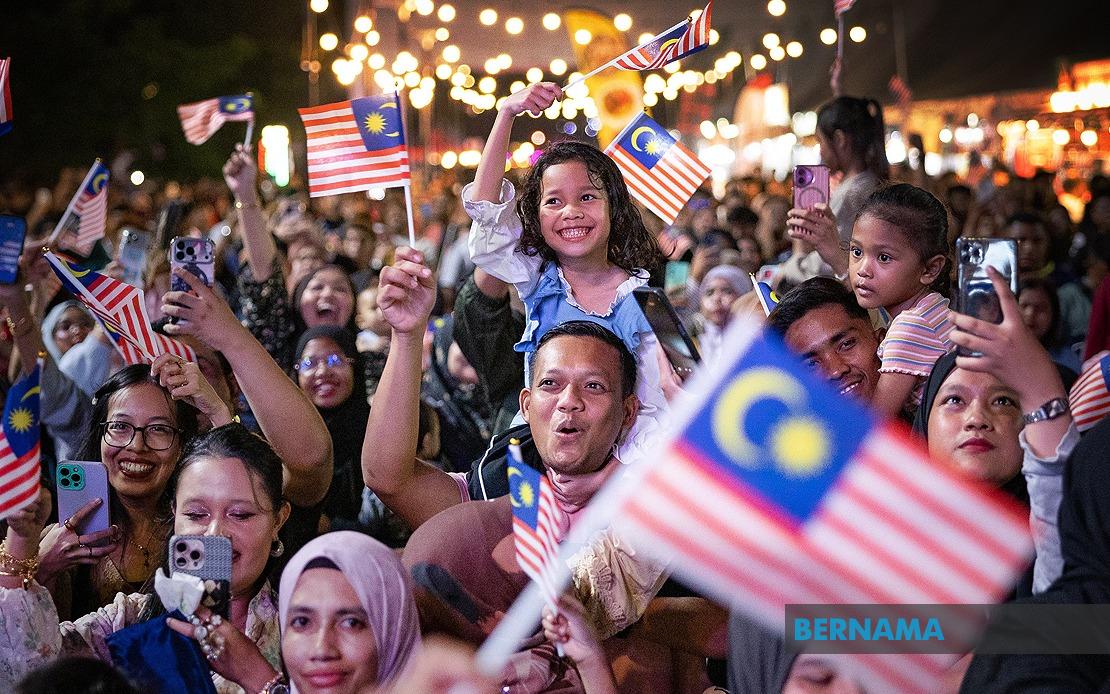
Patriotic sentiment reached fever pitch across Malaysia on National Day Eve as communities nationwide gathered for countdown celebrations and cultural showcases that underscored the nation's independence and diversity. The festivities demonstrated sustained public enthusiasm for marking the annual occasion, with major urban centres hosting orchestrated programmes that blended entertainment, history and civic pride.
Kuala Lumpur's Dataran Merdeka emerged as the centrepiece of national celebrations, drawing more than 100,000 visitors who converged on the historic square to participate in 'Kita Bagi Jadi @ Ambang Merdeka 2026,' a 90-minute concert specifically commissioned to commemorate the milestone. The venue's capacity to absorb such numbers reflected careful logistical planning, with crowds beginning to arrive from 8 pm onwards, transforming the plaza into a sea of waving Jalur Gemilang flags against the illuminated backdrop of the iconic Sultan Abdul Samad Building. The architectural grandeur of Malaysia's administrative heart provided an evocative setting for expressions of national identity.
The concert featured a carefully curated line-up of established and emerging local artists, with performers including Aina Abdul, Aman RA, Nadia Aqilah, Asmidar, Haziq Rosebi, Mimifly, Izen Kong and Pasya supported by approximately 350 backing performers. This investment in live entertainment reflected strategic decisions to engage younger demographics and mainstream audiences rather than restricting participation to formal civic ceremonies. The creative direction emphasised music, dance and narrative storytelling focused on Malaysian history and cultural heritage, positioning artistic expression as a vehicle for national consciousness.
Official attendance underscored the administration's commitment to the occasion. Hannah Yeoh, Minister in the Prime Minister's Department (Federal Territories), and Kuala Lumpur Mayor Datuk Seri Fadlun Mak Ujud both participated in proceedings, signalling high-level political endorsement. The presence of senior government representatives at multiple celebration sites across different states—including Selangor's Menteri Besar Datuk Seri Amirudin Shari and Perlis Chief Minister Datuk Seri Ab Rauf Yusoh—demonstrated a coordinated nationwide approach to marking the occasion rather than centralised ceremonialism confined to the capital.
Military pageantry and security force demonstrations added ceremonial weight to evening proceedings. The VAT 69 Commando unit executed a skydiving display that commanded attention from assembled crowds, while the Fire and Rescue Department, police and Malaysian Armed Forces presented live performances that showcased institutional capabilities and fostered civil-military connection during civilian celebrations. These elements reflected traditional approaches to National Day commemoration that have evolved over decades, blending military symbolism with entertainment and civic participation.
The midnight transition to National Day proper was orchestrated with escalating drama. Led by the Menteri Besar, coordinated shouts of 'Merdeka' resonated across Dataran Merdeka at the precise moment of changeover, accompanied by fireworks and sophisticated lighting displays that transformed the urban skyline. Subsequent performances by established artists including Datuk Ramli Sarip, Datuk Awie, Gerhana Skacinta, Merrah and Wani Kyrie extended festivities into the early hours, with film screenings of 'Mukhsin' and 'Sepet' scheduled to commence from 2 am—curating a continuous cultural experience spanning the night.
Beyond headline entertainment, venue programming encompassed diverse community activities that broadened accessibility and participation beyond concert attendance. The Bulatan Sultan Azlan Shah Run, Jualan Rahmah subsidised food sales, thrift markets, free health screenings and karaoke competitions created informal spaces where Malaysian society could gather, interact and celebrate in less formal settings. These multi-faceted offerings acknowledged that National Day engagement extends across demographic and socioeconomic boundaries, requiring programme diversity to sustain participation throughout extended festivities.
Perlis represented significant secondary celebration activity, with over 46,000 visitors attending a sports complex venue—a substantial regional turnout reflecting decentralised celebration patterns. This geographic distribution demonstrated that National Day enthusiasm extended well beyond Kuala Lumpur's concentrated urban masses, with provincial centres mobilising comparable participation despite demographic and infrastructure differences. Muhammad Sanusi's direct appeal to the Perlis gathering to 'appreciate and safeguard' national independence articulated the underlying messaging framework deployed across multiple ceremonial contexts.
The constitutional monarch's formal address carried particular symbolic weight. Tuanku Syed Sirajuddin's emphasis that contemporary independence represented an inheritance of 'long struggles, great sacrifices, and unity among diverse races' provided historical continuity and implicitly cautioned against taking sovereignty for granted. By explicitly linking past sacrifice to present responsibility, the royal message articulated a philosophical framework casting National Day observance as temporal anchor connecting history, present-day stewardship and future custodianship. This framing proved particularly resonant given contemporary pressures on social cohesion and institutional stability.
The scale of participation and consistency of enthusiasm evident across multiple venues suggests sustained public investment in National Day rituals despite the ordinary rhythms of contemporary Malaysian life. Whether animated by genuine patriotic conviction, desire for family entertainment, or social convention, the turnouts across Kuala Lumpur, Perlis and intermediate locations demonstrated that independence commemoration retains considerable mobilising power within Malaysian society. As the nation approaches 2026 marking 70 years since Merdeka, the enthusiasm observed during the 69th anniversary suggests renewed planning for what officials anticipate will be a particularly significant milestone celebration.

