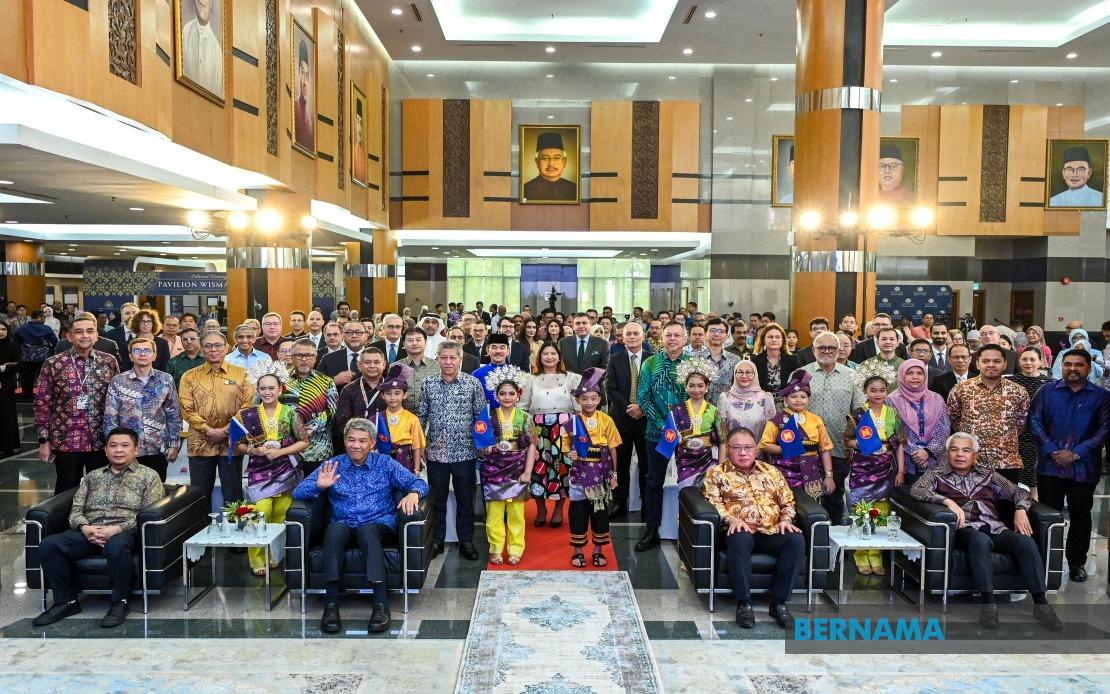
Malaysia has reinforced its enduring commitment to Southeast Asian regionalism by commemorating ASEAN's 59th founding anniversary, an occasion that underscores nearly six decades of sustained partnership and institutional contribution to the 11-member grouping. The celebration, held Monday at the Foreign Ministry headquarters in Putrajaya, drew approximately 300 attendees including government officials, diplomatic representatives and international organisation delegates, reflecting the significance Malaysia places on its role within the bloc.
The regional organisation, formally established on August 8, 1967, emerged from the Bangkok Declaration signed by Indonesia, Malaysia, the Philippines, Singapore and Thailand—five nations determined to foster cooperation across a strategically vital corner of Asia. What began as a quintet has expanded substantially over the past half-century, growing to encompass eleven member states through successive waves of enlargement that have progressively broadened the grouping's geographic reach and political weight across Southeast Asia.
Foreign Minister Datuk Seri Mohamad Hasan presided over the commemorative event, which carried the thematic declaration "59 Years of Navigating Together." This framing deliberately emphasises collective advancement through shared challenges and opportunities, a message particularly resonant given contemporary regional tensions spanning maritime disputes, climate vulnerabilities and economic interdependencies. The ministry's statement positioned ASEAN's institutional architecture around three foundational pillars—political-security cooperation, economic integration and socio-cultural exchange—each dimension reinforcing the others in pursuit of regional stability and prosperity.
The ceremony included multimedia presentation of Malaysia's specific trajectory within ASEAN's institutional evolution, screened through a video montage titled "ASEAN Journey: Navigating Our Future, Together - 59 Years of Malaysia in ASEAN." Such retrospectives serve multiple purposes: they cement historical consciousness among younger generations of policymakers and the public, illustrate Malaysia's contributions to regional norm-setting and consensus-building, and demonstrate continuity in foreign policy orientation across successive administrations. Malaysia's geographic position, straddling the Strait of Malacca and bordering several member states, has positioned it as a natural facilitator of intra-regional dialogue.
The expansion trajectory illustrates ASEAN's evolutionary character and absorptive capacity. Brunei Darussalam joined in 1984, while Vietnam's 1995 admission marked the first post-Cold War enlargement, fundamentally reshaping the grouping's geopolitical orientation. The 1997 simultaneous admission of Laos and Myanmar expanded ASEAN into mainland Southeast Asia proper, while Cambodia's 1999 accession completed the territorial consolidation of the region. Most recently, Timor-Leste's accession during the 47th ASEAN Summit in October last year represented the bloc's first enlargement in two decades, extending ASEAN's reach into the maritime Southeast and reflecting the grouping's continued relevance as a vehicle for regional integration.
Malaysia's consistent advocacy for ASEAN centrality—the principle that the grouping should anchor regional architecture and shape broader geopolitical outcomes—reflects broader strategic calculations about Malaysia's role and influence. As a middle power without the economic heft of Indonesia or Singapore's financial sophistication, Malaysia has leveraged ASEAN membership to amplify its voice in regional affairs, particularly regarding maritime security, trade arrangements and diplomatic mediation between larger powers. This positioning has made ASEAN forums instrumental in Malaysian foreign policy execution.
The commemoration also served ceremonial functions, with Tourism, Arts and Culture Minister Datuk Seri Tiong King Sing and Deputy Foreign Minister Datuk Lukanisman Awang Sauni among senior figures participating in symbolic gestures including the traditional cake-cutting ceremony. Such rituals, seemingly routine, carry diplomatic weight by visibly demonstrating governmental commitment and allowing lower-profile officials platform access. The attendance composition—spanning government, diplomacy and international organisations—reflected ASEAN's positioning as both intergovernmental mechanism and facilitator of broader transnational engagement.
For Malaysian readers and policymakers, ASEAN membership remains foundational to national strategic orientation. The grouping provides institutional mechanisms through which Malaysia coordinates responses to transnational challenges including terrorism, human trafficking, maritime piracy and pandemics. Economically, ASEAN integration through frameworks like the ASEAN Free Trade Area and ASEAN Plus Three arrangements shapes Malaysian trading patterns and investment flows, affecting employment and consumer welfare across the economy.
The political-security dimension has gained prominence as great power competition intensifies. ASEAN's doctrine of non-interference, whilst sometimes critiqued as enabling authoritarian governance within member states, has permitted the grouping to maintain cohesion despite profound internal differences. Malaysia has navigated this balance by advocating selective norm development—particularly regarding maritime law, cybersecurity and counter-terrorism—whilst respecting sovereignty principles that protect its own policy autonomy. The regional grouping's central role in forums like the East Asia Summit and ASEAN Regional Forum positions member states as interlocutors between competing powers seeking access to Southeast Asian markets and strategic assets.
Looking forward, ASEAN faces mounting pressures testing its institutional resilience. Myanmar's political crisis, complex maritime territorial disputes, climate-induced migration patterns and technological disruption all demand sophisticated collective responses. Malaysia's continued investment in ASEAN frameworks, demonstrated through such commemorative events and ongoing diplomatic engagement, reflects calculations that regional cohesion serves national interests better than unilateral assertion. The bloc's demonstrated capacity to accommodate eleven diverse nations with varying political systems, development levels and external alignments suggests mechanisms remain functional despite strains, though adaptation may be necessary as geopolitical competition sharpens and non-traditional security challenges multiply.

