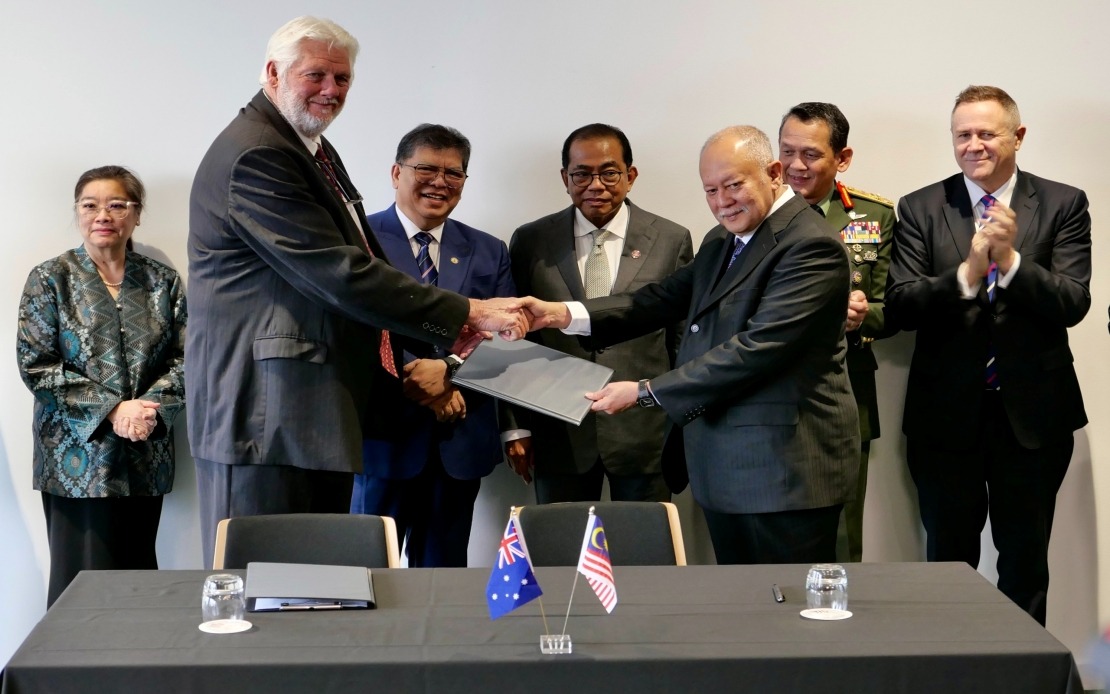
Malaysia has taken a decisive step towards self-reliance in defence manufacturing through a landmark collaboration between Weststar Defence Industries and Australia's Rocket Technologies International. Defence Minister Datuk Seri Mohamed Khaled Nordin announced the partnership during an official visit to Australia this week, framing the agreement as integral to the country's long-term security objectives and industrial ambitions. The deal represents a calculated shift in Malaysia's approach to defence procurement, moving away from sole reliance on imports towards developing indigenous expertise in advanced weapons systems.
The strategic importance of this partnership lies in its alignment with Malaysia's National Defence Industry Policy, a framework designed to cultivate homegrown capabilities in critical defence sectors. By establishing manufacturing operations on Malaysian soil, the collaboration creates pathways for knowledge transfer and skill development that extend beyond the immediate parties involved. The policy reflects regional recognition that defence autonomy requires not merely acquiring systems but mastering their design, production, and maintenance—a capability gap that has long constrained Southeast Asian nations.
Under the arrangement, Weststar will construct a production facility domestically, with rocket manufacturing commencing within approximately two years. This phased approach signals confidence in both parties' technical readiness while allowing time for workforce training, supply chain development, and regulatory frameworks to mature. The subsequent expansion into missile production indicates ambitions that transcend incremental industrial growth, potentially positioning Malaysia as a regional hub for advanced aerospace-defence manufacturing.
Integration into Rocket Technologies International's global supply chain represents a significant economic opportunity that extends beyond military applications. Malaysian companies will gain access to international defence procurement networks, creating export possibilities and fostering competition that drives innovation. This exposure to global standards and practices should elevate Malaysian defence manufacturers' technical sophistication, benefiting civilian aerospace sectors as well. The arrangement effectively transforms Malaysia from a consumer of foreign defence technology into a participant in global value chains.
Defence Minister Mohamed Khaled emphasized that the investment generates substantial returns for Malaysia's defence sector while simultaneously strengthening national security infrastructure for future generations. This dual benefit—combining economic growth with strategic capability building—reflects a pragmatic approach to defence policy that recognizes security investments as legitimate national development priorities. Such framing helps justify defence spending to constituencies concerned primarily with immediate economic needs, demonstrating how security and prosperity interconnect.
The partnership was formalized during Mohamed Khaled's three-day working visit to Australia, underscoring how diplomatic engagement creates space for substantial commercial and strategic agreements. The signing ceremony at the National Convention Centre in Canberra involved Weststar Group founder Tan Sri Dr Syed Azman Syed Ibrahim and RTI founder Allan James Payne, indicating high-level commitment from both organizations. This personal involvement by principals signals confidence that the partnership extends beyond contractual obligations into deeper institutional relationships.
Malaysia's delegation visit to the Institute for Space, Defence and Advanced Technologies at the University of Southern Queensland illuminated how Australia leverages academia-industry collaboration to advance defence innovation. The inspection of advanced composite manufacturing and hypersonics laboratories demonstrated that modern defence capability requires continuous investment in research infrastructure and intellectual capital. For Malaysian defence planners, this exposure provides a blueprint for developing similar ecosystem frameworks domestically, recognizing that procurement alone cannot substitute for indigenous innovation capacity.
The high-level composition of Malaysia's delegation—including Royal Malaysian Air Force chief General Tan Sri Muhamad Norazlan Aris, the National Defence University vice-chancellor, and the National Aerospace Industry Corporation Malaysia chief executive—reflects the partnership's significance across military, educational, and industrial domains. This multi-stakeholder involvement suggests coordinated national effort rather than isolated commercial transaction, with implications for curriculum development, military doctrine, and industrial policy across multiple government agencies.
Bilateral defence cooperation with Australia extends beyond the Weststar-RTI agreement. Defence Minister Mohamed Khaled's meeting with Australian Deputy Prime Minister and Defence Minister Richard Marles discussed broadening strategic cooperation, indicating both nations recognize shared interests in regional stability and maritime security. Enhanced Malaysia-Australia defence relations carry implications for Southeast Asian security architecture, particularly regarding counterbalancing regional power dynamics and maintaining freedom of navigation in contested waters.
Parliamentary engagement during the visit, including discussions with Speaker Milton Dick and Australian parliamentarians, positioned the partnership within broader institutional frameworks. Democratic oversight of defence agreements through parliamentary processes enhances legitimacy and ensures accountability. Malaysia's parliamentary delegation's participation signals that defence cooperation commands cross-party support, suggesting this policy transcends electoral cycles and domestic political competition.
For Malaysian stakeholders, the partnership creates employment opportunities in high-skilled manufacturing sectors, fostering technical expertise in aerospace and advanced materials. Local supply chain development will generate demand for precision engineering, quality assurance, and logistical capabilities, potentially stimulating secondary industries. Workers and companies participating in this ecosystem gain exposure to international standards and practices, improving overall industrial competitiveness beyond the defence sector.
The agreement must navigate complexities inherent in defence technology transfer and international security regulations. Export controls governing advanced technologies and intellectual property sharing require careful negotiation to ensure Malaysia gains sufficient capabilities while satisfying Australian and international compliance frameworks. Successfully managing these regulatory dimensions determines whether the partnership delivers genuine sovereignty benefits or remains constrained by technological dependence masked by domestic assembly operations.
Looking forward, this partnership positions Malaysia as an increasingly self-reliant regional defence power while deepening strategic alignment with Australia. Success in establishing indigenous rocket and missile production capability will enhance Malaysia's strategic autonomy and potentially create export opportunities across Southeast Asia, where nations face similar pressures to develop advanced defence systems domestically rather than depending exclusively on distant suppliers.

