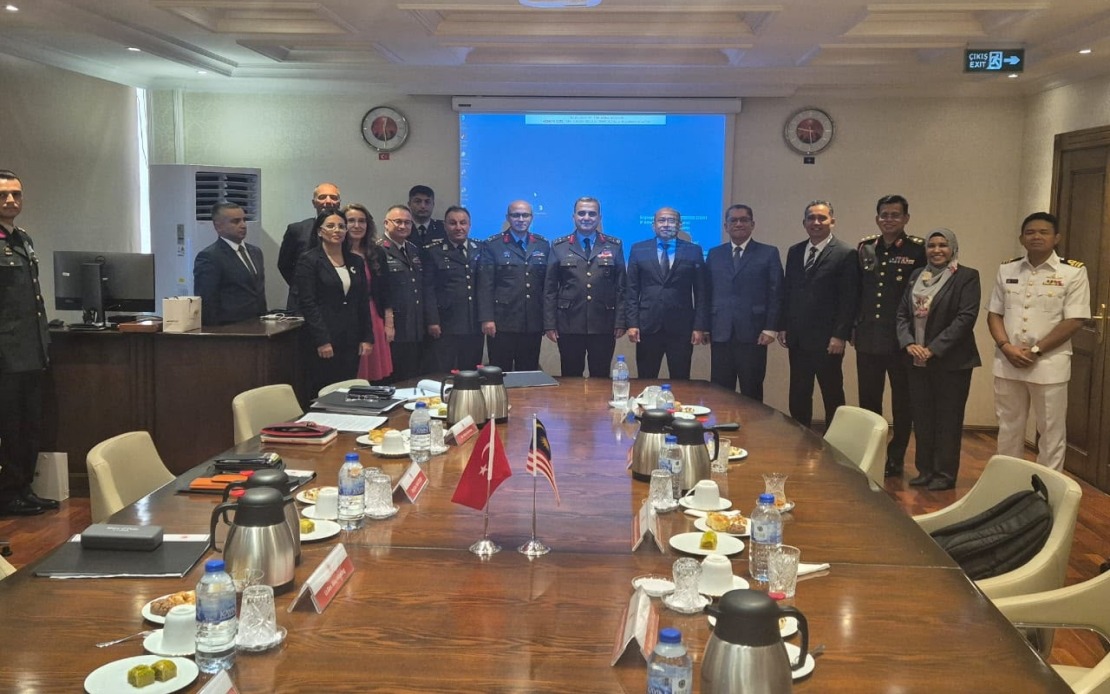
Malaysia and Türkiye have taken a significant step in formalising their defence relationship through their inaugural policy dialogue held in Ankara this week, signalling deepening military engagement between the two nations. The meeting, which took place at Türkiye's Ministry of National Defence headquarters, marks a transition from ad-hoc defence contacts to institutionalised strategic consultation, establishing a precedent for regular high-level discussions on security matters of mutual concern.
The Malaysian delegation was led by Datuk Yani Daud, deputy secretary-general of policy at Malaysia's Ministry of Defence, while the Turkish side was represented by Lt Gen Ilkay Altindag, the director-general of defence and security at the Turkish defence ministry. This level of representation underscores the seriousness both governments attach to the dialogue, moving beyond routine diplomatic courtesies to substantive policy-level engagement on military strategy and operational cooperation.
During their discussions, both nations examined a comprehensive agenda encompassing defence policy frameworks, long-term strategic planning, and the complex geopolitical security landscape affecting their respective regions. The talks included an extensive exchange of views on how regional stability can be maintained through sustained dialogue and cooperative mechanisms, reflecting shared concerns about transnational security challenges that transcend traditional bilateral relationships.
Malaysia explicitly acknowledged Türkiye's diplomatic efforts in promoting peace in West Asia, particularly highlighting the significance of the Makkah Pact as an instrument for de-escalation and regional conflict prevention. This recognition carries particular weight given Malaysia's own commitment to regional stability and its diplomatic role within Muslim-majority nations, suggesting alignment between Kuala Lumpur and Ankara on approaches to Middle Eastern security challenges that increasingly intersect with Southeast Asian strategic interests.
A crucial outcome of the meeting was the agreement to establish formal Terms of Reference governing future policy talks. This framework provides both nations with a structured platform to discuss cooperation instruments, identify areas for military-to-military collaboration, and evaluate potential defence programmes that could enhance interoperability and capability-sharing. Such institutional architecture transforms what might otherwise remain episodic consultations into a sustainable mechanism for ongoing strategic coordination.
The Malaysian defence ministry formally extended an invitation to Türkiye to participate in the second Policy Talk, scheduled to take place in Kuala Lumpur during 2025. This reciprocal arrangement, alternating venue between the two capitals, reflects established diplomatic protocol for strategic dialogues and indicates both parties' commitment to embedding these conversations within their respective institutional frameworks. The shift in venue also signals Malaysia's intention to position itself as an equal stakeholder in shaping this emerging partnership.
This developing relationship must be understood within the broader context of Malaysia's defence diversification strategy. While Malaysia maintains longstanding defence partnerships with Western nations, particularly the United States and European allies, the expansion of military engagement with Türkiye reflects a deliberate effort to cultivate relationships with rising powers and fellow Muslim-majority nations pursuing independent defence trajectories. Türkiye, as a NATO member with substantial indigenous defence capabilities and a complex regional role spanning Europe, the Middle East, and increasingly, Asia, offers Malaysia access to different technological perspectives and strategic insights.
For Türkiye, the engagement signals its broadening geopolitical reach beyond traditional Euro-Atlantic focus areas. Ankara has been systematically expanding defence relationships across the Islamic world and in regions of strategic importance, viewing military partnerships as instruments of soft power and diplomatic influence. Malaysia's significance lies not merely in bilateral terms but as a gateway to Southeast Asian security networks and as a representative of the diverse Muslim world's security concerns.
The timing of this inaugural dialogue reflects broader shifts in global security architecture. As traditional Western-led security arrangements face scrutiny from some quarters and as regional powers seek greater autonomy in defence matters, initiatives like the Malaysia-Türkiye Policy Talk represent attempts to construct alternative frameworks for strategic consultation. These arrangements need not be confrontational; rather, they reflect the multipolar security environment where nations pursue partnerships across ideological and geographical boundaries.
From a Malaysian perspective, this partnership potentially offers several practical benefits. Türkiye possesses advanced defence technologies, particularly in unmanned systems and aerospace sectors, where collaboration could enhance Malaysian capabilities. Additionally, intelligence and information-sharing protocols established through policy talks can provide Malaysian defence planners with broader perspectives on geopolitical developments affecting regional security, from Middle Eastern dynamics to great power competition in strategic waterways.
The reference to the Mid-Term Review of Malaysia's Defence White Paper suggests this partnership aligns with officially articulated strategic priorities. The defence white paper outlines Malaysia's security vision and identifies key capability gaps and partnership objectives, indicating that engagement with Türkiye addresses identified strategic requirements rather than representing an ad-hoc diplomatic gesture.
Looking forward, the establishment of regular policy talks creates space for exploring concrete defence cooperation mechanisms. Beyond dialogue, both nations could potentially pursue joint training exercises, technical exchange programmes, or collaborative defence research initiatives. Such deepening engagement would represent a natural evolution from policy-level consultation to operational-level cooperation.
This initiative also reflects Malaysia's broader Southeast Asian context. As ASEAN nations pursue increasingly diverse defence partnerships to maintain strategic autonomy amid great power competition, Malaysia's outreach to Türkiye demonstrates how individual members are calibrating their external relationships to serve national interests while remaining committed to regional frameworks. The Malaysia-Türkiye dialogue thus represents a microcosm of contemporary international relations where traditional alliances coexist with flexible, issue-based partnerships adapted to evolving security environments.

