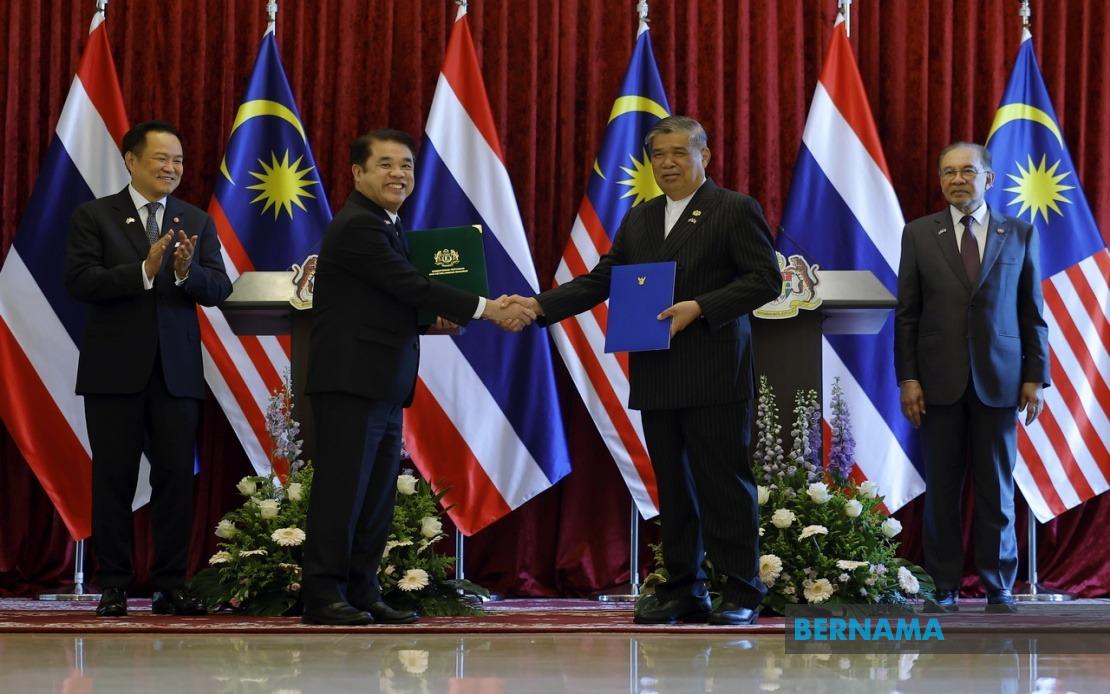
Thailand and Malaysia have committed to substantially expanding their agricultural collaboration through the signing of a broad memorandum of understanding that addresses food security, technological advancement, and workforce development. The agreement emerged from high-level bilateral discussions held Thursday between Thai Prime Minister Anutin Charnvirakul and Malaysian Prime Minister Datuk Seri Anwar Ibrahim in Putrajaya, marking a significant step forward in the two nations' agricultural relationship and broader economic partnership.
The scope of the freshly inked accord encompasses cooperation spanning multiple agricultural domains: crop production, livestock management, fisheries development, scientific research, technology sharing mechanisms, human capital development, and integrated food security strategies. Both governments recognized that agriculture remains a vital foundation for regional stability and prosperity, particularly as Southeast Asia navigates evolving global food systems and climate-related uncertainties. The cooperation framework signals that Malaysian and Thai policymakers view agricultural resilience as inseparable from national food sufficiency and economic growth.
A particularly consequential aspect of the bilateral understanding involves the resolution of longstanding market access complications affecting two major commodities: shrimp and barramundi, commonly known as seabass. These trade irritants had previously constrained the flow of these high-value fisheries products between the two countries, creating friction that extended beyond individual producers to affect broader agricultural commerce. By directly addressing these obstacles, the two governments demonstrated pragmatism in removing barriers that had limited farmers' and aquaculturists' export opportunities and market integration.
According to Thai Government spokesperson Ratchada Thanadirek, the agricultural ministers from both nations now carry responsibility for accelerating the implementation of measures designed to enhance market access and alleviate the practical difficulties faced by farming communities on either side of the border. This delegation of specific implementation authority to ministers reflects a structured approach to ensuring that agreements translate into tangible benefits rather than remaining ceremonial declarations. The timeline for resolving remaining complications was deliberately compressed to reflect the urgency both governments attach to this initiative.
The agricultural framework forms part of a substantially more expansive bilateral cooperation agenda that stretches well beyond farming and fisheries. The two leaders also reached consensus on deepening engagement across multiple economic sectors including international trade, foreign investment attraction, tourism promotion, physical infrastructure development, and security collaboration. This holistic approach recognizes that agricultural advancement cannot succeed in isolation from broader economic conditions, investment climate stability, and institutional cooperation.
A concrete numerical target provides measurable ambition for the bilateral relationship: both governments have reaffirmed their objective of achieving thirty billion United States dollars in annual bilateral trade volume within the foreseeable future. This target reflects confidence that deepened cooperation across agriculture, energy, high-technology manufacturing, and supply chain integration can substantially expand mutual economic value. For Malaysian enterprises and farmers, access to Thai markets and supply chain partnerships represents meaningful commercial expansion opportunities, while Thai agricultural producers gain comparable benefits from Malaysian market openness and investment.
The memorandum's emphasis on supply chain cooperation across food security, energy resources, and advanced manufacturing demonstrates sophisticated economic thinking about regional interdependence. Both nations recognize that food security transcends national borders in an increasingly integrated Southeast Asia, and that collaborative approaches to production, logistics, and distribution create mutual advantages unavailable through purely competitive posturing. This supply chain integration also contributes to broader energy cooperation and technological advancement, linking agricultural development to Malaysia and Thailand's wider development objectives.
Prime Minister Anutin's visit marks his first bilateral engagement with Malaysia since his reappointment to office in March 2026, underscoring the significance both governments attach to this relationship during what appears to be a particularly active phase of Thai policymaking and diplomatic engagement. The timing and substance of the visit suggest that Thailand views Malaysia as a cornerstone partner for regional economic integration and food system stabilization. For Malaysian policymakers, the visit reinforces their commitment to deepening ASEAN integration through substantive bilateral partnerships that complement multilateral arrangements.
The bilateral discussions carried additional symbolic weight given that 2027 will mark the seventieth anniversary of Malaysia-Thailand diplomatic relations. Prime Minister Anutin has directed Thai government agencies to expedite implementation of the agreements and finalize outstanding memoranda of understanding by that milestone date, transforming the anniversary into a celebration of renewed cooperation frameworks rather than merely historical commemoration. This forward-looking approach suggests that both nations view their relationship as continuously evolving rather than settled.
A particularly practical element of the visit involves the scheduled joint opening on Friday of a new road connecting border infrastructure facilities at Bukit Kayu Hitam in Kedah with Thailand's corresponding Sadao complex. This physical infrastructure project—linking Malaysian and Thai immigration, customs, quarantine, and security installations—enables more efficient cross-border movement of goods and people. Such infrastructure improvements directly support the agricultural and supply chain cooperation outlined in the memorandum, demonstrating how diplomatic agreements require supporting physical and logistical arrangements to achieve practical effectiveness.
For Malaysian agricultural producers, particularly those engaged in aquaculture and seafood processing, the resolution of barramundi and shrimp trade barriers opens previously constrained export pathways into Thai markets and through Thailand into broader Southeast Asian distribution networks. The technology transfer provisions within the MoU similarly create opportunities for Malaysian farmers and fisheries operators to adopt improved production methods and quality enhancement techniques. Meanwhile, human resource development cooperation allows Malaysian agricultural professionals to access Thai expertise while contributing their own knowledge to regional advancement.
The emphasis on resolving specific trade complications rather than deferring them signals that both governments have moved beyond diplomatic courtesy into substantive problem-solving. This pragmatic orientation, combined with concrete infrastructure projects and clearly delineated ministry-level responsibilities, suggests that the current bilateral engagement cycle may deliver more lasting results than some previous cooperation frameworks. The agricultural memorandum thus represents not merely a ceremonial agreement but a foundation for intensifying Malaysia-Thailand economic integration at a moment when regional food security and supply chain resilience have become increasingly important considerations for Southeast Asian policymakers.

