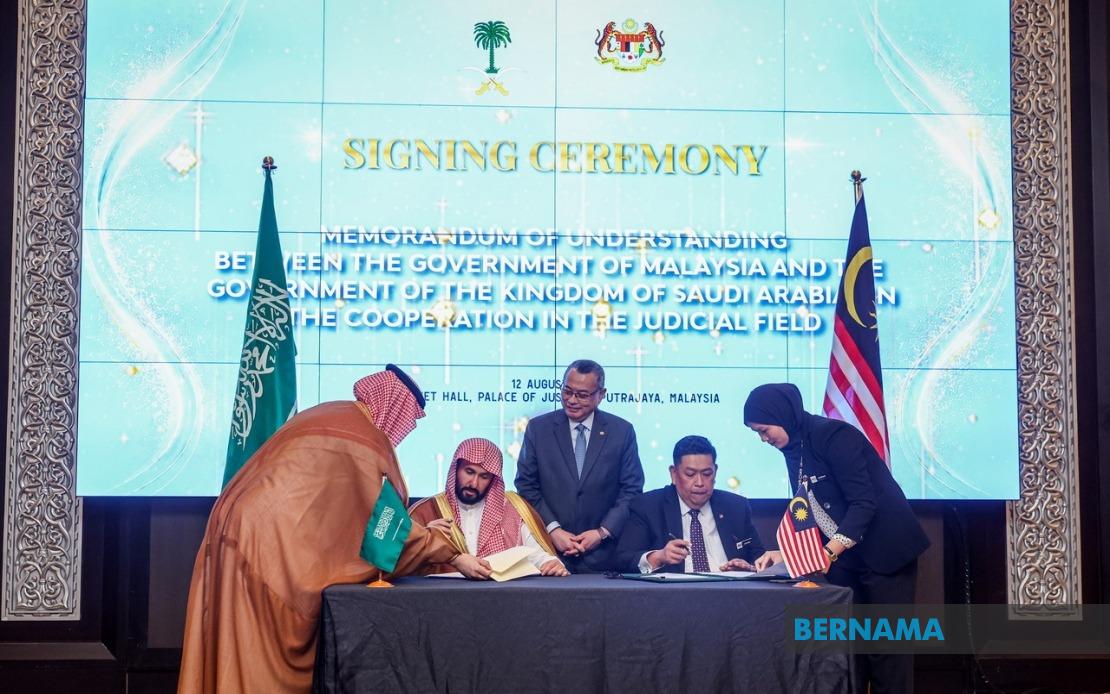
Malaysia and Saudi Arabia have taken a significant step toward deepening their legal and institutional ties by executing a memorandum of understanding that commits both nations to expanded cooperation across the judicial sphere. The accord was formalised at the Palace of Justice in Putrajaya on August 12, with Chief Registrar of the Federal Court of Malaysia Azhaniz Teh Azman Teh and Saudi Arabian Minister of Justice Sheikh Dr Waleed Mohammed Alsmani affixing their signatures to the document. Chief Justice Tun Wan Ahmad Farid Wan Salleh witnessed the ceremony, underscoring the high-level importance both governments place on the development of their legal relationship.
The agreement establishes a structured platform through which Malaysia's judiciary and its Saudi Arabian counterpart can pursue collaborative initiatives on multiple fronts. The framework encompasses civil case management methodologies, judicial technology infrastructure and the broader digitalisation of court processes—areas where Malaysia has developed considerable expertise through its e-Court system. Beyond operational matters, the MoU facilitates the systematic exchange of practical insights and publicly accessible judicial information, creates avenues for institutional visits between senior judicial officers, and enables regular dialogue sessions that allow both systems to learn from each other's experiences and innovations.
The timing of this accord reflects a broader pattern of strengthening bilateral relations between Kuala Lumpur and Riyadh. The visit by Sheikh Dr Waleed served as the catalyst for the MoU signing, representing a deliberate diplomatic engagement aimed at consolidating the traditionally cordial ties between the two predominantly Muslim-majority nations. For Malaysia, such initiatives underscore its positioning as a jurisdiction willing to export judicial knowledge and best practices to partners in the broader Islamic and Asian world, enhancing its regional standing in legal and institutional development.
A particularly notable aspect of the cooperation framework involves knowledge-sharing on the Malaysian judiciary's approach to sexual offences against children. This component of the MoU demonstrates that the partnership extends beyond administrative efficiency to encompass substantive legal expertise in protecting vulnerable populations. By discussing how Malaysia's courts handle such sensitive matters, both nations can benefit from comparative approaches to prosecuting and adjudicating crimes that pose challenges across different legal traditions and social contexts. This reflects a growing recognition globally that institutional cooperation on child protection measures strengthens judicial systems across borders.
The e-Court system, which featured prominently in the dialogue sessions between the two delegations, represents one of Malaysia's most significant achievements in judicial modernisation. The digitalisation of court proceedings has enhanced efficiency, reduced backlogs, and improved access to justice for litigants and legal practitioners. By sharing technical specifications, implementation strategies, and lessons learned from rolling out such a system across a multi-level court hierarchy, Malaysia provides Saudi Arabia with valuable guidance as it contemplates or advances its own digital transformation initiatives. The reverse flow of knowledge—where Saudi Arabia shares its institutional structures and experiences—enriches Malaysia's understanding of how other major judicial systems operate.
For Malaysia specifically, this agreement carries implications for how the country positions itself within the Association of Southeast Asian Nations and beyond. As a jurisdiction that regularly enters into bilateral and multilateral judicial cooperation agreements, Malaysia demonstrates its commitment to harmonising practices and standards with international partners. This approach facilitates smoother legal cooperation, aids in enforcing judgments across borders, and creates familiarity that benefits Malaysian businesses, professionals, and citizens operating in Saudi Arabia. Conversely, increased engagement with Malaysian courts benefits Saudi Arabian stakeholders seeking legal remedies or clarity on shared commercial, family, or criminal law matters.
The broader context of this MoU extends to how Southeast Asian nations increasingly engage with major global and regional powers on institutional matters. Malaysia's willingness to formalise judicial cooperation with Saudi Arabia—a nation of significant economic and geopolitical weight—signals that the country views such partnerships as foundational to its development aspirations. Saudi Arabia, as a major economy and a hub of Islamic jurisprudence, brings substantial resources and institutional sophistication to any partnership it enters. The exchange with Malaysia becomes mutually beneficial, as both nations learn from each other's approaches to managing modern judicial systems.
The implementation of this MoU will likely unfold gradually, with the office of the Chief Registrar taking the lead in coordinating specific initiatives. Regular exchanges of delegations, joint training programmes for judicial officers, and technical missions focusing on particular areas of shared interest will probably characterise the initial phase. The Malaysian judiciary's statement expressing optimism about implementation suggests that concrete mechanisms and timelines are likely being developed even as formal procedures are concluded. This pragmatic approach ensures that the MoU does not remain merely symbolic but translates into tangible benefits for both judiciaries.
Looking forward, this agreement may serve as a template for Malaysia's engagement with other nations seeking to modernise their judicial systems or enhance their institutional capacity. The emphasis on technology transfer, practical experience-sharing, and structured dialogue reflects best practices in international judicial cooperation that have proven effective in other bilateral and regional arrangements. For Southeast Asian observers, Malaysia's role in facilitating such partnerships demonstrates the region's capacity to contribute meaningfully to global judicial standards and practices, positioning ASEAN countries not merely as recipients of institutional expertise but as active contributors to international legal development.

