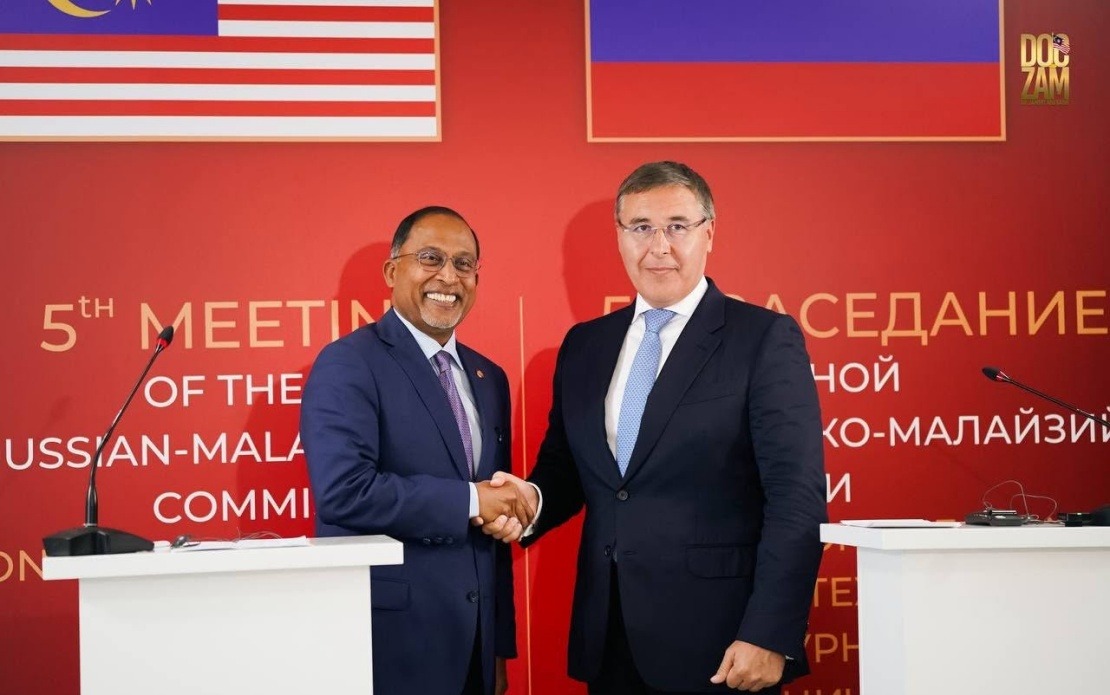
Malaysia and Russia are moving swiftly to cement their bilateral relationship by committing to finalise a comprehensive 2027 Joint Action Plan before the year concludes. Higher Education Minister Datuk Seri Dr Zambry Abd Kadir announced the agreement following the Fifth Meeting of the Malaysia-Russia Joint Commission for Economic, Scientific, Technical and Cultural Cooperation, which took place in Vladivostok. The framework aims to transform the warmth of high-level political ties—involving His Majesty Sultan Ibrahim and Russian President Vladimir Putin—into tangible, measurable outcomes that will benefit citizens of both nations.
The decision to accelerate the joint action plan's completion underscores both countries' recognition that ad-hoc cooperation, while useful, requires institutional scaffolding to achieve lasting impact. By establishing clear structures and timelines, Malaysia and Russia are signalling to their respective business communities, academic institutions, and research bodies that partnership frameworks carry genuine weight and will be operationalised. For Malaysian stakeholders, this timeline offers clarity on which sectors will receive concentrated attention and resources over the coming years, enabling better strategic planning.
In the educational sphere, Russia's commitment to provide 40 scholarships annually to Malaysian students represents a sustained investment in human capital development. These positions are particularly valuable given Malaysia's pursuit of engineering and technological talent—fields where Russian expertise remains world-recognised. Beyond scholarship numbers, both countries have endorsed the establishment of a Malaysia-Russia Rectors' Forum scheduled for 2027, a platform that promises to facilitate direct dialogue between university leadership on research priorities, student exchanges, and joint academic ventures. The expansion of the MAI-UniKL Russian Aerospace Programme further signals deepening technical collaboration in a sector where Russian knowledge remains formidable.
Trade and food security considerations have equally animated discussions, with both nations exploring expanded market access and strengthened commercial ties. Of particular significance is the dialogue around fertiliser supply, including urea, which carries direct implications for Malaysia's agricultural sector and food security objectives. As regional grain prices and fertiliser costs remain volatile—partly reflecting geopolitical tensions and supply chain disruptions—Malaysia's engagement with Russia on agricultural inputs represents pragmatic diversification away from traditional suppliers. This bilateral conversation thus extends beyond commercial advantage to encompass national resilience.
The cooperation framework increasingly encompasses strategic and emerging technology domains that will shape the next decade's geopolitical and economic landscape. Artificial intelligence, digital technology, smart cities, information security, and telecommunications feature prominently on the agenda, reflecting both nations' recognition that technological capability now determines competitive positioning. Russia's experience in cybersecurity and AI development may offer Malaysian government and private sector entities valuable insights, while Malaysia's Southeast Asian market knowledge and digital economy innovations could benefit Russian enterprises seeking regional expansion.
Energy sector collaboration demonstrates particularly practical dimensions. Liquefied natural gas and liquefied petroleum gas cooperation speak to Malaysia's role as a regional energy hub and Russia's position as a major global energy producer. The framework's inclusion of renewable energy and peaceful nuclear energy exploration signals both countries' awareness of the energy transition imperative, even as they maintain engagement across conventional energy partnerships. For Malaysia, particularly, these conversations carry weight given the nation's aspirations to develop domestic renewable capacity while managing energy security concerns.
Financial cooperation initiatives represent perhaps the most forward-looking dimension of the bilateral relationship. Collaboration between Bank Negara Malaysia and Russia's central bank, coupled with exploration of Labuan's potential as an international financial centre and ASEAN gateway, speaks to Malaysia's positioning as a regional financial services hub. The specific mention of Islamic finance cooperation recognises Malaysia's pre-eminence in this domain and offers opportunities for Russian financial institutions to access expertise and markets. Digital assets collaboration similarly addresses contemporary financial innovation, positioning both nations at the frontier of fintech development.
Three cooperation agreements exchanged at the meeting—involving UiTM partnerships with Moscow Power Engineering Institute and the Institute of Experimental Medicine, plus UTHM's arrangement with the State University of Land Use Planning—instantiate the framework's principles through concrete institutional links. These agreements transform abstract bilateral commitments into specific working relationships where Malaysian and Russian scholars and students will interact regularly, conduct joint research, and develop professional networks. Such person-to-person connections often prove more durable than government-to-government arrangements, creating constituencies invested in sustained cooperation.
The momentum will culminate in 2027 when Malaysia assumes the role of host for the sixth Joint Commission meeting, coinciding with the 60th anniversary of diplomatic relations. This scheduling choice carries symbolic weight, transforming a routine organisational meeting into a commemoration of six decades of engagement. It also provides Malaysia an opportunity to demonstrate infrastructure, institutional maturity, and commitment to partnership—considerations that may influence Russia's perception of Malaysia as a reliable ally in a region where influence is contested.
For Malaysia and Southeast Asia more broadly, this deepening Russia partnership reflects a deliberate strategy of maintaining diverse international relationships despite pressures toward polarisation. Malaysia's simultaneous engagement with Western partners, China, and Russia—coupled with ASEAN's non-aligned traditions—reflects a pragmatic acknowledgment that regional stability and national prosperity depend on avoiding exclusive bloc alignment. Russian cooperation in education, technology, energy, and finance provides counterbalance and alternative pathways for Malaysian development, particularly in domains where Western sources face restrictions or impose conditions Malaysia may find constraining.
The emphasis on mutual respect and benefit in Dr Zambry's closing statement reaffirms Malaysia's foundational diplomatic principle. This language, while routine in official statements, carries genuine significance in contexts where power imbalances might tempt stronger actors toward exploitative arrangements. Malaysia's insistence on reciprocal benefit serves as a reminder that bilateral relationships, however asymmetric in certain dimensions, must demonstrate tangible value to both parties to sustain political support domestically.
The 2027 joint action plan thus represents far more than a bureaucratic exercise. It constitutes a binding commitment to translate diplomatic rhetoric into institutional reality, creating frameworks within which Malaysian and Russian institutions, businesses, and individuals can collaborate effectively. Success will depend on implementation—the degree to which the agreements reached in Vladivostok translate into functioning partnerships, visible outcomes, and mutual prosperity. For Malaysian policymakers and stakeholders, the challenge ahead involves ensuring that these bilateral commitments align with domestic development priorities and generate measurable benefits for the population.

