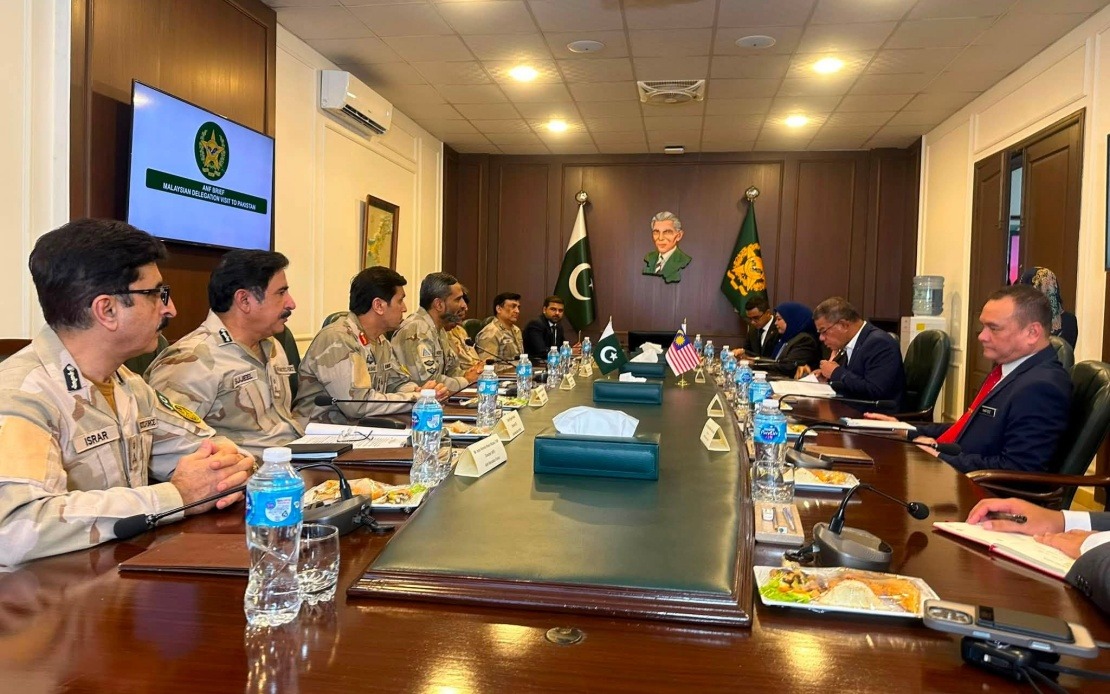
Malaysia and Pakistan are moving to formalise their anti-narcotics collaboration through a proposed Memorandum of Understanding designed to create a more systematic and robust approach to tackling the region's mounting drug crisis. Home Minister Datuk Seri Saifuddin Nasution Ismail disclosed the initiative following discussions held at the Anti-Narcotics Force (ANF) Pakistan headquarters in Islamabad, where he was briefed by Director-General Major General Abdul Moeed. The framework represents a significant step in transforming bilateral cooperation from ad-hoc coordination into a structured, long-term partnership built on shared intelligence and coordinated enforcement action.
The urgency underlying this agreement stems from the dramatic evolution of drug threats across Asia. Synthetic narcotics, particularly methamphetamine, have proliferated throughout the region, while criminal enterprises have become increasingly sophisticated in deploying transnational networks capable of evading detection across multiple jurisdictions. These organisations operate with financial resources and logistical capabilities that dwarf those of individual nations, making unilateral action inadequate. The complexity of modern trafficking demands enforcement agencies work in concert, pooling resources and intelligence to dismantle supply chains before contraband reaches street-level markets.
Pakistan's strategic importance in this regional calculus cannot be overstated. Positioned directly along trafficking corridors extending from Afghanistan—where opium production remains a major revenue source for armed groups—Pakistan occupies a critical choke point in global drug flows. Narcotics flowing through Pakistani territory eventually reach markets across South Asia, Southeast Asia, and beyond. For Malaysia, situated at the terminus of many Asian trafficking routes, cooperation with Islamabad is not merely advantageous but essential. Without collaboration upstream, domestic enforcement agencies face an endless battle against supply that constantly replenishes itself from sources beyond national control.
The bilateral relationship has already demonstrated practical value. Between 2012 and 2018, Malaysian and Pakistani agencies jointly coordinated over 28 cases involving significant quantities of illicit drugs and criminal networks. These successes, however, underscore the potential for even greater impact with formalised structures. Saifuddin Nasution emphasised that genuine cooperation extends far beyond treaty language. The MoU is intended to catalyse real operational changes: accelerated intelligence sharing, synchronised operations guided by intelligence analysis, and systematic training exchanges that elevate capabilities across both law enforcement establishments. These mechanisms will enable the two nations to identify trafficking patterns, anticipate shipments, and intercept contraband before it enters circulation.
During his two-day official visit to Islamabad, which commenced on Thursday, August 20, the Home Minister also engaged with Pakistan's political leadership on the broader architecture of bilateral relations. A courtesy call on Deputy Prime Minister and Foreign Minister Mohammad Ishaq Dar revealed the interconnected nature of Malaysia-Pakistan ties. Discussions ranged across geopolitical developments and regional security to economic collaboration encompassing trade, investment, and food security—topics that acquire heightened relevance as supply chain disruptions and inflation shape regional priorities. Pakistan's potential as a supplier of rice and meat addresses direct Malaysian concerns about agricultural self-sufficiency and market diversification.
A parallel track of negotiations with Pakistan's Interior and Narcotics Control Minister Syed Mohsin Raza Naqvi proved equally consequential. Both officials consented to establish a Joint Working Group that will deepen cooperation across security matters, narcotics enforcement, and police training. This institutional mechanism ensures that cooperation does not dissipate between high-level visits but rather maintains momentum through regular engagement and coordinated planning. The signing of the International Transfer of Prisoners Agreement during this meeting further substantiates the partnership, enabling both nations to manage the custody and prosecution of transnational criminal suspects more efficiently.
Beyond narcotics, the visit showcased Malaysia's interest in adopting Pakistani technological innovations in identity management and border security. The delegation's briefing at Pakistan's National Database and Registration Authority (NADRA), led by chairman Lt Gen Muhammad Munir Afsar, focused on biometric systems, digital identity verification, and technology-enabled civil administration. NADRA's integrated approach—combining identity databases with border management protocols and law enforcement support—represents a model that Malaysia's Home Ministry views as potentially applicable to Malaysian contexts. The comparative advantage offered by studying another nation's systems lies in understanding which investments yield genuine security gains versus which consume resources without proportionate returns.
This technological dimension carries particular significance for Malaysia's digital transformation agenda aligned with the MADANI Government's broader objectives. Enhancing identity management infrastructure, e-government service delivery, and cybersecurity capabilities directly supports law enforcement priorities while simultaneously improving public-sector efficiency. The proposed expertise exchange and cooperation framework will enable Malaysian agencies to evaluate NADRA's methodologies, assess their transferability to Malaysian institutional contexts, and potentially adapt successful practices to domestic circumstances. Such technological cooperation, though less visible than narcotics seizures, ultimately creates the informational and administrative foundations upon which effective law enforcement rests.
The timing of these initiatives reflects regional realities that transcend bilateral relations between Kuala Lumpur and Islamabad. Synthetic drug proliferation, militant financing through narcotics trafficking, and organised crime increasingly represent transnational security challenges that no single nation can contain alone. Southeast Asia's geographical position—sandwiched between major drug production zones in the Golden Triangle and Crescent and major consumer markets in East Asia—renders the region uniquely vulnerable to trafficking pressures. Malaysia, as both a transit corridor and a market with significant consumption, bears particular exposure to these flows. Strengthening upstream cooperation with Pakistan addresses supply dynamics that domestic enforcement, however vigilant, cannot independently resolve.
The formation of structured cooperation mechanisms also signals to criminal networks that enforcement capabilities are consolidating across borders. Intelligence sharing means that a transaction detected in one jurisdiction informs investigations in another. Coordinated operations prevent traffickers from exploiting gaps between jurisdictions. Training exchanges raise enforcement standards throughout the partnership, eliminating weak links that criminal organisations typically exploit. These cumulative effects create an environment where trafficking becomes progressively riskier and less profitable, theoretically incentivising either cessation or displacement to regions with weaker cooperation frameworks.
For Malaysian readers and policymakers, the significance extends beyond immediate narcotics concerns. The Malaysia-Pakistan MoU exemplifies how bilateral partnerships address challenges that regional forums like ASEAN sometimes struggle to tackle due to consensus requirements and sovereignty sensitivities. Direct country-to-country cooperation, particularly between nations with complementary geographic advantages and institutional strengths, often achieves results that broader multilateral arrangements cannot. As transnational crime continues evolving in sophistication and reach, such pragmatic bilateral frameworks will likely prove increasingly central to Malaysian security strategy. The visit to Islamabad, therefore, represents more than diplomatic courtesies; it constitutes a deliberate investment in institutional capacity and intelligence networks that will shape Malaysia's security landscape for years ahead.

