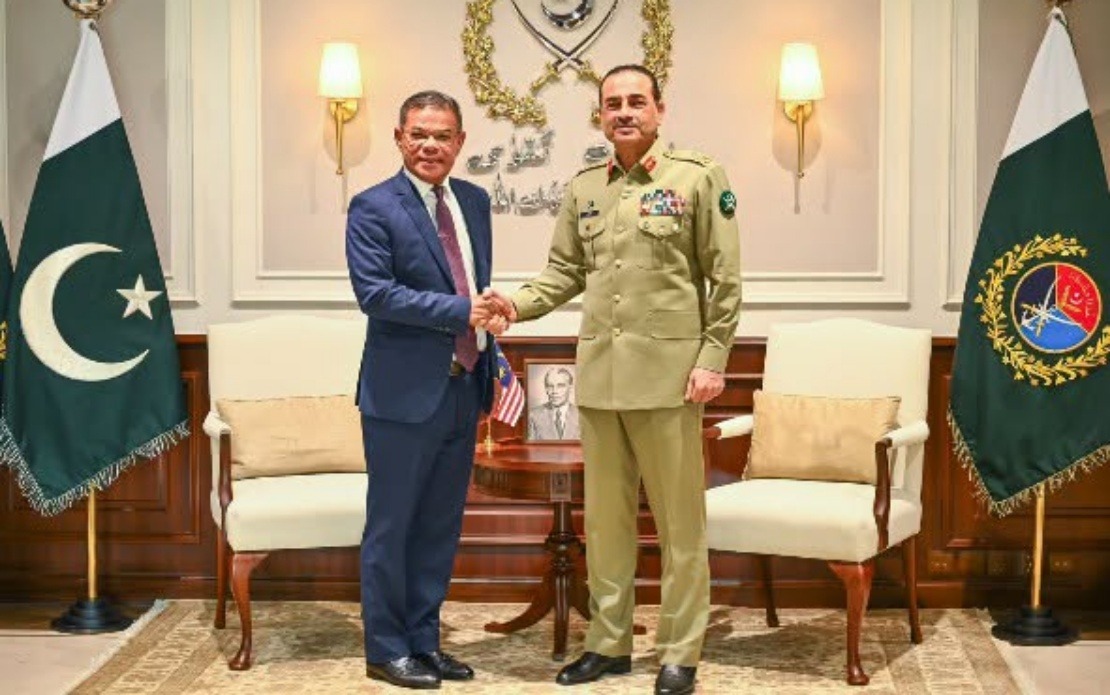
Malaysia and Pakistan have pledged to deepen cooperation on conflict resolution and regional security matters, drawing on their respective track records in facilitating high-stakes diplomatic negotiations. The commitment emerged from a meeting between Home Minister Datuk Seri Saifuddin Nasution Ismail and Pakistan's Chief of Defence Forces and Chief of Army Staff Field Marshal Syed Asim Munir at General Headquarters in Rawalpindi during an official visit by the Malaysian delegation.
The bilateral engagement centred on exchanging practical insights from both countries' experiences in managing international tensions and brokering peace agreements. Officials explored how diplomatic channels, dialogue mechanisms, and trust-building initiatives can be harnessed to address contemporary geopolitical challenges affecting the wider region. Such exchanges reflect a growing recognition among South and Southeast Asian powers that military posturing alone cannot resolve deeply rooted conflicts; instead, sustained engagement and negotiated settlements offer more durable pathways to stability.
Saifuddin Nasution highlighted Pakistan's prominent role in facilitating discussions between the United States and Iran regarding maritime security concerns in the Strait of Hormuz. Pakistan's geographical position, its relationships with both Western and Islamic nations, and its diplomatic infrastructure have enabled Islamabad to serve as an intermediary in several regional disputes. Field Marshal Syed Asim elaborated on Pakistan's experience in these peace-building efforts, offering insights into the mechanisms and patience required when working with parties holding deeply divergent interests and strategic objectives.
In reciprocal fashion, the Malaysian delegation shared details of Kuala Lumpur's mediation efforts between Thailand and Cambodia, which culminated in a ceasefire arrangement. Malaysia's involvement in Southeast Asian conflict management stems partly from its role as a founding member of the Association of Southeast Asian Nations and its commitment to the principle of non-interference combined with constructive engagement. The Thailand-Cambodia case demonstrates how careful diplomacy, respect for sovereignty, and neutral intermediation can create space for adversaries to step back from military confrontation and pursue negotiated settlements.
Both countries recognised that despite facing distinct regional challenges—Pakistan contending with tensions in South Asia and the broader Indo-Pacific, Malaysia navigating ASEAN's complex internal dynamics and extra-regional pressures—the fundamental tools of conflict resolution remain consistent. Negotiation, sustained dialogue, and incremental confidence-building measures have proven more effective than military escalation in creating conditions for lasting peace. This consensus reflects a maturation of approach among regional powers increasingly aware that protracted disputes drain resources and destabilise broader development agendas.
The implications for Southeast Asia are substantial. As major powers intensify competition and smaller nations navigate shifting strategic alignments, the region requires credible mediators with established diplomatic credentials and relationships spanning multiple geopolitical camps. Malaysia's demonstrated capacity to facilitate resolution between neighbouring ASEAN members, combined with Pakistan's experience managing conflicts between distant powers with vastly different political systems, illustrates how middle powers can punch above their weight through patient diplomacy and institutional neutrality.
Saifuddin Nasution underscored Malaysia's commitment to prioritising diplomatic and negotiated solutions in addressing international disputes, framing this stance as consistent with Malaysia's broader foreign policy orientation toward regional and global peace, stability, and shared prosperity. This positioning reflects how Malaysia seeks to expand its soft power and influence not through military expenditure or great-power alignment, but through demonstrable competence in facilitating dialogue and building consensus among parties with competing interests.
The meeting also implicitly acknowledges the limitations of unilateral or coercive approaches to security challenges. As both nations face complex transnational issues—from terrorism and organised crime to maritime disputes and resource competition—cooperation built on shared experience and mutual respect offers advantages over zero-sum confrontation. Pakistan's institutional experience managing civil-military relations and multiple security fronts, combined with Malaysia's track record in multi-stakeholder consensus-building, creates potential for deeper operational collaboration beyond dialogue.
Looking ahead, the discussions suggest both countries may explore more formalised mechanisms for sharing lessons learned, training diplomatic and military personnel in mediation techniques, and potentially coordinating positions in international forums where regional security is debated. Such initiatives could strengthen the broader architecture of regional stability at a time when traditional power balances are shifting and new security threats demand creative responses.
The bilateral engagement also reflects broader trends in Malaysian foreign policy under current leadership, which emphasises pragmatic engagement with diverse partners and value-based diplomacy centred on shared interests rather than ideological conformity. By positioning itself as a reliable, principled intermediary in regional disputes, Malaysia enhances its strategic autonomy and influence among both large and small states seeking alternatives to great-power patron systems.
As regional tensions persist—whether in the South China Sea, between India and Pakistan, or within ASEAN itself—the role of skilled mediators becomes increasingly precious. Malaysia's investment in such diplomatic capacity, demonstrated through successful interventions in regional conflicts and now through knowledge-sharing with strategic partners like Pakistan, represents a form of soft power that generates returns far exceeding its cost while positioning the nation as an indispensable voice for stability and reasoned dialogue in an increasingly multipolar world.

