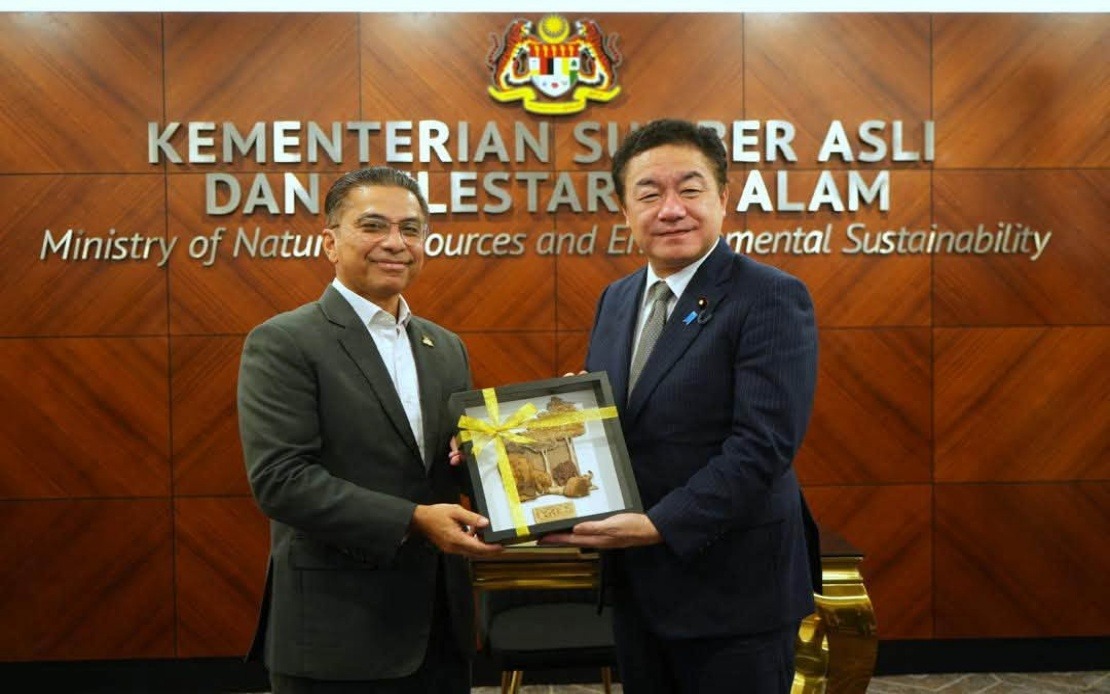
Malaysia and Japan have taken concrete steps to deepen their strategic partnership across critical sectors including rare earth elements, minerals, and climate action, with high-level officials from both nations meeting in Putrajaya this week to review progress on earlier commitments. The engagement centred on advancing mechanisms established under the Malaysia-Japan Comprehensive Strategic Partnership framework, signalling the growing importance both countries place on resource security and environmental transition in an increasingly competitive geopolitical landscape.
The courtesy visit by Japan's Parliamentary Vice-Minister of Economy, Trade and Industry Komori Takuo to the Ministry of Natural Resources and Environmental Sustainability provided an opportunity to assess implementation of decisions made during a bilateral summit in June. Deputy Natural Resources and Environmental Sustainability Minister Syed Ibrahim Syed Noh led the Malaysian side in discussions aimed at translating diplomatic agreements into tangible cooperative mechanisms that benefit both economies. This level of engagement underscores how resource and climate concerns have become central to bilateral relations between two of Asia's major industrial powers.
A primary focus of the meeting was acknowledging Japan's substantial technical contributions through established channels. Malaysia specifically commended the ongoing technology transfer initiatives facilitated by the Japan International Cooperation Agency, or JICA, alongside the Japan Organisation for Metals and Energy Security, known as JOGMEC. These institutions have been instrumental in building capacity within Malaysia's resource sector, providing expertise that enhances processing capabilities and workforce development. The recognition reflects Malaysia's strategy of leveraging Japanese know-how to upgrade its mineral industry from extraction to value-added manufacturing.
Crucially, Malaysia reaffirmed its position maintaining a moratorium on exporting raw rare earth materials, a policy stance that distinguishes it from competitors in the global supply chain. This strategic decision ensures that downstream processing and value-addition activities remain concentrated domestically, generating greater employment and economic returns compared to merely exporting unrefined commodities. The emphasis on this policy during high-level talks suggests it remains non-negotiable for Malaysian policymakers, even as regional and global demand for rare earths accelerates amid technological innovation and energy transition requirements.
Beyond mineral cooperation, both delegations marked progress on climate-related initiatives that carry implications extending well beyond bilateral relations. They welcomed the near-completion of negotiations on a Memorandum of Cooperation governing the Joint Crediting Mechanism, or JCM, a framework rooted in Article 6.2 of the Paris Agreement. This carbon market instrument allows countries to collaborate on emission reduction projects while generating tradeable carbon credits, creating financial incentives for transitioning to cleaner technologies. Malaysia's participation in such arrangements reflects its commitment to meeting internationally pledged climate targets while exploring mechanisms that offset mitigation costs through market mechanisms.
The expected finalization of the JCM agreement by year-end will enable investment flows toward low-carbon technology deployment across Malaysian industries and infrastructure sectors. Such cooperation can accelerate the energy transition by making green technologies more accessible and cost-competitive compared to fossil fuel alternatives. This alignment with Japan's substantial green technology sector creates mutual benefit, as Japanese firms gain market opportunities whilst Malaysia gains access to proven environmental solutions that support its broader development goals.
Malaysia's Nationally Determined Contribution, or NDC, represents the country's climate pledge under the Paris framework, setting targets for greenhouse gas emissions reductions by specific dates. The JCM cooperation directly supports achievement of these targets by financing emissions reduction projects that might otherwise be economically unviable. This dual advantage—meeting climate commitments whilst unlocking capital for green development—explains why climate cooperation features prominently in Malaysia's diplomatic engagement with technologically advanced partners like Japan.
Both countries envision a strategic combination whereby Japanese expertise in green technology merges with Malaysia's abundant natural resources and economic potential to build a competitive green economy. This positioning acknowledges that future industrial advantage will accrue to nations capable of sustainable resource management paired with advanced technology deployment. Rather than competing for dominance in traditional industries, Malaysia and Japan appear to be collaborating to establish leadership in the emerging green economy, which analysts expect to generate substantial growth and employment opportunities throughout this century.
The Malaysian delegation's composition reflected the whole-of-government approach required for such initiatives, incorporating representatives from the Foreign Ministry alongside natural resources officials and senior NRES personnel. Japanese Ambassador to Malaysia Shikata Noriyuki and senior METI officials represented Tokyo's commitment to substantive engagement beyond ceremonial diplomacy. This multi-agency participation ensures that agreements translate into coordinated implementation across relevant government departments and agencies.
For Malaysia, deepening cooperation with Japan on rare earths carries strategic weight given global supply chain vulnerabilities exposed in recent years. As critical minerals become essential for battery technology, electronics, and renewable energy infrastructure, securing reliable processing partnerships and technology transfer reduces dependency on any single source and builds domestic industrial resilience. Japan's interest reflects its own resource constraints and need for stable supplies to fuel its advanced manufacturing sectors, making bilateral cooperation mutually reinforcing.
The emphasis on technology transfer through JICA and JOGMEC indicates Japan's preference for developing partner-nation capacity rather than maintaining technological monopolies. This approach generates long-term commercial advantages by creating ecosystems where Japanese companies can expand operations and secure markets, whilst partners like Malaysia build indigenous capabilities and industrial depth. Such arrangements represent more sophisticated development cooperation than simple aid arrangements, creating genuine partnerships around shared economic interests.
Regional observers note that Malaysia-Japan cooperation in critical minerals and climate technology assumes greater significance amid great power competition for resource security and technological leadership. By institutionalizing cooperation through mechanisms like the JCM and formalizing technology partnerships, both countries signal confidence in a rules-based regional order and demonstrate that prosperity can be advanced through collaboration rather than confrontation. This message carries particular resonance in Southeast Asia, where smaller nations benefit from partnership frameworks that distribute benefits equitably.

