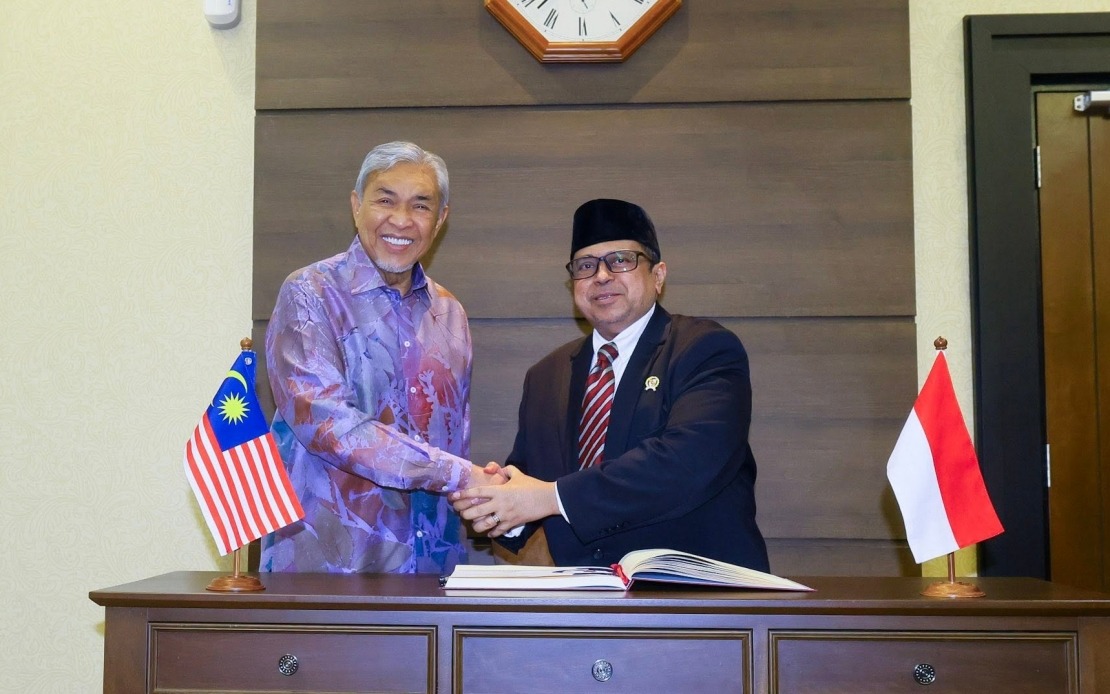
Malaysia and Indonesia are poised to deepen their collaboration across multiple economic fronts, with particular emphasis on elevating the halal industry as a shared growth engine for both nations. Deputy Prime Minister Datuk Seri Dr Ahmad Zahid Hamidi outlined the partnership trajectory during discussions with Indonesia's Ambassador to Malaysia, Raden Datuk Mohammad Iman Hascarya Kusumo, and the head of Indonesia's Halal Product Assurance Organising Body (BPJPH), Dr Ahmad Haikal Hassan, at Parliament recently. The delegation's visit signals renewed momentum in bilateral relations, moving beyond ceremonial exchanges toward concrete institutional frameworks that could reshape how both countries approach halal commerce and standards.
The proposed Malaysia-Indonesia Halal Council (MIHC) represents the centrepiece of this expanded cooperation framework. Rather than operating as an advisory body, the council would function as a practical mechanism for aligning divergent halal certification processes, which currently present friction points for businesses seeking to operate seamlessly across both markets. For Malaysian exporters particularly, harmonised standards would reduce compliance costs and accelerate market access in Indonesia, Southeast Asia's largest economy by population. Conversely, Indonesian producers could leverage Malaysian expertise in halal branding and international marketing, areas where Malaysia has established considerable institutional advantage through its own certification bodies and decades of industry development.
Beyond bilateral arrangements, both nations are contemplating the establishment of an ASEAN Halal Council, a more ambitious institutional project that reflects growing recognition of halal commerce as a strategic asset for the entire region. Such a body would theoretically create a unified voice for Southeast Asian halal producers in global trade negotiations and supply chain discussions, potentially countering commercial pressures from non-halal jurisdictions that have historically set standards without Muslim-majority input. The council could also standardise training protocols for halal auditors and inspectors across member states, addressing the current reality that certification quality varies significantly depending on which country's inspectors conduct the assessment.
The proposed World Halal Development Council represents an even more expansive vision, positioning Malaysia and Indonesia as architects of globally recognised halal governance rather than participants in frameworks designed by others. This ambition reflects the combined economic weight of both nations within the global halal market, estimated at over USD 2 trillion annually. By establishing the World Council, Malaysia and Indonesia would essentially be claiming intellectual and organisational leadership in an industry where they possess both historical legitimacy and contemporary market presence. Such positioning could translate into influence over how developed nations with significant Muslim populations—from France to Australia—approach halal certification and import protocols.
Ahmad Zahid, speaking in his capacity as chairman of the Malaysia Halal Industry Development Council, framed the cooperation as a natural extension of the two nations' historical proximity and shared Islamic heritage. However, the practical dimensions extend well beyond cultural affinity. Indonesian agricultural output, particularly in palm oil and spices, requires halal pathways to maintain access to Southeast Asian markets and to compete effectively in North Africa and the Middle East. Meanwhile, Malaysia's logistical infrastructure, financial services, and pharmaceutical manufacturing capabilities would benefit substantially from integrated supply chains with Indonesia, where production costs remain lower in several key sectors. Trade between the two countries in halal-certified products currently represents only a fraction of total bilateral commerce, suggesting considerable untapped potential.
The cooperation framework also encompasses rural development and human capital initiatives, underscoring recognition that the halal industry's future depends on sustained investment in producer training and infrastructure beyond urban centres. Both countries contain substantial rural populations engaged in agriculture, fishing, and food processing—sectors where halal certification could provide value-added opportunities and premium pricing. By coordinating training programmes and technology transfer initiatives, Malaysia and Indonesia could address the persistent skills gap that currently limits rural producers' ability to meet international halal standards. This dimension holds particular relevance for Malaysian policymakers concerned about inclusive growth and agricultural modernisation.
The timing of this initiative reflects broader regional strategic calculations. As China deepens its Belt and Road infrastructure investments across Southeast Asia, both Malaysia and Indonesia appear intent on carving out economic leadership in sectors where they possess intrinsic advantage. The halal industry represents precisely such a domain—one where Islamic credentials and market familiarity cannot be easily replicated by external powers. By establishing institutional architecture now, both nations position themselves to capture growing global demand for halal products as Muslim populations in developed nations increase and as Islamic finance expands into consumer goods sectors.
For Malaysian businesses, the implications are multifaceted. Food manufacturers, cosmetics producers, pharmaceuticals firms, and logistics companies all stand to benefit from reduced bureaucratic friction and expanded market access across the Indonesia-Malaysia corridor. However, the cooperation also intensifies competitive pressures, as Indonesian producers gain clearer pathways to Malaysian distribution networks and consumers. Companies that view the halal cooperation primarily as a threat, rather than an opportunity to integrate supply chains and share market risks, may find themselves disadvantaged within the emerging bilateral framework.
The proposed councils also carry significant symbolic weight within regional diplomacy. By positioning halal industry development as a pillar of Malaysia-Indonesia relations, both governments signal that Islamic-oriented economic policy constitutes a legitimate and sophisticated approach to development, rather than a marginal concern. This messaging counters narratives that frame Islamic commerce as backward-looking or incompatible with modern markets. Successive iterations of halal standardisation, certification, and trade have demonstrated instead that Islamic commercial principles attract diverse participants—from multinational corporations to startup entrepreneurs—and generate substantial employment and export revenues.
Implementation challenges will inevitably arise as these councils transition from announcement to operational reality. Bureaucratic coordination between Malaysian and Indonesian agencies has historically proceeded unevenly, with political shifts and institutional rivalries occasionally disrupting initiatives. The councils will need clear governance structures, dedicated funding, and commitment from both governments' trade and industry portfolios to avoid becoming consultative bodies that meet sporadically without meaningful output. Moreover, other ASEAN members may harbour concerns about Malaysian-Indonesian dominance within regional halal governance, particularly if smaller nations perceive that the councils favour larger economies' commercial interests.
The broader strategic context suggests, however, that both governments recognise the halal industry's potential sufficiently to overcome institutional obstacles. Indonesia's growing middle class increasingly demands premium halal-certified products, while Malaysia's position as a global halal hub creates natural incentives for integration. As global awareness of halal standards expands beyond traditional Muslim markets—driven by consumer demand for transparency, ethical sourcing, and food safety—the commercial logic supporting deeper cooperation strengthens considerably. The initiative announced through Ahmad Zahid's parliamentary discussions thus represents not merely diplomatic courtesy but genuine recognition of mutual economic interest in building institutional capacity for a sector poised for sustained global expansion.

