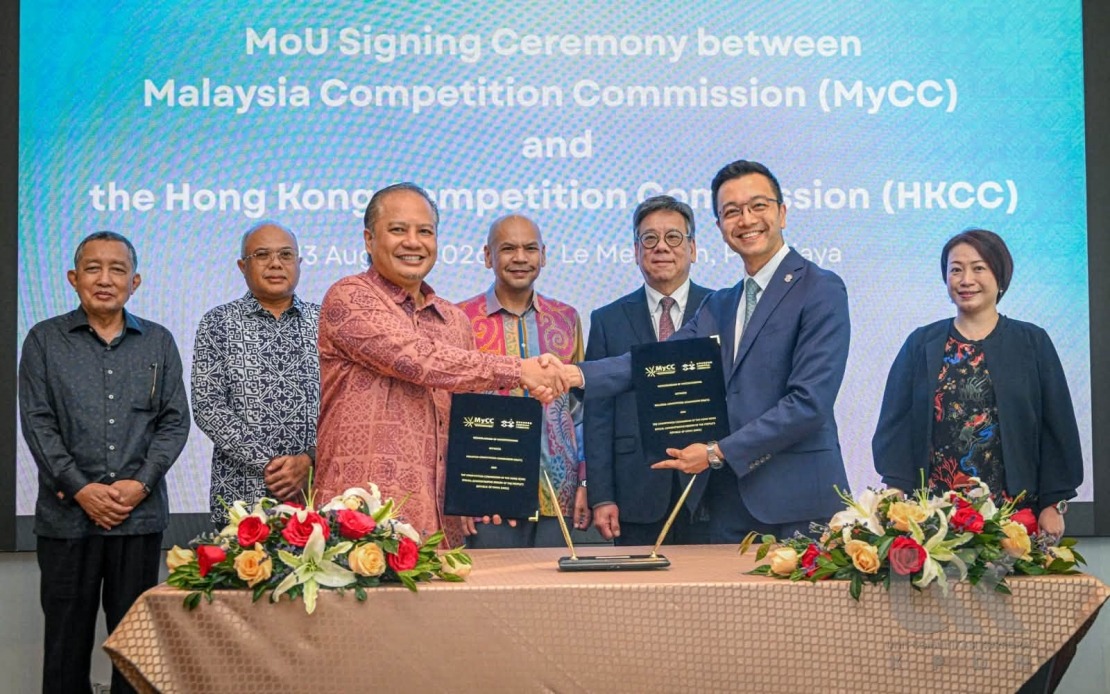
The Malaysia Competition Commission (MyCC) and the Hong Kong Competition Commission (HKCC) have formalised a new partnership aimed at fortifying their collaborative efforts on competition law enforcement and policy development. The memorandum of understanding, inked on August 13, represents a significant step in regional regulatory coordination at a time when business activities increasingly transcend territorial boundaries. For Malaysian businesses and consumers alike, this agreement signals a growing institutional maturity in how regional authorities will address anti-competitive practices that span multiple jurisdictions.
Domestic Trade and Cost of Living Minister Datuk Armizan Mohd Ali underscored the strategic importance of this partnership within Malaysia's broader international engagement on competition matters. The Hong Kong accord marks the fourth such bilateral arrangement MyCC has pursued, following previously established cooperation frameworks with the Türkiye Competition Authority, the Korea Fair Trade Commission, and the Philippine Competition Commission. This expanding network of agreements reflects a deliberate Malaysian government strategy to position the country as an active player in regional and global competition governance architecture.
The underlying rationale for such cooperation stems from the structural realities of modern commerce. Cross-border commercial relationships, supply chains that span continents, and digital platforms operating seamlessly across multiple markets create enforcement challenges that individual national authorities struggle to address in isolation. A competition violation perpetrated simultaneously in Malaysia and Hong Kong may involve the same corporate entities or coordinated conduct, yet without formal information-sharing mechanisms and coordinated investigative protocols, authorities risk duplication of effort, contradictory findings, or worse, allowing anticompetitive conduct to slip through regulatory gaps.
Armizan highlighted that the agreement encompasses substantive cooperation on information exchange regarding legislative developments and policy evolution within each jurisdiction. As competition law frameworks continue to adapt—particularly with emerging issues around digital markets, labour practices in the gig economy, and sustainability-linked cartel concerns—having direct channels for discussing these developments allows regulators to learn from peer experiences and anticipate potential enforcement challenges. Malaysian regulators can benefit from observing how Hong Kong addresses sophisticated cartels or merger scrutiny in sectors integral to both economies, such as shipping, finance, and technology.
The practical dimension of the collaboration extends to investigative cooperation and capacity building. Both agencies have committed to sharing enforcement experience and conducting joint training initiatives, workshops, and officer secondment programmes. Such technical exchange strengthens institutional capabilities at the operational level where cases are actually investigated and prosecuted. Malaysian competition officers working alongside Hong Kong counterparts develop deeper understanding of sophisticated investigation techniques, evidence gathering methodologies, and approaches to handling complex cross-border evidentiary challenges that increasingly characterise major competition cases.
Research collaboration constitutes another pillar of the arrangement. As competition authorities grapple with novel economic phenomena—whether involving algorithmic pricing, platform gatekeeping, or data-driven discrimination—having access to peer research and methodological approaches accelerates Malaysia's institutional learning. This proves particularly valuable for a middle-income jurisdiction like Malaysia, where resources for dedicated research capacity may be more constrained than in larger developed economies. Hong Kong's experience as a sophisticated Asian financial hub provides insights relevant to Malaysian regulators navigating similar market dynamics.
The bilateral focus on addressing cross-border competition issues explicitly acknowledges the practical reality facing MyCC. Increasingly, anticompetitive conduct affecting Malaysian markets originates from or involves entities based elsewhere. Port operators, shipping lines, financial services providers, and technology companies operating across Southeast Asia and extending into East Asia may engage in price-fixing, bid-rigging, or exclusionary conduct that harms Malaysian consumers and businesses. Without cooperative arrangements with Hong Kong authorities, investigating and prosecuting such conduct becomes significantly more difficult, particularly when evidence or witnesses reside in Hong Kong's jurisdiction.
Armizan's emphasis on the government's commitment to dynamic and competitive market conditions reflects the policy rationale undergirding MyCC's international engagement. Competition law ultimately serves consumer welfare and economic efficiency. A marketplace free from cartels, predatory monopolies, and anticompetitive mergers theoretically delivers better prices, improved quality, and greater innovation. By strengthening MyCC's enforcement capacity through international cooperation, the government aims to deliver these consumer benefits while maintaining Malaysia's attractiveness as an investment destination—foreign investors value transparent, fairly administered competition regimes.
The timing of this agreement also merits consideration within broader regional dynamics. As the Association of Southeast Asian Nations (ASEAN) continues evolving its economic integration agenda, competition authorities face mounting pressure to harmonise approaches and coordinate on enforcement. Malaysia's bilateral arrangements with multiple jurisdictions, including now Hong Kong, contribute to an organic regulatory ecosystem where authorities operate with shared understandings and established protocols. This informal but increasingly institutionalised network may eventually facilitate more formal ASEAN-wide competition frameworks.
Looking forward, MyCC's stated intention to continue strengthening ties with regional and international authorities suggests an expansionary posture. Additional bilateral agreements with other major trading partners—whether within ASEAN or beyond—would further embed Malaysian competition enforcement within global regulatory networks. For businesses operating in Malaysia, this trajectory implies increasingly sophisticated competition enforcement, more rigorous scrutiny of potentially anticompetitive conduct, and closer attention to practices that might invite regulatory attention from multiple jurisdictions simultaneously.
The agreement also reflects Malaysia's pragmatic recognition that unilateral enforcement action, however rigorous, cannot adequately address contemporary competition challenges. When Malaysian consumers pay elevated prices due to cartel activity coordinated across multiple Asian jurisdictions, or when Malaysian businesses face exclusionary conduct by multinational firms, MyCC's effectiveness ultimately depends on cooperation from authorities in other relevant jurisdictions. The Hong Kong MoU formalises such cooperation, establishing institutional channels, information-sharing protocols, and professional relationships that facilitate coordinated enforcement when circumstances warrant.
Ultimately, this partnership represents competition policy evolved beyond the isolationist approach of earlier decades. Malaysia's government, through MyCC, has accepted that preserving competitive markets requires engagement with international peers and willingness to share information and coordinate action. For Malaysian consumers and businesses, the practical implications manifest over time as enforcement becomes more effective, particularly in cases involving cross-border conduct. The agreement signals that authorities take seriously their mandate to maintain competitive markets, and they possess the institutional frameworks to do so credibly.

