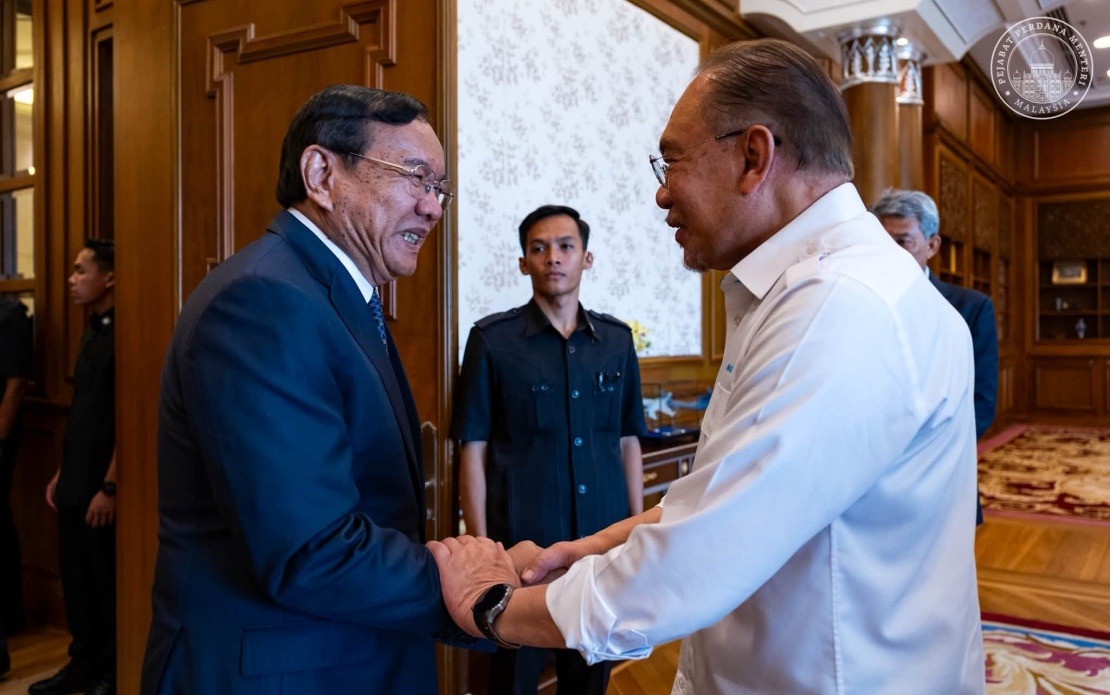
Prime Minister Datuk Seri Anwar Ibrahim has signalled a significant expansion of Malaysia-Cambodia bilateral relations, with both nations committing to joint efforts across multiple economic and security frontiers. The pledge emerged during talks with Cambodian Deputy Prime Minister and Foreign Minister Prak Sokhonn, who arrived in Malaysia for a two-day official visit that underscores the deepening engagement between Southeast Asia's established and emerging economic players.
The cooperation framework encompasses several strategically important sectors that reflect contemporary development priorities. Digital economy initiatives and artificial intelligence collaboration represent forward-looking areas where both nations seek technological advancement and capacity building. The halal industry dimension carries particular significance for Malaysia, whose halal ecosystem has become a global benchmark, while Cambodia stands to benefit from expertise and market access in this high-value trade segment. Food security cooperation addresses a shared regional concern, particularly given climate vulnerabilities and supply chain interdependencies affecting Southeast Asian nations.
Human capital development forms another cornerstone of the renewed partnership. This dimension suggests initiatives ranging from educational exchanges to skills training programmes that can enhance workforce competitiveness in both economies. Such investments in people-to-people connectivity have historically proven durable foundations for sustained bilateral relations, moving partnerships beyond transactional government dealings into deeper societal engagement.
Beyond economic sectors, security cooperation occupies a central place in the bilateral agenda. Combating cross-border crime remains a persistent challenge across the region, with organised trafficking networks, smuggling operations, and criminal syndicates operating with little regard for national boundaries. Malaysia and Cambodia's commitment to enhanced coordination in this domain signals recognition that shared security threats require coordinated responses spanning law enforcement, intelligence sharing, and judicial cooperation.
The timing of Prak Sokhonn's visit carries strategic weight, arriving just before the Third Malaysia-Cambodia Joint Commission for Bilateral Cooperation meeting scheduled for August 4. This formal mechanism provides structured opportunity to translate political commitments into concrete action plans, with working groups typically tasked with implementing sector-specific initiatives and monitoring progress on previous agreements. Such institutional frameworks prevent bilateral undertakings from remaining rhetorical gestures, instead embedding them within regular review and accountability processes.
Another dimension animating current discussions is the approaching 70th anniversary of diplomatic relations between Malaysia and Cambodia in 2027. This milestone provides both symbolic and practical impetus for strengthening ties. Anniversary celebrations often catalyse special initiatives and commemorative projects that can generate momentum for expanded cooperation. For Malaysia and Cambodia, this temporal landmark offers opportunity to reflect on shared history while projecting confidence about future partnership trajectories.
The ASEAN dimension underpins both nations' bilateral relationship and collective regional vision. As fellow ASEAN member states, Malaysia and Cambodia share institutional commitments to regional peace, unity, and prosperity. The invocation of ASEAN Community Vision 2045 in bilateral discussions reflects how individual member state partnerships nest within the broader regional architecture. This nested approach suggests that Malaysia-Cambodia cooperation serves not merely bilateral interests but contributes to realising the Association's long-term strategic objectives around economic integration, people connectivity, and political-security cooperation.
For Malaysia, strengthened engagement with Cambodia reflects broader strategic positioning within Southeast Asia. Cambodia's geographic location adjacent to Thailand and Vietnam, combined with its role as a developing economy with significant growth potential, makes it a valuable partner for trade expansion and investment diversification. Malaysian businesses have increasing interests in Cambodian markets, particularly in hospitality, real estate, and manufacturing sectors where Malaysian expertise and capital can drive mutual benefit.
Cambodia's perspective on deepened cooperation with Malaysia likely reflects its own strategic calculations regarding great power dynamics and regional positioning. Stronger ties with Malaysia, a relatively stable and prosperous ASEAN member, offer Cambodia avenues for technological transfer, capacity building, and economic opportunities. In the context of complex regional geopolitics, maintaining robust partnerships with fellow ASEAN states provides Cambodia with enhanced strategic flexibility and diversified external relationships.
The halal industry cooperation merits particular attention given Malaysia's global leadership position and Cambodia's emerging interest in this sector. Malaysia has successfully positioned itself as a halal standards-setter and major halal product exporter, creating entire ecosystems around certification, production, and distribution. Cambodia's involvement in halal production for export markets could generate employment, attract investment, and open new trade corridors. For Malaysia, exporting halal expertise reinforces soft power while creating business opportunities for Malaysian companies providing advisory services and certification support.
Artificial intelligence collaboration between Malaysia and Cambodia signals awareness that technological advancement cannot be left to developed nations alone. Developing countries that actively position themselves within emerging technology ecosystems gain competitive advantages in subsequent decades. Joint Malaysia-Cambodia initiatives in AI research, talent development, and application could yield innovative solutions to regional problems while building technological sovereignty and reducing dependency on external technology providers.
Food security cooperation assumes heightened importance in Southeast Asia's context of climate vulnerability, rapid urbanisation, and population growth. Malaysia and Cambodia, as agricultural producers and consumers, face shared challenges in ensuring stable food supplies amid changing environmental conditions. Cooperation spanning agricultural research, supply chain management, and trade facilitation can enhance regional resilience while creating commercial opportunities for agribusiness sectors in both countries.
Looking forward, the success of Malaysia-Cambodia cooperation depends on translating political statements into sustained institutional engagement and measurable outcomes. Regular Joint Commission meetings, sector-specific working group activities, and monitoring mechanisms will prove essential for maintaining momentum. For Malaysian readers and businesses, these developments signal expanding opportunities for trade, investment, and professional engagement with Cambodia, particularly in technology, halal products, and agricultural sectors.

